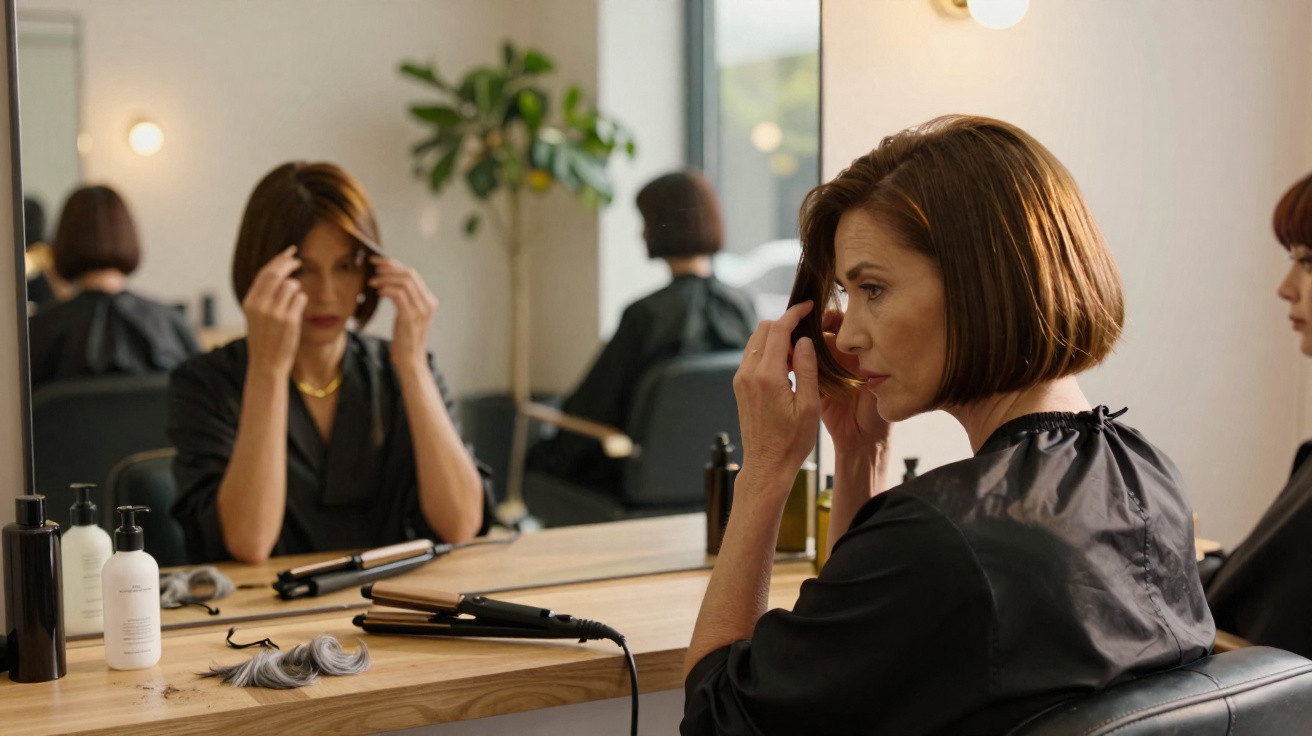
Hairdressers are discreetly getting ready for a spring surge as one crisply tailored haircut begins appearing on catwalks, social feeds and group chats.
Built around shine, exactness and unapologetic neatness, this emerging look is also prompting an uneasy discussion about attitudes towards women over 40.
The gloss bob, explained
A gloss bob is a precisely shaped bob, either bluntly cut or gently graduated, then finished to a reflective, mirror-like sheen. It typically falls from the jawline to slightly below the collarbone, with virtually no frizz or stray hairs. Picture a glass-smooth surface, crisp outlines and an almost lacquered finish.
Stylists frame it as a “grown woman’s cut”, rather than a TikTok-driven craze. It is neither shaggy nor undone, and it is not intentionally tousled. Instead, it is sleek, full-looking and commonly styled with a centre parting that deliberately contours the face.
The gloss bob is less about length and more about message: control, care and being visibly high‑maintenance on your own terms.
Across social media, it is increasingly becoming the signature style of celebrities in their late 30s, 40s and 50s who openly reject the expectation to either pursue youth or “age gracefully” by fading from view.
Why the gloss bob is everywhere for spring 2026
At spring fashion shows in New York, London and Paris, gloss bobs have already appeared on models across a range of ages. Hair teams say the style performs brilliantly in photographs, reflects studio lighting and immediately makes clothing appear more “expensive”.
Figures from salon chains in the US and UK indicate a rise in bookings for “glass bob”, “liquid bob” and “gloss bob” cuts from late 2025. That upward trend is expected to accelerate as celebrity advertising campaigns and red-carpet appearances gather pace in early 2026.
The rise also has practical roots. Following years dominated by beach waves, curtain fringes and shaggy layers, many women are opting for a tidier look. Hybrid work, ring-lit video meetings and high-resolution smartphone cameras mean hair receives close scrutiny every day, rather than only at special events.
- It appears crisp in video meetings and photographs.
- It is seen as “professional” in more conservative offices.
- It suits tailoring, dresses and athleisure alike.
- It feels short and fresh while remaining long enough to tie or clip back.
Importantly, the gloss bob also conveys wealth, or at least the impression of it. Its shine generally depends on healthy hair, in-salon gloss services and heated styling tools, all of which require both money and time.
The uncomfortable reality it reveals about ageing women
The gloss bob’s popularity is not purely aesthetic; it brings a subtler cultural expectation into view. Once women enter their 40s, every noticeable change can be interpreted. Hair may be treated as evidence of ambition, attractiveness, health and even supposed “relevance”.
The gloss bob subtly reinforces a message: to be seen as “put together” past a certain age, women must show visible effort.
Because grey hairs can show more clearly in a blunt bob, many women may feel pressure to colour their hair regularly. Wisps, flyaways and thinning areas are also more obvious against a shiny finish, steering clients towards scalp care and volumising products. A haircut presented as empowering can therefore become another demanding standard to uphold week after week.
A double standard is at work, too. On men, grey hair and less structured styles are frequently described as “distinguished”. On women, a sleek, gleaming bob is celebrated as “age-defying” - wording that quietly demeans the age it supposedly honours. Such praise maintains the notion that appearing older is a problem requiring a solution, rather than an ordinary reality of life.
From “mum bob” to a power symbol
For many years, the bob represented practicality and was often derided as the “mum cut”. The gloss version reverses that idea. It is aspirational rather than domestic, with a finish more reminiscent of a luxury car than a trip to the supermarket.
On red carpets, actors in their 40s and 50s are wearing gloss bobs alongside sharply tailored suits and pared-back gowns. In advertising campaigns, beauty companies feature midlife ambassadors with impeccably neat bobs and near-glass-like colour. The implication is not surrender, but preparation.
The gloss bob allows aging women to signal power and control, but still within a narrow, youth‑leaning template.
The hairstyle communicates: I can afford to colour my roots every four weeks, make time for consistent trims and commit to heat-styling my hair. This display of control remains admired in a culture that is still uncomfortable with visibly ageing.
The maintenance calculation
Stylists are candid about the upkeep involved. A blunt, glossy bob begins to lose its impact as soon as the ends become rough or the shape drops. Most clients are encouraged to return every six to eight weeks.
| Aspect | Low-effort bob | Gloss bob |
|---|---|---|
| Cut frequency | 12–16 weeks | 6–8 weeks |
| Styling tools | Air-dry, occasional wave | Blow-dry + straightener/brush |
| Products | Basic shampoo/conditioner | Heat protectant, serum, gloss spray |
| Colour upkeep | Optional, flexible | Root touch-ups for many wearers |
For women balancing employment, caring duties and the routine administration of midlife, that maintenance timetable can resemble a second job. A style that appears to offer simplicity may instead tie them to regular and expensive salon visits.
Beauty standards concealed by the shine
The gloss bob is often described as “polished but low drama”. Under that surface, however, are several established beauty expectations:
- Hair is expected to be thick and dense enough to create a sharp outline.
- Grey hair should be controlled or blended, unless it appears intentionally styled.
- Frizz and texture are expected to be smoothed into a more consistent silhouette.
- Angles and shine should keep the face looking visually “lifted”.
Every one of these standards subtly assesses women whose hair does not naturally behave in that way. Those with textured or tightly coiled hair may need chemical straightening or repeated heat styling to recreate the same sheen, increasing the likelihood of breakage. Women with fine or thinning hair may be left feeling their natural texture is somehow “not enough” for the trend.
What’s framed as a universal trend quietly assumes a certain type of hair, a certain budget and a certain amount of unpaid time.
Discussion of this style also reveals that youth remains the benchmark. Compliments for celebrity gloss bobs often centre on how “fresh” and “girl‑like” they look, instead of recognising strength, character or lived experience.
Can the gloss bob truly feel empowering?
There is, however, another perspective. Many women say they feel more confident after choosing a sharp bob. The cut can emphasise the jawline, neck and cheekbones, drawing attention away from facial lines or lost volume.
For those who spent years using long hair as a shield, a precise bob can feel like a purposeful step into view. Some women in their 50s and 60s see the choice not as anti-ageing but as pro-visibility: a means of occupying visual space without depending on signals of youth.
Intention is important. Chosen as an instrument of self-expression, the gloss bob can feel defiant: a refusal to vanish or dress “quietly” simply because of age. Adopted through obligation - because it is believed to be the only suitable cut after a particular birthday - it becomes a further source of pressure.
Making the gloss bob work on your terms
Stylists recommend approaching the gloss bob as a starting point rather than a strict set of rules. Its central features are form and shine, both of which can be tailored to different hair types and lifestyles.
- Texture: Introduce gentle waves or a bend through the lengths to reduce the need for constant straightening.
- Length: Leave it a little longer around the face to soften lines or make room for curls.
- Colour: Choose gloss treatments in your natural shade, grey included, rather than using full-coverage colour.
- Parting: Replace a defined centre parting with a softer side parting to create more lift.
Stylists often encounter a similar situation: a 48-year-old client with wavy, greying hair requests the strict, glass-straight bob worn by a 30-year-old influencer. Once they understand the heat styling and time required, many opt for a hybrid version - a bob that remains tidy while allowing their waves and greys to show. The trend remains visible, but is shaped around reality rather than fantasy.
Practical benefits and risks to consider
In terms of hair health, the gloss bob involves obvious compromises. Regular heat styling can dehydrate and weaken the hair, particularly if it is already fragile. Intensive smoothing treatments can provide shine for weeks, but may irritate the scalp or change natural texture over the longer term.
There are advantages as well. Frequent trims remove split ends and may make hair appear thicker. Prioritising shine often leads people to condition more effectively and use less chemical lightening. In certain cases, swapping extreme bleaching for a darker, reflective bob may genuinely strengthen hair resilience.
The healthiest gloss bob tends to be one that accepts some natural texture and limits daily heat, rather than chasing a perfect glass finish every single morning.
Anyone considering the cut can use a straightforward approach: ask their stylist to create two versions, the “Instagram” version and the “Tuesday morning” version. The first demonstrates the effect of a complete salon blow-dry, while the second depends on air-drying or minimal styling. If those results are dramatically different, the hairstyle is likely to demand significant upkeep.
Beyond seasonal trends, the gloss bob poses a broader question: who is allowed to age visibly without apology? Every sharply cut, glossy bob entering an office or train carriage becomes another point in that conversation, whether or not its wearer intended to take on that role.

















Comments
No comments yet. Be the first to comment!
Leave a Comment