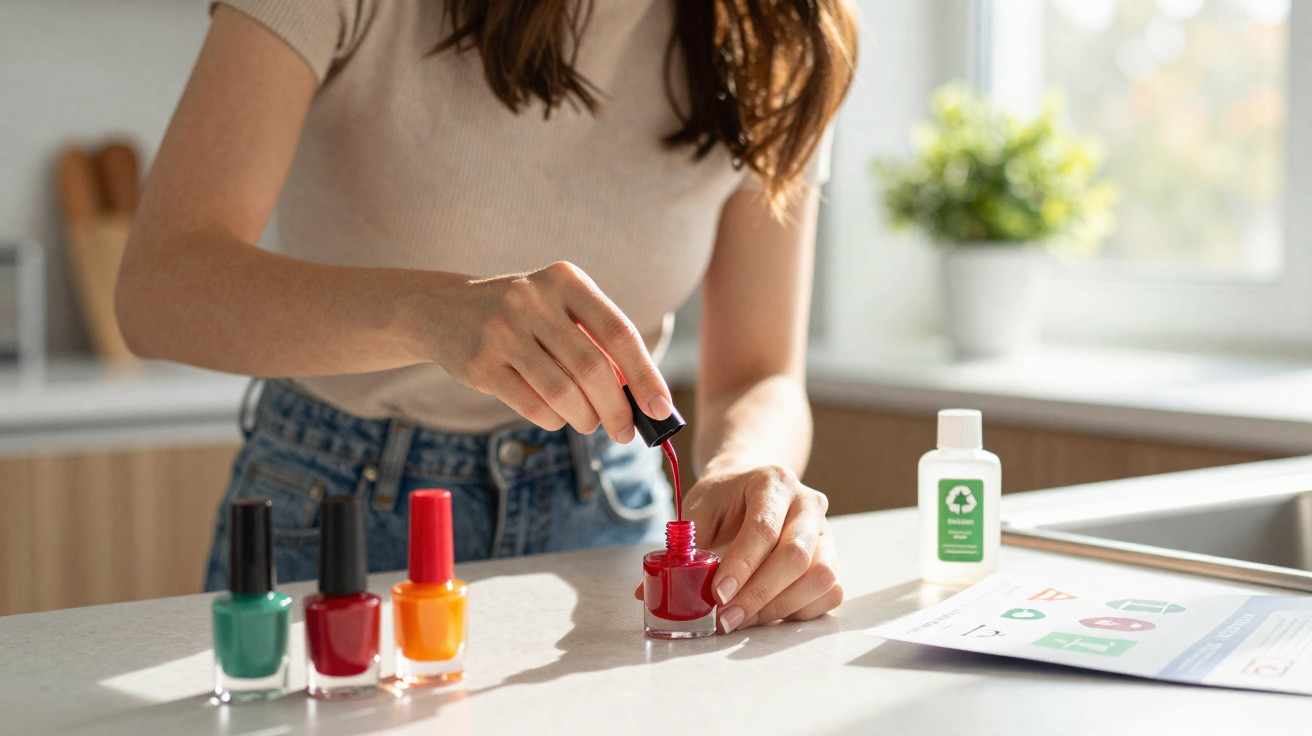
Many people use spring as an opportunity to clear out their bathroom shelves and ruthlessly throw away old cosmetics. Dried-up nail varnish often ends up automatically in the bathroom bin or the glass-recycling bank. That is exactly what frustrates waste operators – and, depending on the region, it can even become expensive. Nail varnish belongs in an entirely different category from empty yoghurt pots or glass bottles.
Why a nail varnish bottle is not ordinary waste glass
The mistaken assumption: “Glass is glass, so it goes in the recycling bank”
The instinct seems reasonable: the bottle is made of glass, so it belongs in the glass-recycling bank. That is how we sort wine bottles, jam jars and oil bottles, and it feels like the responsible thing to do. With nail varnish, however, that logic simply does not apply.
“For glassworks, nail varnish bottles are a contaminant, not a raw material.”
Glass used for cosmetics is often specially processed. It may be coloured, frosted, coated or toughened. Its chemical composition also frequently differs from that of bottle and container glass. During melting at glassworks, even a small proportion of the “wrong” type of glass can make entire batches unusable.
Sorting and recycling-process problems
Their size creates another issue: nail varnish bottles are very small. They can easily slip through automated sorting systems, get caught in gaps or be incorrectly identified by optical sensors. For the machinery, they are an unusual item that disrupts processes and increases maintenance work.
The remaining contents make matters particularly difficult: there is almost always some product left in the bottle, whether as liquid varnish, a thick residue or a dried-on layer. Combined with the plastic brush and often metal components, this creates a problematic mixture that must be kept completely out of glass recycling.
What nail varnish contains: a small bottle with a substantial chemical load
Hazardous substances you cannot see
Most nail varnishes consist of a blend of solvents, plasticisers, film-forming agents and colour pigments. Names such as toluene, formaldehyde and certain phthalates often appear in specialist literature, even though many manufacturers now promote “cleaner” formulations.
Even products marketed with “free from” claims generally contain substances that remain demanding for both the environment and waste operators. If they are burned with residual waste, filtration systems have to work at full capacity to remove pollutants from the flue gases. Should nail varnish reach landfill or the environment without treatment, its components can pollute soil and groundwater over the long term.
“When it comes to disposal, nail varnish behaves more like paint or solvent than lipstick or shower gel.”
Fire risk in refuse vehicles and incinerators
One aspect is almost always overlooked: nail varnish is highly flammable. The same applies to many nail varnish removers. This is rarely noticeable in everyday use, but waste logistics are a different matter.
Inside refuse vehicles, bags are compacted under high pressure. At incineration plants, many different materials are packed closely together. If flammable vapours from varnish and remover meet heat or sparks, the risk of smouldering fires rises. Even one small burst bottle can make health and safety considerably more difficult for refuse workers and plant operators.
Empty or not? The distinction matters
The theoretical exception: a completely empty, clean bottle
In theory, a glass bottle that is entirely empty and thoroughly rinsed could be disposed of as ordinary residual waste and, in some cases, even placed in a glass-recycling bank. In practice, this rarely happens.
The bottle neck is narrow, while varnish adheres strongly and becomes thick. Removing every trace would require a considerable amount of nail varnish remover or specialist cleaner. That would merely shift the problem: a solid residue would become an even more difficult solvent mixture to handle.
Everyday reality: dried-up or half-full leftovers
Nail varnish is usually thrown away because:
- its texture has become thick and gloopy;
- the brush no longer reaches the bottom;
- only an unusable amount remains;
- the colour is no longer appealing or applies streakily.
In every one of these situations, product remains in the bottle – liquid, sticky or dried on. From that point, the entire container is classed as hazardous waste. Legally, it is the contents rather than the packaging that count. Waste operators therefore apply correspondingly strict requirements.
The bin-fine trap: what incorrectly discarded nail varnish can cost
Basic penalty for incorrect sorting
Many towns and districts now inspect bin contents far more closely. Refuse workers may check containers at random, or so-called “waste scouts” may accompany waste-collection rounds.
“Anyone caught putting hazardous chemicals in the wrong bin can quickly face a noticeable fine.”
If hazardous waste is found in your household rubbish or recycling bin, local authorities may impose a fine. A typical range is around €30 to €40 per offence. The allegation is then “incorrect waste separation” or “illegal disposal of hazardous waste”.
When it becomes genuinely costly
The first fine does not necessarily end the matter. If payments are not made or offences are repeated, the amounts can rise quickly. Depending on local regulations, considerably higher sums are possible, in some cases reaching three figures.
It becomes especially serious when nail varnish or other chemicals are illegally dumped – for example, in woodland, by the roadside or beside glass-recycling banks. Authorities then refer to this as “fly-tipping”. Depending on the federal state and the scale of the offence, penalty ranges are often far above those for a simple sorting mistake.
Where should nail varnish go? How to dispose of it correctly
Hazardous waste, not cosmetic waste
In waste management, nail varnishes are classed as “small quantities of special hazardous waste”, often grouped with:
- paint residues and varnishes;
- solvents and cleaning products;
- pesticides and wood preservatives;
- adhesives and resins.
These materials are sent to specialist facilities, where they are burned in a controlled way at very high temperatures. Filters ensure that as little pollution as possible enters the air.
Finding the right collection point
The simplest option is to visit a municipal recycling or waste-reception centre. Almost every local authority runs such sites, usually with a separate area for hazardous materials. They have lockable cupboards, separate drums or well-ventilated rooms for chemicals.
Many regions also operate mobile hazardous-waste collections that regularly stop at specified locations, often supermarket car parks or central public spaces. You can hand in household quantities of nail varnish, partly full aerosol cans, paint or chemicals there free of charge or for a small fee.
| Product | Incorrect route | Correct disposal |
|---|---|---|
| Nail varnish with residue | Residual waste, yellow recycling bin, glass-recycling bank | Recycling centre / mobile hazardous-waste collection |
| Nail varnish remover | Toilet, sink | Recycling centre / mobile hazardous-waste collection |
| Paint residues containing solvents | Residual waste | Recycling centre |
| Empty nail varnish bottle, genuinely clean | Glass-recycling bank | Small quantities: residual waste; if unsure, recycling centre |
How to avoid nail varnish leftovers and use bottles for longer
Rescue thickened varnish instead of throwing it away
Before discarding your next bottle, it is often worth attempting to revive it. A specialist nail varnish thinner – not ordinary remover – can often make overly thick varnish usable again. A few drops are enough; then roll the bottle back and forth between your hands. This distributes the thinner without creating air bubbles.
If the varnish becomes smooth again, its usable life is extended considerably. Every extension reduces the need for new purchases and the number of problematic bottles that will eventually need disposing of.
Give it away, swap it or use it creatively
If you no longer like certain colours but they are still perfectly usable, pass them on to friends, family or swapping groups. Many people are pleased to receive nearly full bottles, especially in fashionable shades.
For craft and DIY enthusiasts, nail varnish can also serve as a miniature enamel paint. For example, you can:
- colour-code keys;
- decorate the heads of screws or hooks;
- paint stones, glass beads or small decorative items;
- mark tools by colour.
These second uses replace other paints or varnishes and reduce the use of additional chemicals.
What terms such as “hazardous waste” actually mean
The term sounds dramatic, but it initially only means that a substance requires special handling. Relevant criteria include flammability, toxicity, environmental hazards and irritant effects. Nail varnish meets several of them at once: it is highly flammable, contains solvents and can potentially harm aquatic organisms.
That is why nail varnish bottles are subject to different rules from shower gel, shampoo or soap, which are largely compatible with residual waste or the yellow recycling bag. Knowing the distinction makes everyday waste sorting much more confident.
Ultimately, treat nail varnish more like a miniature tin of paint than an innocent cosmetic product. Taking it to the right collection point protects the climate, waste-management workers and your own wallet – while your new favourite varnish then comes with a little less guilt.

















Comments
No comments yet. Be the first to comment!
Leave a Comment