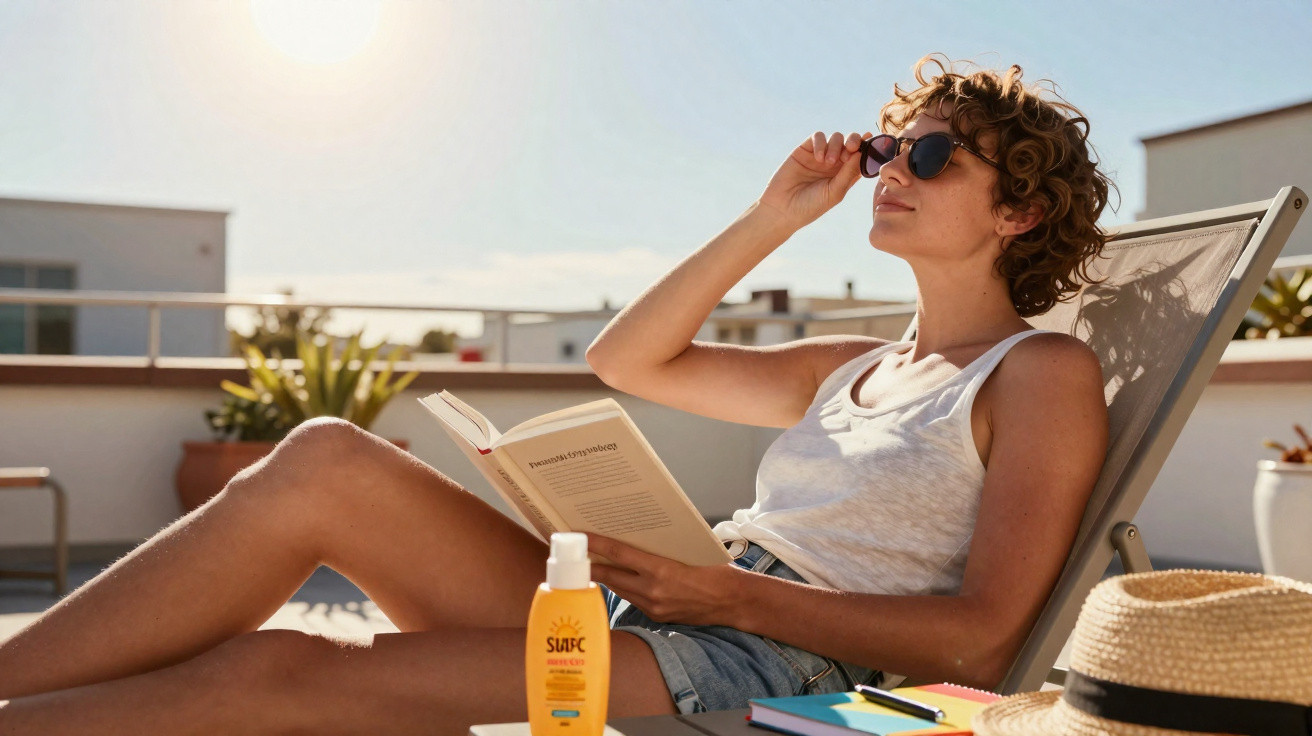
Behind this desire, there is often more than simply wanting to “soak up the sun”.
Returning from a holiday without a tan can quickly make people feel as though they have missed out. In many minds, a golden complexion is still associated with rest, attractiveness and a “good summer”. New psychological research suggests that, particularly among women, attitudes towards tanning can reveal a surprising amount about self-image, competitiveness and willingness to take risks.
Why tanning has such a powerful hold on our ego
Whether at the beach, by a lake or on the balcony, lying down, closing your eyes and feeling the sun on your skin is part of a holiday for many people. In our culture, a tan has long ceased to be merely a by-product of summer; it has become a status symbol.
- It conveys: “I went on holiday.”
- It is linked with health, fitness and an active lifestyle.
- It is meant to make the eyes and facial features stand out.
- It creates distance from the past: “I do not look as pale and stressed as I did before the holiday.”
This image is especially deeply rooted for women. Those who want to be viewed as more attractive often look to beauty ideals, and for many people a tan remains part of that ideal.
Sun exposure as a risk: what really happens to your skin
The downside is well known, but is frequently pushed aside in everyday life. Sunlight acts through ultraviolet radiation, whether it comes from the sky or a sunbed. This radiation damages the genetic material in skin cells and can affect the eyes too.
UV radiation causes sunburn, speeds up skin ageing, contributes to pigmentation problems and allergies, and increases the long-term risk of skin cancer. The eyes can also suffer immediate and lasting harm – from painful “sunburn” of the cornea to cataracts and retinal damage.
Despite knowing this, many people quickly abandon sun protection on the first warm day of the year, thinking: “It’ll be fine.” This is precisely where things become interesting, as health knowledge meets psychological motivations.
What the researchers wanted to find out
A recent study published in the journal Evolutionary Behavioral Sciences examined the issue more closely: which women tan particularly heavily, and why? The research team focused on heterosexual women and brought together two perspectives:
- How do women assess their own “attractiveness” as a partner?
- How strongly do they feel they are competing with other women for attention and partners?
Two groups took part. In the first, 93 women answered questions about their views on sunbathing, how they rated their own value as a partner, and their tendency towards competition with other women. The second group involved 193 women, who were asked not only about these attitudes but also about their actual tanning behaviour: how often do they lie in the sun? Do they use sunbeds or self-tanning products?
Self-esteem and tanning: women who feel attractive are more likely to protect themselves
Perhaps the most surprising finding was that women who see themselves as valuable and desirable partners tend to take a more critical view of intensive tanning. They place greater importance on skin health and are less willing to accept major risks for it.
Anyone who generally views their own charisma and attractiveness positively has less need to “add more” – and is more willing to forgo excessive sunbathing.
If you recognise yourself in this description, one of two patterns will often apply:
- Either you think: “I feel comfortable even without deeply tanned skin; a light tan is enough for me.”
- Or you feel: “I need a tan before I can feel good in my own body at all.”
The study indicates that these differences are about more than personal taste. Underneath them lies a deeper issue: how much people value themselves as a partner and as a person.
Competition with other women: when a tan becomes armour
The investigation’s second key finding was that women with a strong sense of competition with other women – those who feel constantly compared with other women – are clearly more inclined towards greater sun exposure.
People who often ask themselves “Who stands out more?” or “Who seems more attractive?” and put themselves under pressure as a result are more likely to engage in risky tanning behaviour. Longer periods of sunbathing, more frequent top-up tanning and less consistent use of sun cream can all be driven by the wish to be one step ahead visually.
A tan becomes a tool in a silent contest: who glows more, who seems more desirable, who looks “more summery”?
This fits a wider pattern identified in evolutionary psychology: competition for potential partners can encourage behaviours that are objectively unhealthy but are perceived as worthwhile if they improve outward appearance.
What your tanning behaviour may reveal about you
Type 1: “I do not care, as long as I am healthy”
Do you avoid the midday sun, apply sun cream consistently and accept that your skin will remain relatively fair? If so, it may well be that:
- you are generally comfortable with your appearance
- you do not compare yourself with others all the time
- you see your body as something worth protecting over the long term
Type 2: “I want to be tanned, whatever it takes”
Do you spend hours in intense sunshine on holiday, top up your tan in the park from spring onwards, or regularly use sunbeds and self-tanning products? Then the following factors may play a part:
- You feel noticeably more attractive with a deeper tan.
- You experience strong pressure in daily life to compare your appearance with others.
- You accept risks to your skin in order to achieve a particular beauty ideal.
This does not mean that every sun lover automatically has low self-esteem. However, the study identifies clear tendencies: the more important comparison with others feels to you, the more likely you are to treat tanning as a “project” rather than simply seeing it as a side effect of enjoyable days outdoors.
How to approach the wish for a tan more healthily
Feeling comfortable in your body does not mean avoiding every ray of sunshine. The more relevant question is: how much risk is really necessary, and at what point does it become unhealthy?
- Set realistic aims: A lightly tanned complexion can often be achieved through moderate time outdoors in the shade and good skin care.
- Choose your sun exposure wisely: Radiation is less aggressive in the morning and later in the afternoon.
- Take protection seriously: Use high-factor sun cream, a hat and sunglasses, particularly if your skin is very fair or sensitive.
- Question sunbeds: Artificial radiation is not a harmless shortcut; it is an additional strain on the skin and eyes.
- Consider self-tanning products as an alternative: These products can make a significant visual difference without UV exposure, provided you tolerate their ingredients.
When beauty ideals narrow your perspective
One point is often overlooked: many common beauty ideals have developed historically, been reinforced by the media and shaped by culture. Only a few decades ago, fair skin was regarded as a status symbol. Today, for many people, the opposite represents leisure, travel and “lifestyle”.
Defining yourself through your skin tone means giving up a great deal of control. The weather, genetics and working life all help determine how tanned you can become. Focusing more on charisma, gestures, clothing or body language takes pressure away from skin colour. This can be a genuine relief, particularly for people with naturally very fair skin or skin prone to pigmentation marks.
Practical signs to look out for
A few questions can help you assess your own relationship with the sun more clearly:
- Does it upset you greatly if you think you look “too pale” after a holiday?
- Do you deliberately plan holidays and days off around times when the sun is out?
- Do you feel jealous when other people are “more beautifully” tanned than you?
- Do you ignore warning signs from your skin because “there is still more to get”?
If you often answer “yes” internally, you may be living more in comparison with others than you realise – and may be more likely to expose yourself to risks simply to keep up in appearance.
How psychological insight can genuinely protect your skin
Dermatologists have warned for years about rising numbers of skin cancer cases, which are often linked to leisure-time behaviour. Campaigns promote shade, shirts and sun cream. Yet every year, people still lie unprotected on the beach at midday.
The new research shows that facts alone are not enough. Change can happen only once people understand the inner motives behind their appetite for the sun – recognition, competition and insecurity. Anyone who realises, “I am actually doing this to feel more attractive than other people”, has the opportunity to consciously change course and find healthier ways to feel good about their body.
Ultimately, the sun remains what it has always been: a powerful force with both benefits and downsides. How much you expose yourself to it says a great deal about how you see yourself – and how much your long-term health matters to you.

















Comments
No comments yet. Be the first to comment!
Leave a Comment