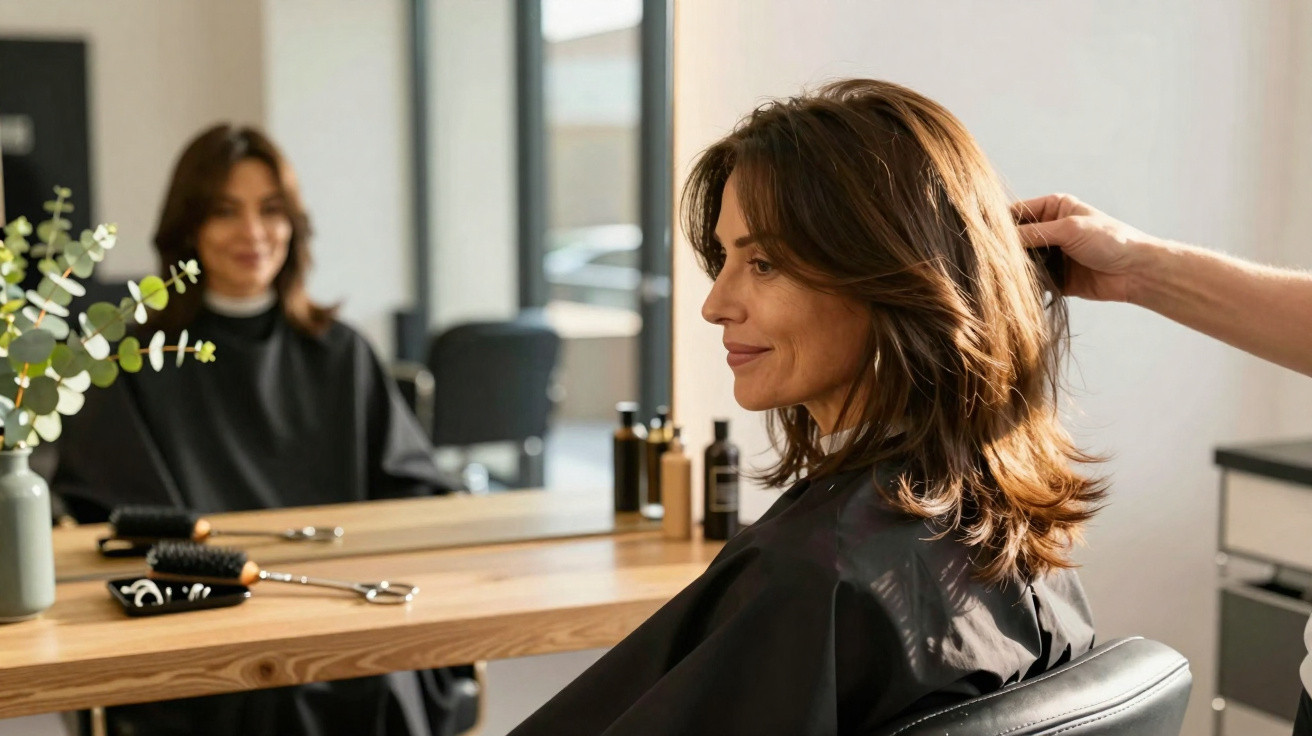
If you are over 50 and look in the mirror in the morning, you may recognise the feeling: facial features can seem a little lower, the chin less sharply defined and the eyes heavier. Before considering injectables or surgery, many professionals rely on a far simpler trick: certain hairstyles that visually lift facial features and recreate the effect of a mini lift without any procedure.
Why certain hairstyles visually lift the face after 50
This effect is less about magic than mechanics. When hair is secured tightly backwards and slightly upwards, it creates a subtle pulling effect across the upper part of the face.
“The pull created by the hair can slightly tighten the temples, outer corners of the eyes and upper cheek area, creating the temporary impression of a lift.”
Exposing the forehead also allows more light to fall on the upper face. This can make:
- the eyes appear more awake and larger
- shadows beneath the eyes look slightly reduced
- the face seem longer overall
- looser areas around the lower face appear less prominent
As we age, skin loses firmness, particularly around the jawline and neck. Shifting volume and visual tension upwards can therefore create the illusion of a firmer overall appearance. Hairstyles with a clear upward and backward direction noticeably enhance this effect.
The trend for tightly secured hairstyles
Celebrity stylists have used sleek ponytails and high buns for years to highlight facial contours. Above all, two elements matter: where the hairstyle sits and how smooth and close to the head the hair is at the sides.
Professional hairstylists often use:
- a natural-bristle brush to smooth hair closely against the head
- a light gel or wax to tame flyaways
- hairspray to keep the style in place
Despite these benefits, experts caution against putting the scalp under constant strain. Tying hair extremely tightly too often can cause headaches and, over time, even hair loss around the roots. Looser alternatives, varying the height and regular scalp massages can help maintain a balance.
The three most effective lifting hairstyles after 50
1. A high ponytail for a more awake-looking face
A high ponytail is the quickest way to achieve a visible tightening effect. Not only its height but also its precise placement is important.
Hairdressers use an imaginary line running from the chin, past the outer corner of the eye and up towards the back of the head. The hair tie should ideally sit where this line ends. This creates a gentle diagonal tension that visually lifts facial contours.
“A high-set ponytail can visually lift the area around the eyes and cheeks, working like a freshness filter for the face.”
It is especially beneficial for:
- people with round or oval faces
- women with medium-length to long hair
- anyone prone to slightly fuller cheeks or a soft jawline
To avoid reversing the effect, the tie should not sit too low. A low ponytail visually pulls the face downwards, emphasising precisely the features it is intended to disguise. Brush the side sections back firmly; this can make fine lines around the temples appear smoother.
2. A high twisted bun for maximum tightening
For a more pronounced result, choose a high, lightly twisted bun. Start with a very high ponytail, twist it firmly and wrap it around itself. The result is a compact knot at the crown of the head.
This knot acts as an anchor point, keeping the pull consistent and distributing tension over several hours. It also concentrates volume at the very top of the head, visually lengthening the face and making the cheeks appear narrower.
There is another benefit: the neck is left exposed. If fine lines or small areas of excess skin are visible here, a bare, elongated neck can look surprisingly elegant and draw attention away from the chin area.
This look is particularly suitable for:
- thicker or medium-thick hair that has enough hold in a ponytail
- people with prominent cheekbones
- anyone wishing to visually lengthen a shorter or broader neck
3. A high half-up style as a gentler lifting option
If a sleek ponytail feels too severe or uncomfortable, a high half-up style is a good alternative. Take only the top section of hair, from around ear level upwards, backwards and secure it high, leaving the remaining lengths loose.
“The upper half of the face benefits from the upward pull, while the loose lengths create soft contours and frame the neck area.”
This option is particularly useful when:
- the scalp is sensitive
- hair is finer and breaks easily in tightly secured ponytails
- a very sleek everyday look feels too harsh
The loose lengths can frame the jawline, add some volume at the sides and visually disguise a slightly loose neck. At the same time, the sections tied upwards gently lift the eye area and brows.
How to achieve the lifting look without stressing hair and scalp
A little care in the preparation helps these hairstyles look more youthful while keeping hair healthy.
- Gentle hair ties: Fabric-covered ties or spiral hair ties distribute pressure more evenly and help prevent breakage.
- Avoid constant tension: Wear high-tension styles only on selected days, choosing looser hairstyles in between.
- Scalp care: A gentle evening massage with fingertips or a soft massage brush promotes circulation.
- Haircare products: A drop of serum through the lengths prevents tightly tied hair from looking dull.
Anyone prone to headaches should check how the hairstyle feels: if the hair tie can be moved slightly without immediately losing tension, it is usually comfortable enough. If there is pulling or pressure, loosen it or choose a lower position.
Which lifting hairstyle suits which hair type?
The three lifting hairstyles can generally be adapted for almost every hair type, although a few details make styling easier.
| Hair type | Recommended lifting hairstyle | Professional tip |
|---|---|---|
| Fine, straight hair | High half-up style or high ponytail | Apply volumising spray at the roots and smooth the lengths only lightly. |
| Thick, straight or slightly wavy hair | High bun or sleek ponytail | Brush hair thoroughly before tying it, then lightly twist the lengths. |
| Curly or coily hair | High half-up style | Define the curls and secure only the top section more firmly. |
What the visual lifting effect can do – and what it cannot
Hairstyles with a lifting effect do not create new skin or replace medical treatments. For a few hours, they create more flattering light and tension across the face. Keeping this in mind makes it possible to use them deliberately: for special occasions, important appointments or simply on days when your reflection looks tired.
Pairing the style with make-up can also be effective. Drawing additional attention to the upper face – for example with gently defined brows, a touch of highlighter at the temples and subtle eyeshadow – intensifies the lifting effect. Soft contouring around the chin further supports the impression of a more defined facial line.
Anyone following the basic principle that tension should move upwards rather than downwards can experiment with simple techniques. Small adjustments to the height, sleekness and amount of hair tied back are often enough to find a favourite version with a lifting boost.















Comments
No comments yet. Be the first to comment!
Leave a Comment