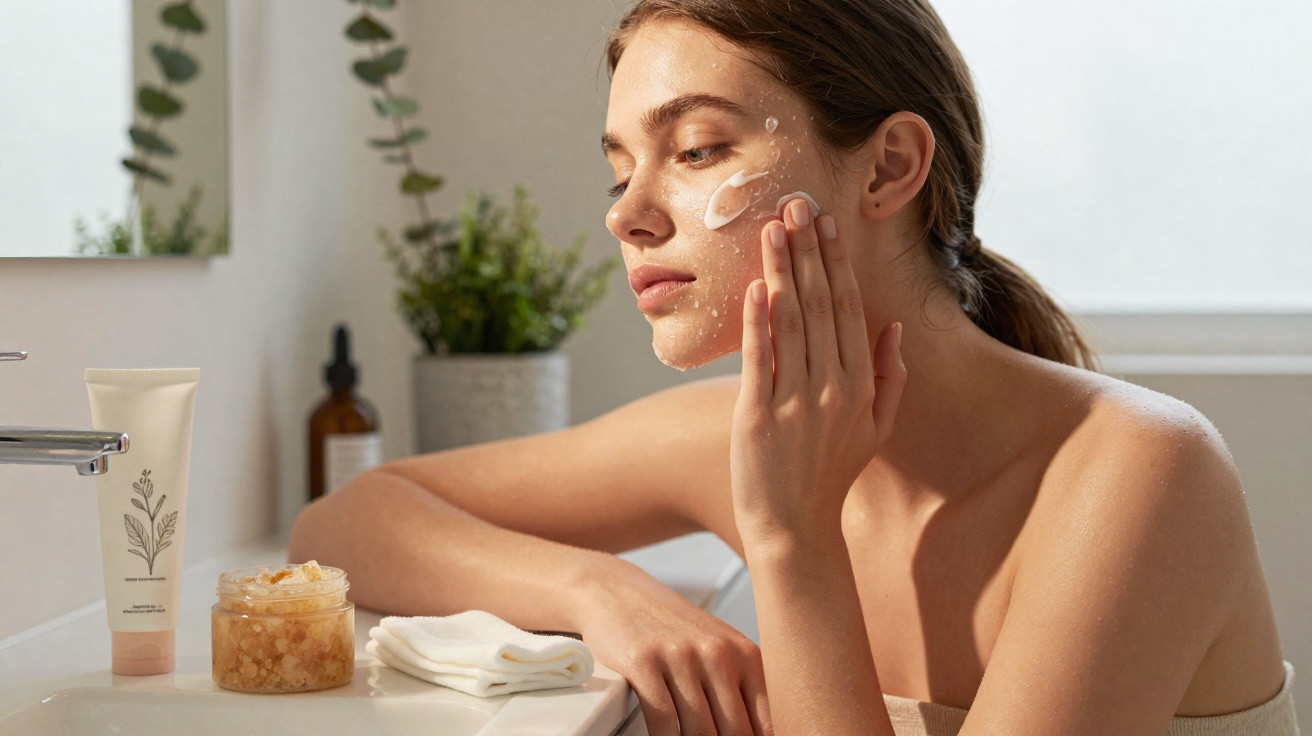
The bathroom is hazy with steam, your playlist is spot on, and you have that feeling that “new skin loading” is about to happen.
You pick up your favourite exfoliating scrub: the one that smells of a tropical break and contains little grains you can genuinely feel. You work it over your cheeks in a few firm circles, spend longer on your nose and perhaps do your chin again “because of the pores”. Then you rinse, expecting the glass-skin finish promised on the packaging.
What you get instead is a tight, slightly squeaky face. It appears smooth initially, but then turns a little red and oddly glossy. Make-up catches on dry areas that did not exist the day before. The following evening, you repeat the process with more force, trying to “buff away” the rough texture, dullness and tiny bumps.
That is the point at which a habit that feels deeply satisfying begins to work quietly against your skin.
The exfoliation habit that backfires
The everyday practice that can weaken skin rather than smooth it is straightforward: exfoliating too frequently, too vigorously and with unsuitable products. Few people believe they are doing anything drastic. They are simply scrubbing “until it feels clean”, or applying a peeling toner nightly because TikTok says it creates a glow.
What seems like commitment is actually a gradual wearing away of the skin barrier. It rarely looks damaged all at once. Instead, the signs creep in: growing sensitivity, unexplained tightness after cleansing, redness that does not fade, or the peculiar combination of a shiny forehead and flaky nose. The cruel irony is that the harder you pursue smoothness in this way, the rougher your skin may become.
In a busy London dermatology clinic on a Tuesday, a young woman sits in the examination chair. Her make-up has been carefully applied, yet it cannot fully conceal the redness. She insists her skin feels “textured and dirty” and explains that she uses a grainy scrub every evening, a peel mask twice weekly and a “glow toner” bought online.
Her phone holds screenshots of influencers with poreless complexions, before-and-after reels and lists of “must-have acids”. Yet her own “after” is very different: cleansing now stings, foundation separates across her cheeks, and tiny spots are appearing where she had never previously struggled. She cannot work out why her skin is worsening when she is putting so much effort into it.
She is far from unusual. A UK study found increasing irritant reactions associated with excessive use of acids and scrubs, particularly among people under 35. The routine may look like care, but the skin interprets it as an assault.
To see why this happens, it is more useful to think about structure than “deep cleaning”. The stratum corneum, your outermost skin layer, resembles a brick wall: flattened dead cells form the bricks, while fats act as the mortar that holds them in place. This wall is the skin barrier, keeping moisture in while blocking irritants, pollution and microbes.
In principle, exfoliation lightly lifts away a small number of loose surface bricks. Over-exfoliation disrupts the mortar and dislodges too many bricks in one go. Physical scrubs containing large or sharp particles may cause invisible micro-tears, experienced only as stinging and roughness. Using potent acids or peel pads every day can thin the barrier, leaving nerves and blood vessels more exposed.
The outcome is more than redness. When a compromised barrier cannot retain water, the skin becomes dehydrated and may compensate by producing extra oil. This creates the confusing combination of shine, flakes and breakouts: precisely the opposite of the clear, smooth skin you wanted.
How to exfoliate without wrecking your skin
The answer is not to eliminate exfoliation altogether, but to approach it like caffeine: useful and powerful, yet fully capable of causing problems when overdone. The most protective change is moving from “scrub until smooth” to a routine that is minimal, deliberate and gentle. For most faces that are neither sensitive nor acne-prone, this means exfoliating one to three times per week, rather than every night.
Replace harsh, grainy scrubs with milder choices, such as enzyme powders, low-percentage lactic acid toners or ultra-fine chemical exfoliants made for sensitive skin. Allow the ingredient to do its job rather than relying on your hands. Apply with fingertips and minimal pressure, as though smoothing cream over a balloon rather than scouring a pan. A faint tingle lasting a few seconds may be normal, but burning, itching or throbbing is a flashing warning sign.
Dermatologists often repeat one understated rule: if foundation is catching on dry patches, you need more moisture rather than more exfoliation. In practical terms, every exfoliation session should be matched with calming, replenishing care. Look for fragrance-free moisturiser, ceramides, glycerin, panthenol or squalane. Glow does not result from stripping the skin; it comes from a hydrated, intact barrier.
A 29-year-old I spoke to believed her weekly “self-care night” required a hot shower, a salt body scrub, a facial scrub, a clay mask and then an AHA peel. Shaving made her legs burn, cold weather caused her cheeks to flare red, and even products labelled “for sensitive skin” stung. Once she stopped all exfoliation for three weeks and used only gentle cleansing and a rich cream, people started asking what she’d done to look so rested. Sometimes the most effective routine is the one that seems almost too boring.
Let’s be honest: despite what perfect social-media routines suggest, nobody really does this every day. Most of us rush, overuse one product to compensate for neglecting another, and then blame our skin when it objects.
Skin follows a logic that does not suit an instant-results mindset. It renews itself approximately every 28 days, somewhat faster in younger people and more slowly as we age. Aggressively exfoliating every night does not “help” that process; it interrupts it. Cells are removed before they can mature properly, which is why the surface can begin to appear glossy, thin and almost plastic-like.
Barrier damage does not always look dramatic. It may be a persistent, subtle feeling that every product now tingles. It may be cheeks that suddenly react to the same moisturiser you have used for years, or sunlight that feels harsher on your face than it once did. In time, repeated inflammation can make redness more lasting, trigger rosacea or eczema flare-ups and leave skin less resilient overall.
So the practice that feels like control - scrubbing, peeling and pursuing that “after” photograph - gradually takes away what you need to look good over the long term: a settled, strong and functional barrier that does not protest every time it is touched.
The gentle exfoliation routine that actually smooths
A skin-friendly exfoliation routine begins by removing products. First, reduce your bathroom shelf to one exfoliant at a time. Do not combine a scrub, a peel and a glow toner. Select one option: either a mild chemical exfoliant, such as 5–10% lactic acid, polyhydroxy acids or a gentle BHA, or a very soft, non-abrasive scrub containing rounded particles that is used infrequently.
Apply it at night to clean, dry skin, no more than two or three evenings weekly. Follow it with a moisturiser that is reassuringly simple: fragrance-free, without potent active ingredients and focused solely on supporting the barrier. On evenings without exfoliation, keep everything as gentle as possible: cleanse, hydrate, perhaps use a niacinamide or hyaluronic acid serum, then apply cream. That is all. Your skin does not need choreography; it needs consistency.
One particularly useful step is what you avoid immediately after exfoliating. Leave out hot water, facial cleansing brushes and layering vitamin C or retinoids into the same routine, unless your skin is already highly tolerant and you are being guided by a professional. Consider freshly exfoliated skin as if it were wearing thinner pyjamas: still protected, but more sensitive to everything.
If you wake up with tight skin, more redness than usual or that overly clean squeak, handle it as you would a mild sunburn day. Stop exfoliating completely for at least a week. Switch to full comfort mode: milk or gel cleansers, a rich cream and SPF 30 or higher each morning. This straightforward reset can improve your texture more than another session of scrubbing.
There is also an emotional story attached to exfoliation: the belief that skin must be “fixed”, scrubbed and punished into becoming smooth. On a difficult day, adding a few extra harsh circles around the nose can feel like gaining control over something. On a good day, being gentle can feel surprisingly vulnerable.
“Exfoliation should be a whisper to your skin, not a lecture,” says one dermatologist I spoke with. “The goal isn’t to feel something happening. The goal is to see, over weeks, that your skin complains less.”
- Leave space between exfoliation sessions: once to three times weekly, never daily.
- Use one exfoliating product at once, rather than a complete “acid wardrobe”.
- After exfoliating, add moisture as though you are tucking your skin into bed.
- Stop if it burns. Redness and stinging are feedback, not a phase.
- Observe your skin rather than the box instructions. You are the control group.
One perspective can quietly transform everything: your skin is already continuously working to renew and repair itself. You are not the boss making it perform; you are the assistant ensuring it has what it requires. This small shift in thinking often eases the urge to attack every pore. Slowly, that is when texture begins to improve for real.
A new way to think about “smooth” skin
Once you recognise the signs of over-exfoliation, they become visible everywhere: the glossy, tight cheeks of someone in the office who swears by daily peel pads; the friend with a forehead that always seems slightly pink; the influencer who admits off-camera that their skin “hurts a bit” after the fifth product in their routine.
It can be oddly reassuring to realise that your skin is not broken, only overworked. A barrier repeatedly sanded down can regenerate when it receives time and appropriate care. That may involve pausing your most “fun” products and relying on the less glamorous ones instead: plain cleansers, rich creams and reliable sunscreen. It may also involve asking why harshness can sometimes feel more natural than gentleness.
On a crowded bathroom shelf, gentleness is not especially loud. It means skipping a scrub because your face already feels sore. It means stopping at three products instead of eight. It means declining that extra acid toner, even when curiosity is tempting you. On the days you do this, you are not being lazy about your routine. You are doing the one thing your skin cannot do alone: reassuring it that it no longer has to fight so hard.
| Key point | Detail | Why it matters to the reader |
|---|---|---|
| The real problem | Exfoliating too often and too aggressively weakens the skin barrier | Understand why skin becomes red, sensitive, shiny or rough |
| The right frequency | Limit exfoliation to 1–3 times per week using gentle formulations | Reduce irritation while maintaining smooth, comfortable skin |
| The winning habit | Pair every exfoliation session with rich, soothing hydration | Restore a more even complexion without weakening skin over the long term |

















Comments
No comments yet. Be the first to comment!
Leave a Comment