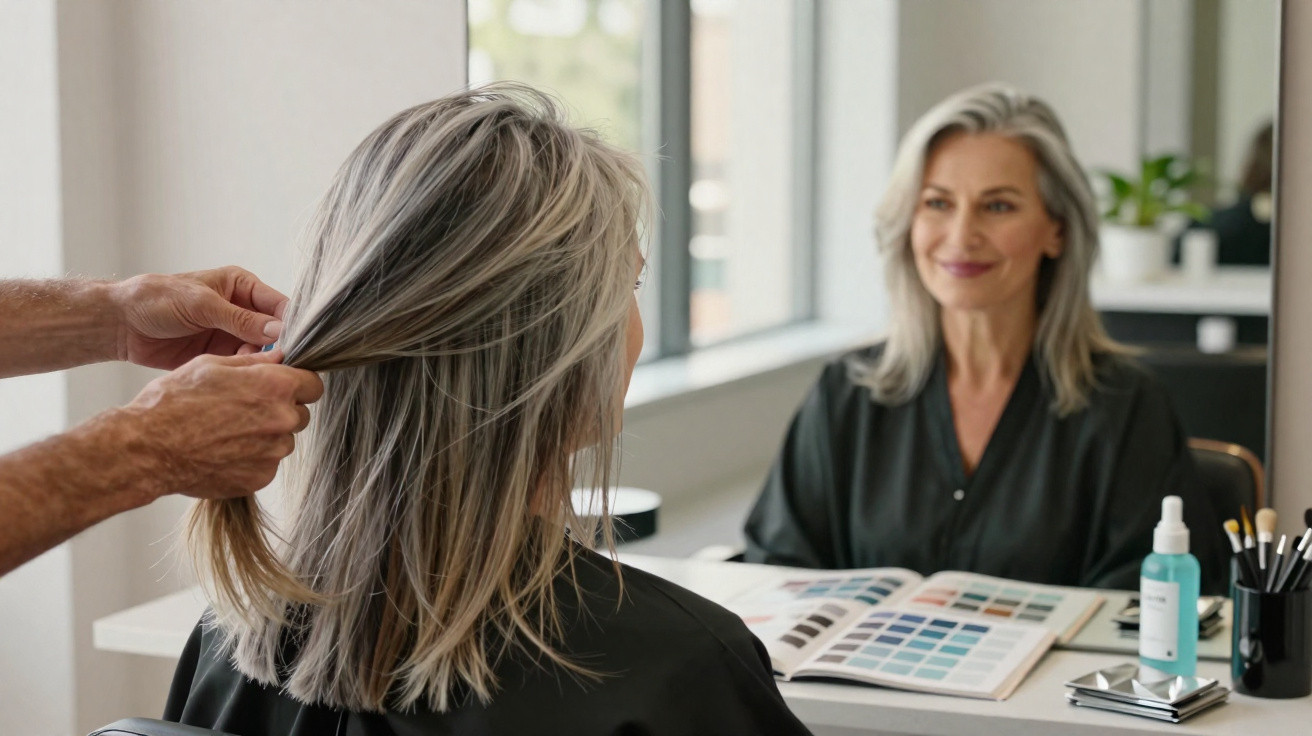
More and more hair salons are adopting an approach that takes a completely different route: natural grey is retained, then skilfully blended into the existing hair colour so the transition looks soft, refined and surprisingly rejuvenating. Rather than choosing an all-over grey transformation or enduring a relentless root-touch-up routine, the result is a gentle combination of silver, greige and delicate highlights – inspired by celebrity examples such as Jennifer Aniston and Sarah Jessica Parker.
Why women over 50 are tired of colouring their roots
Anyone who regularly colours their roots knows the routine: after only a few washes, white strands begin to show again, the next salon appointment is already approaching and the cost starts to mount. Many women describe feeling dependent on the process, as if life has to be organised around the colouring cycle.
- Roots become visible after two to three washes
- The colour soon turns dull or develops a yellow tinge
- Bills add up considerably over the course of a year
- Over time, hair can look lacklustre and damaged
There has also been a shift in ideas of beauty. Increasingly, women want to embrace their age with confidence rather than conceal it – without looking older, washed out or simply grey all over. This is exactly where the new salon technique comes in.
The idea: rather than hiding natural grey, refine it so that it looks like an intentional style rather than something “given up on”.
The technique behind the new grey hair look
This method does not rely on applying one flat grey shade. Instead, the stylist treats the whole head of hair like a canvas, using light and shadow to create dimension. The aim is a seamless move from naturally grey roots into the lengths, with no harsh line and no helmet-like effect.
Delicate highlights instead of an all-over colour
First, the colourist places exceptionally fine, light highlights. Their placement follows the natural pattern of the white hairs, making the grey eventually appear as though it has always been naturally blended through the hair.
Darker tones, known as lowlights, are added in between. These stop the overall colour from becoming too light, flat or blocky. They are especially useful for restoring depth to hair that has previously been heavily coloured.
The finishing touch: cool-toned refinement
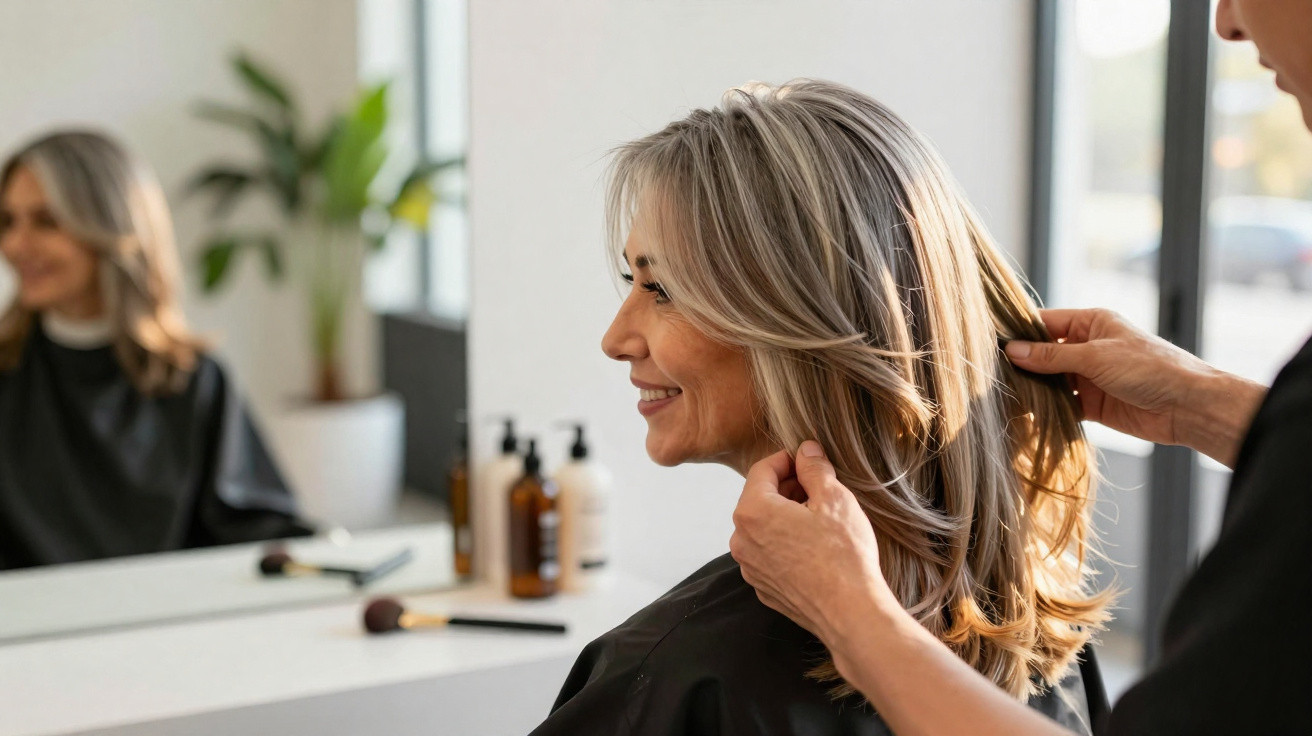
The hair is finished with a cool-toned glaze, often in beige-grey or greige shades – a blend of grey and beige. This patina works like a filter over every strand, bringing the transitions together.
The effect: not a stark root line, but a soft, silvery graduation – as if sunlight and time had coloured the hair very gradually.
Because the contrast is intentionally subtle, natural regrowth is far less noticeable. Your next salon visit can be delayed without making you feel “unkempt”.
Who benefits most from a soft transition to grey hair
Blonde and light-brown hair: ideal for an almost invisible transition
Those with naturally blonde or light-brown hair are particularly well suited to this approach. Their base colour and silver tones are already close together, allowing the stylist to work with fine accents. The result often resembles an expensive, contemporary blonde shade with a few elegant silver reflections woven through it.
Many clients find this more comfortable than making an abrupt choice between “completely grey or not at all”. They can progress gradually while still feeling like themselves.
Dark hair: more planning, but a striking result
Dark brown or black hair requires a little more planning. Here, the aim is to soften the strong contrast between black and white. Stylists often work with:
- Ash brown shades
- Mushroom brown, a cool brown with a mushroom-like tone
- Slightly cool copper tones
- Charcoal shades reminiscent of dark graphite
Skin tone is equally important. Too much contrast can make facial features appear harsher, so colour choices are tailored to the complexion rather than to passing trends.
What matters is not whether the grey shade is especially “on-trend”, but whether it complements the complexion, eyebrows and eye colour.
How to discuss the new grey hair look with your hairdresser
Many women are ready to colour their hair less often but are unsure how to explain what they want in the salon. Being clear from the outset helps prevent misunderstandings.
You can use these points at your next appointment:
- Explain that you no longer want to keep disguising your roots.
- Ask for a soft, seamless transition to grey rather than an all-over colour.
- Mention very fine highlights combined with darker accents.
- Emphasise that you would like a cool-toned finish tailored to your skin tone.
- Ask for a personalised plan covering the next six to twelve months.
A good hairdresser will then outline how many appointments may be needed, recommend a suitable starting colour and explain how the result will develop step by step. There is no need to rush the process – that is precisely what makes it practical for everyday life.
Care, longevity and cost: what to expect
How often will it need refreshing?
In most cases, refreshing the cool-toned patina every six to eight weeks is enough. Highlights need to be reapplied far less often because the roots are no longer working against the natural colour, but with it.
Using a silver shampoo or violet-toned treatment at home can help preserve the cool shade. It is important not to use these products every day, however, as they can leave hair too dry.
What does it cost?
The first appointment may cost more than a basic root colour because it involves additional stages. Over a year, though, this is often offset by the longer gaps between appointments.
| Service | Frequency | Note |
|---|---|---|
| Initial appointment with highlights and finishing treatment | One-off | More involved, individually tailored |
| Patina/gloss | Every 6–8 weeks | Revives shine and tone |
| Additional highlights | Every 4–8 months | Depends on growth and desired intensity |
Why grey hair does not automatically make you look older
Many women worry that grey hair will instantly make them look ten years older. This concern often comes from outdated images: dull, yellowing grey hair, often paired with an uninspiring short cut, was long regarded as an “end point”. This newer approach challenges that idea.
Grey hair can look highly elegant when:
- The cut feels modern and full of movement
- Cool reflections prevent yellow tones
- The colour works with the skin tone
- Styling products provide shine and texture
It is not the colour alone that matters, but the overall look created by the haircut, make-up, clothing and attitude.
Women who deliberately choose a grey hair look often experience it as liberating: no more guilt when roots show through, less time in the salon and a stronger sense of authenticity.
Risks, limitations and useful combinations
Despite all its advantages, hair colour still involves chemicals. Lengths that are severely damaged or have been dyed dark several times can react sensitively to lightening. A reputable hairdresser will therefore work carefully and in stages.
Sometimes it also makes sense to strengthen the hair’s structure at the same time, for example with:
- Protein treatments in the salon
- Bond-building conditioning treatments for use at home
- Gentle heat styling instead of straightening every day
Make-up and clothing can also be adjusted slightly. Fresh blusher, a somewhat bolder lipstick or glasses with a more striking frame can complement the new grey beautifully. Many women report that this makes them look even more vibrant than they did with their previous fully coloured shade.
If you are uncertain, begin with just a few very fine highlights and build up gradually. This keeps you in control throughout, while your reflection will clearly tell you when grey no longer feels like “going without”, but like a considered style choice.
















Comments
No comments yet. Be the first to comment!
Leave a Comment