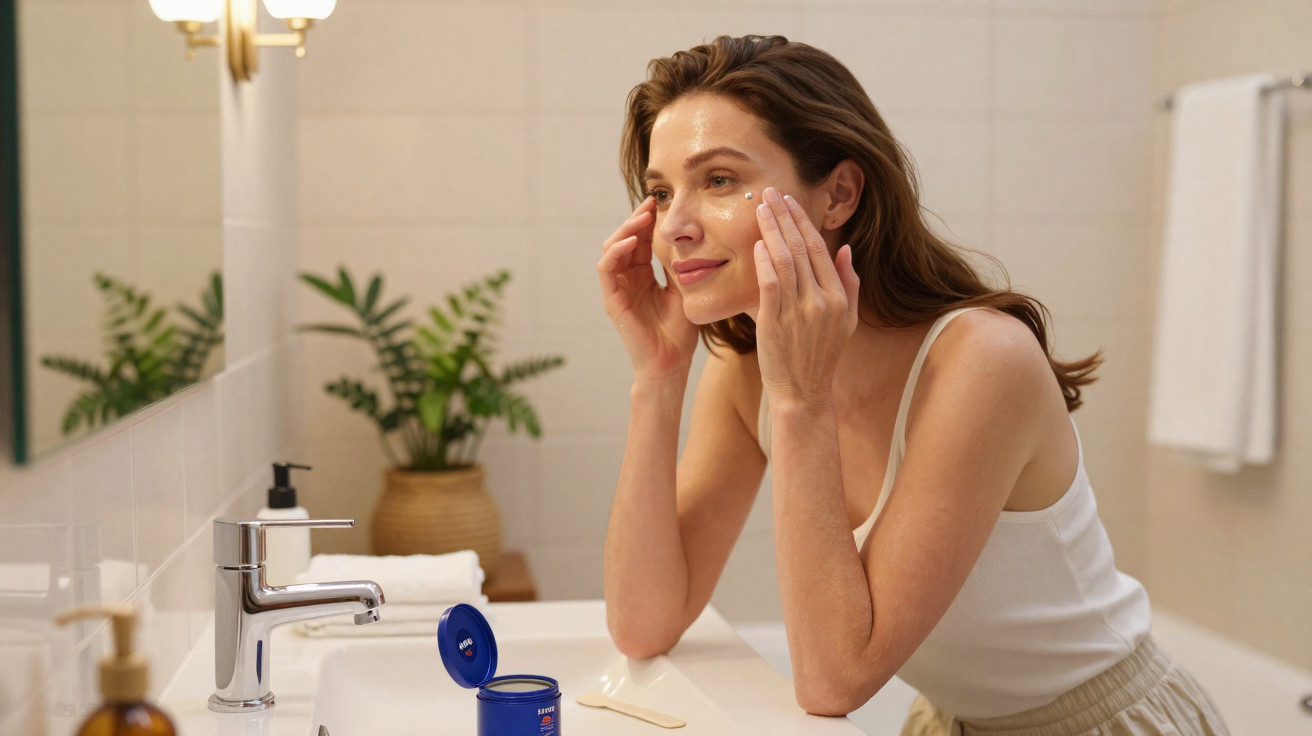
For years, it has sat on bathroom shelves, usually inconspicuously positioned between serums and luxury creams.
Many people have no idea what it can do for the under-eye area.
Nivea Creme is considered a long-standing skincare classic. Yet an increasing number of women over 50 swear by a straightforward approach: they use the familiar blue tin specifically for dark circles and fine lines. It may sound almost too simple, but many find it works remarkably well when a few rules are followed.
Why Nivea Creme is used beneath the eyes
At first glance, the formula of this well-known cream seems unremarkable: fats, waxes and moisture, with no major high-tech claims on the packaging. This is precisely what appeals to people wishing to simplify their skincare routine as they get older. The principle is that the skin beneath the eyes primarily needs protection and support.
As the years pass, the skin produces less collagen and its natural protective barrier becomes thinner. The skin below the eyes is already only a fraction as thick as that on the cheeks. Minor irritation, dryness and visible blood vessels are therefore immediately noticeable in this area. This is exactly where the Nivea approach comes in.
“The trick is not to celebrate the cream as a miracle product, but to use it strategically: little product, precisely applied, regularly.”
What the classic cream can do around the eyes
People who apply Nivea Creme to specific areas generally have three aims:
- Strengthen the skin barrier so it retains moisture more effectively
- Plump up dehydration lines so they appear less pronounced
- Make the area look smoother and more awake
Its highly occlusive texture forms a light layer over the skin. This slows moisture loss and can make the surface appear fuller. For mature, relatively dry skin, this may create a visible immediate effect, particularly when the skin has first been gently cleansed and lightly dampened.
Step by step: how the Nivea Creme trick works after 50
Anyone planning to use this all-purpose cream under the eyes should not simply apply it without a method. The correct order and amount determine whether it becomes a skincare boost or leaves the area over-moisturised and shiny.
The ideal evening routine with the blue tin
Many women over 50 apply Nivea deliberately in the evening. This gives the skin time to recover without layers of make-up on top.
- Gentle cleansing: Thoroughly remove eye make-up with a mild remover, then cleanse the face with a non-foaming cleanser.
- Light hydration: Pat an eye serum or a fluid toner around the eyes. Alternatively, a little lukewarm water left on the skin is sufficient.
- A pea-sized amount of Nivea: Warm a tiny amount of cream between your fingertips.
- Pat rather than rub: Gently press the cream beneath the eye, moving from the inner to the outer corner. It is best to avoid the mobile eyelid, helping to prevent it from “slipping” into the eyes.
- Allow it to absorb: Wait two to three minutes before resting on your pillow. This reduces the amount of product that can get into the eye.
“The rule of thumb is: it is better to use too little Nivea beneath the eyes than too much. A light touch is enough to create a protective film.”
Who benefits most from the Nivea trick?
Nivea beneath the eyes does not have the same effect on everyone. Your skin’s starting condition matters greatly. This overview provides initial guidance:
| Skin type | Suitability for the Nivea trick | Note |
|---|---|---|
| Dry skin | often very good | Can ease tightness and temporarily smooth fine lines. |
| Normal skin | usually good | Use sparingly, especially in winter or when central heating is on. |
| Combination skin | conditional | Apply only directly beneath the eyes and avoid oily areas. |
| Oily or blemish-prone skin | cautiously | Test a small patch first; do not use over a large area. |
| Very sensitive skin | individual | Check the INCI list and wash it off immediately if it stings. |
What Nivea can do for dark circles - and what it cannot
Many people hope that a cream can simply erase dark shadows. In reality, the issue is more complex. Dark circles are often caused by a combination of genetics, thin skin, tiredness, circulation and lifestyle.
Nivea Creme mainly addresses the aspect linked to dryness and a lack of firmness. When the skin is better hydrated and slightly plumped, shadows can look less sharply defined. Fine lines can also make the eyes appear tired; when they look smoother, the whole eye area appears fresher.
“Nivea does not lighten pigmentation issues or replace a healthy sleep routine - it primarily improves the surface of the skin.”
Anyone with pronounced bluish dark circles will not see a spectacular change from the cream alone. However, alongside concealer, sufficient sleep and perhaps a cooling eye product, it can visibly create a more balanced overall appearance.
The impact of age after 50
From the mid-fifties onwards, the eye area loses firmness more noticeably. The fat pads beneath the skin gradually diminish. Blood vessels become more visible and the tear trough becomes more defined. At this stage, even small improvements to the skin’s surface can often make a marked difference.
A simple, consistent routine can then be more beneficial than constantly changing trend-led products. Many dermatologists consider combining gentle active ingredients - for example hyaluronic acid, peptides and mild retinoids - with a protective layer such as Nivea Creme in the evening to be a sound approach. Patience is crucial: people who use this method regularly are more likely to notice changes over weeks rather than days.
Risks, limitations and useful combinations
This cult cream has many fans, but it is not automatically suitable for every eye area. Some people develop irritation in response to fragrance or preservatives. In this case, sensitive skin may become red or even sting.
Anyone prone to these reactions should carry out a patch test first: apply a tiny amount of cream to an inconspicuous area, such as the side of the neck, on two consecutive days. If there is no reaction, there is little against trying it beneath the eye - initially on one side only and not every day.
The approach becomes particularly interesting when paired with other parts of an anti-ageing routine. Common additions include:
- A gentle hyaluronic acid eye serum in the morning for instant freshness
- Retinol at a very low concentration, introduced gradually, to support collagen production over the long term
- A mineral sunscreen extending beneath the eyes to limit further damage
Within this combination, Nivea acts as a “coat”, helping to keep the active ingredients underneath in the skin for longer while protecting the surface. Those who already use very rich eye creams may not necessarily need the additional layer. For a more minimalist routine, it may provide exactly the missing amount of protection.
A realistic everyday scenario
Imagine a 56-year-old woman who has struggled with dark shadows for years. She rarely sleeps for more than six hours, spends a great deal of time working at a screen and tends to eat salty foods. Her bathroom drawer is full of opened eye creams, all of which have worked “so-so”.
She begins a simple experiment: in the evening, she uses only a mild cleanser, a light hyaluronic acid serum and a tiny amount of Nivea beneath her eyes. She cuts down on salty snacks, drinks a little more water and treats herself to cooling eye pads from the fridge twice a week.
After four weeks, she notices that the shadows have not disappeared. Yet they look less harsh, her make-up no longer settles as noticeably into fine lines, and her eyes look more awake overall. The result does not come from one product alone, but from the combined effect of small changes, with the cream in the blue tin making a noticeable contribution.
What many people still do not know about dark circles
Certain terms repeatedly arise in discussions about dark circles but often remain vague. “Lymphatic congestion”, for instance, refers to the tendency for fluid to collect in the tissue. Especially for people over 50 who spend much of their time sitting or drink too little, drainage from the delicate eye area can become slower. As a result, shadows may look stronger in the morning and slightly weaker by evening.
Skincare can affect this only to a limited extent. Cooling products, gentle massage using the ring finger and consciously blinking during screen breaks can stimulate microcirculation. Pairing these with an occlusive cream such as Nivea helps preserve the moisture gained, but it does not directly resolve lymphatic congestion.
Another consideration is that many people underestimate how strongly lighting conditions emphasise dark circles. Harsh overhead lighting and cool office lighting intensify every shadow. Positioning a mirror with softer, side lighting gives a more realistic view of the skin - and therefore of how well skincare techniques are working.
How to adapt your own Nivea trick effectively
Perhaps the most important lesson from all these experiences is that the Nivea Creme trick is not a rigid formula but a starting point. Some people may use it beneath the eyes only in winter. Others may apply it only occasionally, such as before a long flight, to protect the skin from dry cabin air. Others may make it a fixed part of their evening routine and combine it with targeted active skincare.
By observing your skin closely, you can adjust both the amount and frequency. If the area becomes too shiny or feels heavy, applying it every two to three days may be enough. If the skin feels comfortable, soft and less crinkled, this suggests that your personal Nivea trick is working - without expensive specialist products, but with a mindful, informed approach to a classic cream in a tin.

















Comments
No comments yet. Be the first to comment!
Leave a Comment