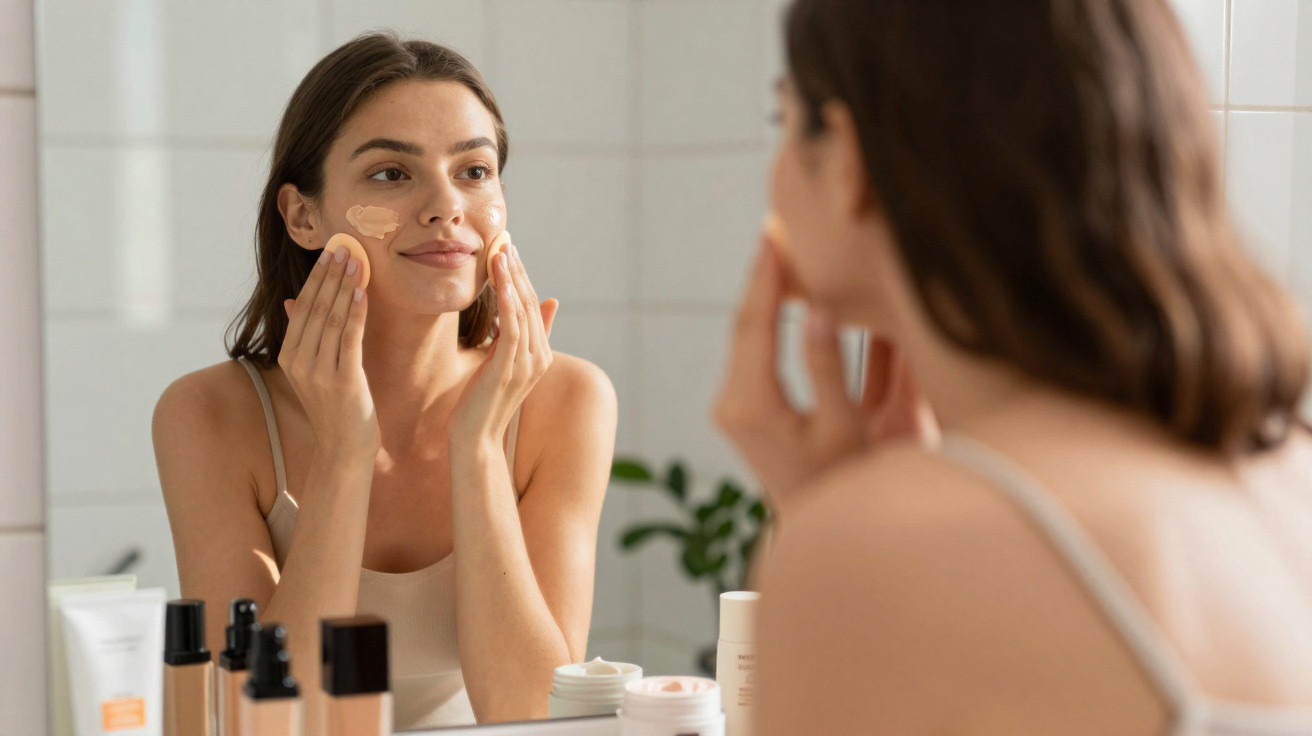
The good news is that, with the right foundation, your complexion can suddenly look remarkably natural.
Shelves packed with products, bold promises on the packaging and flawless skin in advertising images: looking for a foundation can quickly feel overwhelming. Some formulas leave the skin dry, others become shiny within two hours, while others settle into every pore. What matters far more than a product's hype is whether its texture, coverage and finish genuinely suit your skin type. This is where most everyday mistakes are made.
Why choosing the right foundation matters more than ever
Foundation is no longer simply “make-up”. Many formulas now include:
- hydrating ingredients
- anti-ageing components, such as peptides or hyaluronic acid
- UV filters that provide basic daily protection
That brings certain products close to skincare. Even so, an unsuitable texture can make the complexion appear older and less even: shine across the forehead, dry patches around the nose and emphasised lines around the mouth often result from the wrong foundation rather than “bad skin”.
“The key to better-looking skin is choosing a foundation that supports your own skin instead of fighting it.”
The right foundation texture for every skin type
Normal to combination skin: plenty of choice, but choose carefully
If your skin is normal or only slightly combination, almost any format can work in principle: liquid, stick, cushion or powder. The choice mainly depends on how much coverage you want and the effect you prefer.
- Liquid foundation: usually looks more natural, blends easily and works well for everyday wear.
- Compact products: convenient when you are out and about, often offer more coverage, but can look more obviously made-up.
- Tinted moisturiser: gives minimal coverage while being particularly easy to use and nourishing.
If your T-zone tends to shine, semi-matte or matte finishes are generally the better option. A slightly radiant finish can instantly make a dull complexion look fresher.
Dry skin: choose liquid and cream formulas, never overly powdery ones
Dry skin reacts quickly: powder clings to flakes, while matte mousse highlights every line. Liquid or creamy formulas with a subtle glow are therefore ideal.
“Rule of thumb: the drier the skin, the creamier and more moisturising the foundation should be.”
For dry skin, look for descriptions such as “hydrating”, “glow”, “dewy” or “moisturising”. These products often contain:
- glycerine or hyaluronic acid for hydration
- gentle plant oils, such as jojoba or squalane oil
- caring ingredients that ease feelings of tightness
If you want substantial coverage, it is better to opt for medium coverage and use concealer only where needed than to apply a heavy, full-coverage foundation in several layers. Otherwise, you risk drawing attention to the very dry lines you intended to conceal.
Oily skin: matte, yes - but not too heavy
Oily skin can become shiny quickly and is often prone to enlarged pores and blemishes. This leads many people to choose very thick, high-coverage textures. The result is that skin can look mask-like, while pores may become even more congested.
Lightweight, oil-free formulas with a matte or semi-matte finish are a better choice. These products often carry descriptions such as “oil free”, “non-comedogenic” or “long-lasting”.
- Liquid, oil-free foundation: evens out the complexion without weighing it down.
- Mineral powder: absorbs excess sebum and looks more natural than heavy compact powders.
- Mattifying mousse: use sparingly and blend thoroughly, otherwise the complexion can soon look dull.
A translucent powder on the T-zone can help foundation last longer. The important thing is not to repeatedly powder the entire face, as this can create visible edges and leave skin looking “cakey”.
Mature skin: lightweight formulas rather than a heavy layer
As skin ages, its texture and firmness change. Full-coverage, powdery formulas are especially likely to settle into fine lines and make the face appear tired.
“For mature skin, a lightweight liquid foundation is usually the best choice - it evens out the complexion without emphasising every line.”
Many foundations for mature skin contain smoothing ingredients and light-reflecting pigments. They softly diffuse light, making fine lines appear visually softer. Powder and mousse textures can often look harsh here, making facial features seem more severe. Many make-up artists recommend using powder only very selectively on mature skin.
Foundation coverage and finish: how much of a “filter” does your face really need?
As a general rule, the higher the coverage, the greater the chance that the foundation itself becomes noticeable. Light to medium coverage is often enough for a fresh, “real skin” complexion.
| Coverage | Effect | Suitable for? |
|---|---|---|
| Light | evens out very slightly, looks highly natural | few imperfections, natural looks |
| Medium | conceals redness and marks while remaining flexible | everyday wear, combination skin, mild blemishes |
| Full | provides almost complete coverage | special occasions, pronounced concerns - use sparingly |
There are broadly three established finish types:
- Glow / radiant: makes tired-looking skin appear fresher and is ideal for dry and normal skin.
- Natural / satin: looks like “skin, just a little better” and is universally wearable.
- Matte: controls shine and suits oily or combination skin, but can quickly look dull on dry or mature skin.
Application: common foundation mistakes and how to avoid them
Less product, better technique
Many issues are caused by the amount applied rather than the product itself. A small amount of foundation is usually sufficient. Start in the centre of the face - on the nose, cheeks and around the mouth - then blend outwards.
“If you soften the edges and only lightly tint the sides of the face, the result automatically looks more natural.”
There are three main tools to choose from:
- Fingers: warm up the product, making them ideal for light textures and natural looks.
- Brush: offers greater coverage and precision, but can leave streaks when used incorrectly.
- Damp sponge: absorbs excess product and gives foundation a particularly smooth appearance.
For most skin types, a light dusting of translucent powder across the forehead, nose and chin is enough to set the product. Leave drier areas completely powder-free so that the skin's natural glow remains visible.
Your foundation and skincare need to work together
One aspect many people underestimate is this: even the best foundation will perform less well if the skincare underneath is unsuitable.
- Foundation may slip or become patchy over a very rich cream.
- Over a cream that is too light and barely nourishing, the finish can soon appear dry and uneven.
The rule of thumb is to apply skincare, wait five to ten minutes, then work in foundation using gentle movements. If you wish, apply a primer first, particularly for enlarged pores or a very uneven skin texture.
Foundation, skincare and SPF: what these terms actually mean
Many products use descriptions such as “serum foundation”, “BB cream” or “skin tint”. The distinctions overlap, but they can broadly be classified as follows:
- BB/CC cream: lighter coverage, often combining skincare with UV protection.
- Serum foundation: very fluid, feels almost like skincare and usually contains skin-conditioning ingredients.
- Skin tint: provides an extremely sheer tint - more of a “hint of colour” than make-up.
If dependable sun protection is important to you, do not rely on foundation alone, even if it states an SPF. The stated protection only works when generous quantities are applied - more than most people use day to day. Combining separate sun protection with a light foundation on top is the more sensible approach.
When foundation makes skin look worse
Some textures are fundamentally difficult for certain skin types. Examples include:
- Very powdery or mousse-like products on dry or mature skin: they accentuate fine lines and dry areas.
- Highly oily, very shiny formulas on oily skin: they intensify shine and may clog pores.
- Extremely full-coverage products for everyday wear: they remove dimension from the face, leaving it flat and mask-like.
If you notice in the mirror that your foundation needs correcting every day, you will usually be happier with a lighter texture that is better suited to your skin, along with targeted correction using concealer or spot coverage.
A practical test is to stand close to a window in daylight after applying it, then look from an arm's length away. If you notice the foundation before you notice your face, you have either used too much or chosen an unsuitable texture. If the skin simply appears calmer, fresher and more even without the product being visible, you have found your ideal foundation.

















Comments
No comments yet. Be the first to comment!
Leave a Comment