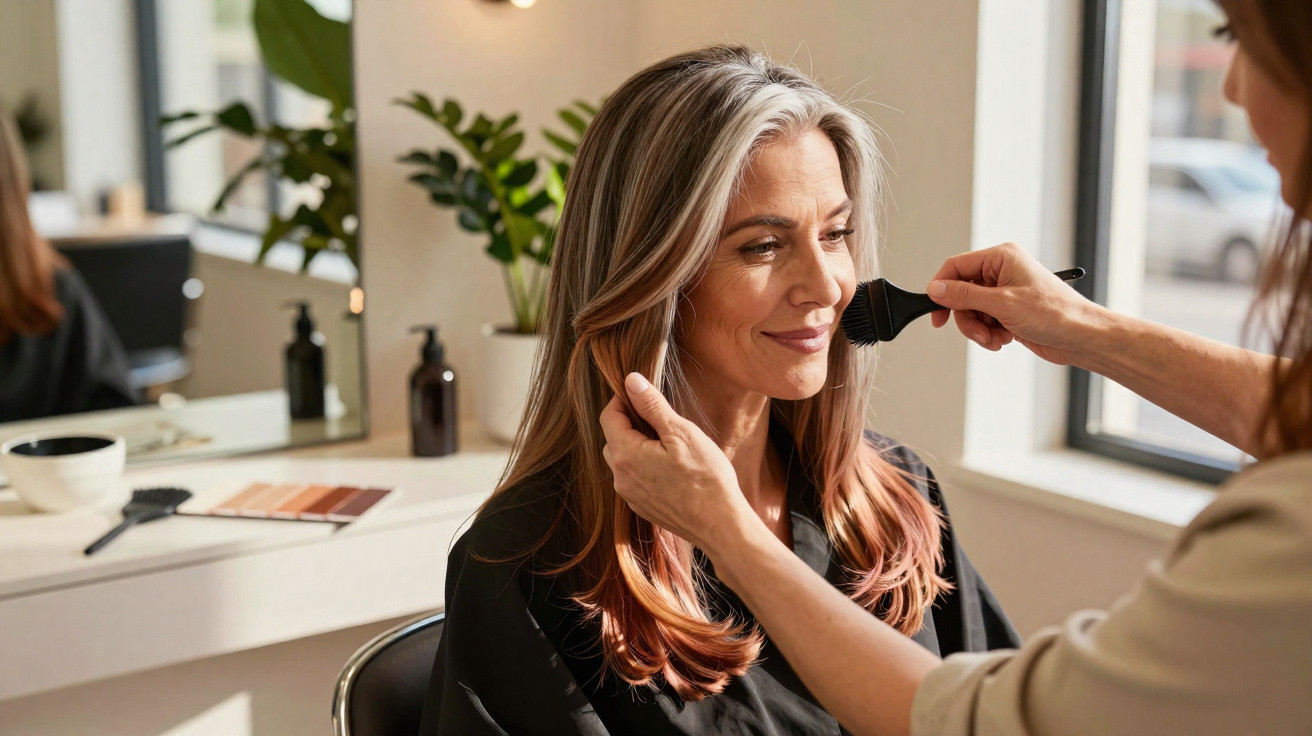
Many women will recognise this: for years, a classic highlighted look brings a summery freshness to the face, yet at some point the very same technique can suddenly appear unexpectedly harsh. The complexion may look paler, fine lines become more noticeable and the colour can seem overly “done”. Salons are now embracing an approach intended to prevent precisely this: “Hair Bronzing”. The principle is similar to using bronzer in make-up – but applied to hair.
Why classic highlights often become less flattering after 50
Hair texture changes noticeably over time. Many women experience:
- lengths that become thinner
- dry ends
- less volume at the roots
- an increasing amount of white or grey hair
The familiar highlighted style, with its pronounced contrasts, can then work against the face rather than enhancing it. Broad light sections beside very dark areas may:
- draw greater attention to expression lines
- deepen shadows around the chin and jawline
- make the complexion appear dull
- make regrowth stand out clearly as the hair grows
“Strong contrasts in the hair can quickly make mature facial features look harsher – taking away lightness and freshness.”
This effect is especially noticeable on naturally dark hair with a traditional highlighted finish. The result often appears less natural, while the time between colour appointments becomes ever shorter. This is exactly where the newer technique comes in.
What the “Hair Bronzing” trend involves
The name takes its inspiration from make-up bronzer: rather than changing the colour all over, warm reflections are placed selectively where sunlight would naturally hit first – around the face and through chosen lengths.
“Hair Bronzing” does not mean adopting a completely new hair colour. Instead, it uses warm shades to visually brighten the face. This might include:
- a delicate golden tone on medium-blonde hair
- warm copper reflections on chestnut brown hair
- honey and caramel tones on dark-blonde hair
“Rather than harsh highlights, a soft glow is created around the face – like after a weekend in the sun.”
The key is to keep the transition from roots to lengths seamless. The colour should look as though the sun has gradually worked it into the hair, rather than as if it has been painted on in a salon.
“Spring Balayage”: a spring version for mature hair
One variation often mentioned in salons is known as “Spring Balayage”. This is an especially gentle technique designed for fine, dry or already slightly damaged hair.
A gentle technique for sensitive hair textures
Rather than using aggressive lightening, colourists often use a clay-based mixture or similarly gentle products. The aim is to avoid placing unnecessary stress on the hair fibre. Colour is applied in very fine, highly precise sections, strand by strand, almost like delicate threads.
This creates:
- subtle shine without sharp lines
- a softer outline around the face
- the appearance of fuller lengths
The effect is reminiscent of a gentle sunny break: not an extreme blonde result, but a natural shimmer that makes the complexion look more lively and awake.
Why the look has such a rejuvenating effect
Warm, slightly golden shades generally give mature skin more radiance than cool, ashy tones. They balance out a complexion that can often look a little dull and bring light back to the face.
“Well-placed warm reflections can visually lift the face – especially around the cheeks, eyes and jawline.”
Unlike all-over colouring, the natural base remains visible. This gives a more modern, less “painted-on” appearance. At the same time, the halo of light around the face distracts from fine lines, as attention is drawn first to the eyes and overall radiance.
How to discuss “Hair Bronzing” clearly at the salon
Anyone wishing to try the trend should be specific with their hairdresser. Rather than simply asking for “highlights”, it is worth describing the desired outcome briefly.
The right wording for your appointment
Useful phrases include:
- “I’d like a very soft halo of light around my face.”
- “No harsh highlights; I’m after fine reflections that are almost invisible individually.”
- “I want the colour to make my skin look warmer, not cooler.”
- “The roots should grow out softly, without a distinct line.”
It is best to bring along a photo that clearly shows the way light and shadow sit in the hair. The exact shade is not the main point; the effect matters most: brighter around the face, a gentle flow into the lengths and no block-colour appearance.
Which shades suit each starting colour
A general guide for mature hair:
- Brunette: warm caramel, bronze or copper shades around the face, only a few tones lighter than the base colour.
- Blonde: soft gold, honey or vanilla shades to make flat, muted blonde tones look more vibrant.
- Dark brown: chocolate highlights with a subtle red or copper undertone to soften the outline.
- With grey strands: beige-golden reflections that do not cover grey completely, but blend it in harmoniously.
“The crucial thing is to go only a few shades lighter than the starting colour – the difference should flatter, not shout.”
Less stress from colouring appointments: a major advantage after 50
“Hair Bronzing” also offers a practical everyday benefit. Because the colour transitions are deliberately soft, regrowth is far less noticeable. Even when new white hairs appear, they do not look like a harsh band across the top of the head.
Many hairdressers plan the look so that an appointment every two to three months is enough. Small adjustments are sufficient instead of repeating a full colour service every time. This saves hassle and time, while being kinder to hair that is already more delicate.
What sensitive scalps and fine hair should consider
As we get older, the scalp and hair can become irritated more quickly. Anyone prone to dryness, itching or breakage should clarify a few points in advance:
- Are low-ammonia or particularly mild products being used?
- How long will the colour be left on the hair at most?
- Is there a conditioning treatment immediately after colouring?
- Which at-home care will keep the lengths supple?
A good salon will explain openly which products are used and what aftercare is advisable. With “Hair Bronzing” in particular, a hydrating shampoo and a rich but lightweight mask are worthwhile for maintaining shine.
Practical care tips for a long-lasting bronzing effect
A few simple habits can help prevent the soft light-reflecting effect from disappearing after only a few weeks:
- Wash with lukewarm rather than hot water.
- Apply heat protection before using a hairdryer, straighteners or curling tongs.
- Use a nourishing mask once a week, ideally with oils such as argan or jojoba.
- During high summer, reduce direct sun exposure with a hat or scarf so the colour does not fade.
Choosing lightweight styling products with a shine finish can also enhance the bronzing look. A glossy serum through the ends or a fine gloss spray is usually enough.
Why this trend is particularly appealing for women over 50
Many women at this stage of life no longer want a radical complete change, but a colour that adapts flexibly. The complexion changes, the eye area becomes more sensitive and hair grows finer – “Hair Bronzing” responds directly to this.
“Rather than ‘painting’ a new face, the technique supports what is already there – simply softer, warmer and more radiant.”
The hairstyle therefore looks more contemporary without becoming loud. It can also create the sense that hair and skin are working together again rather than against each other. Combined with a lightly layered cut or a soft fringe, the bronzing effect can visibly rejuvenate the overall appearance without anyone being able to say exactly why.
Anyone ready to move on from classic highlights without giving up their familiar hair colour entirely may find “Hair Bronzing” a practical, natural and highly flattering option for their next spring or summer salon appointment.

















Comments
No comments yet. Be the first to comment!
Leave a Comment