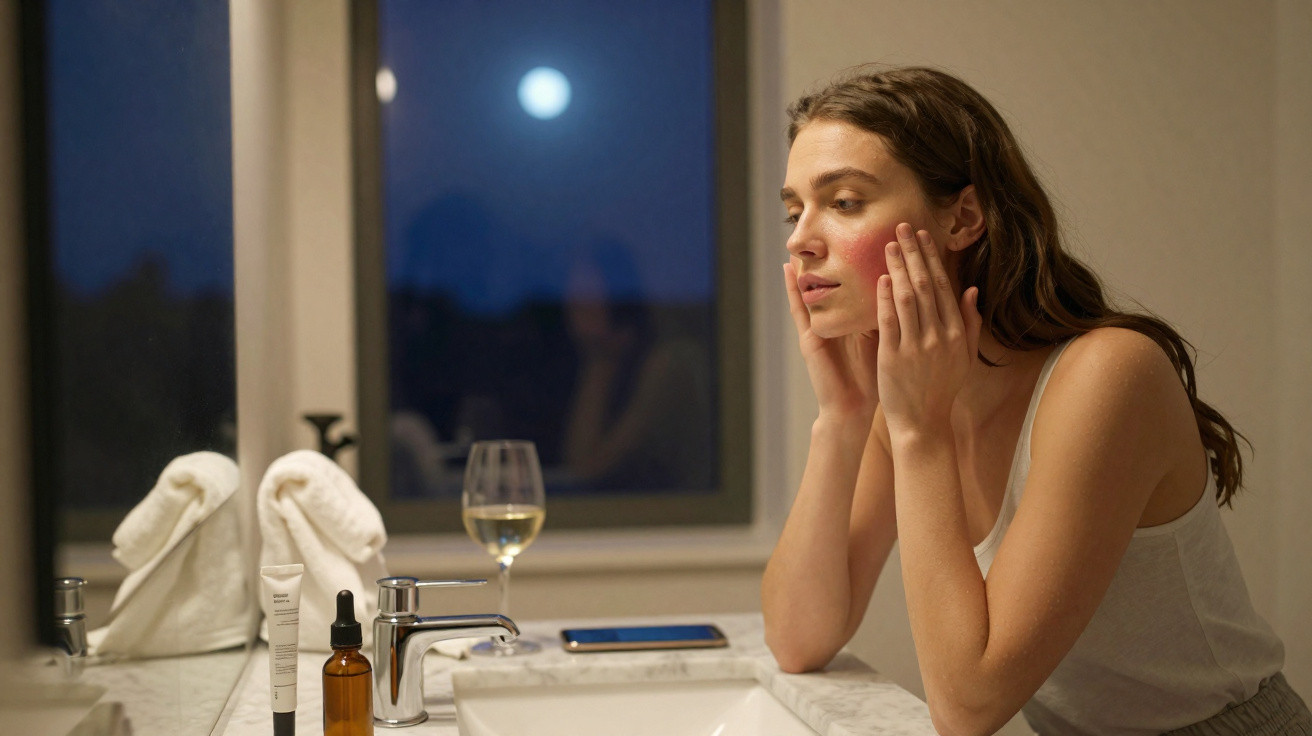
The bathroom is silent, the day is at last finished, and you are beneath unforgiving mirror lighting with your favourite serum in your hand.
This morning, you adored the product. This morning, you thought, “Wow, my skin looks kind of amazing.” But at night? Redness, stinging and odd tiny bumps that seem to have come from nowhere. Same face, same product, same routine-yet a totally different response.
You rinse your face, pat it dry and reach for something milder. Still, the prickling spreads. In the mirror, you look more exhausted and delicate than you did at 8 a.m., and you begin to wonder whether you have suddenly become “allergic” to every product on your shelf. The late-night overthinking begins: Was it the new toner? The retinol? Did double-cleansing cause it? Or is your skin simply... more temperamental at night?
Oddly enough, it is.
Why your skin reacts more dramatically after dark
Dermatologists often discuss the skin’s “circadian rhythm”, but in everyday life you notice it like this: your face can behave differently at different times of day. In the morning, skin may feel firmer, less shiny and slightly protected. By late evening, it is often softer, warmer and easier to irritate. A product that feels effortless at 7 a.m. may sting at 11 p.m., as though your skin’s defences have disappeared.
You are not imagining it. Over a 24-hour period, blood flow in the skin, barrier performance, sebum production and even pH fluctuate. During the night, the skin allows more active ingredients to enter. That can be beneficial in many respects, but it also leaves your skin more vulnerable to everything you apply-both helpful and harmful.
Picture arriving home, automatically removing your make-up and applying your “night routine” as though ticking off tasks. Seconds after using retinol, your cheeks begin to burn. It is the same retinol you used one morning last week without any fuss. Lying in bed, you feel every tingle and question whether you are being overly sensitive or whether your skin is genuinely raising the alarm.
Similar experiences appear on social media: redness that reaches its worst point at night, watering eyes after eye cream, or lips that suddenly feel sore at bedtime. Some clinics even say that the majority of patients’ “urgent” skincare messages arrive late in the evening, when reactions can appear more severe and feel more intense. Quietly, the same pattern plays out in bathrooms worldwide.
Biology explains part of it. At night, the skin barrier-the fine protective layer that locks water in and keeps irritants out-becomes a little more permeable. Transepidermal water loss increases. Blood vessels in the skin widen, while inflammatory mediators rise. Your face becomes more permeable in a literal sense, allowing products to travel further into the skin. That is excellent for repair, but less welcome if your toner contains too much acid or your serum is packed with fragrance.
There is another factor that receives too little attention: your nervous system also changes at night. As stress hormones fall and your body begins its repair processes, you become more aware of physical sensations. The tingle you ignored during a rushed morning shower can feel like an intense burn when you are motionless in a dark room. At 10 p.m., the same product may create a very different physical and emotional experience than it does at 8 a.m.
Complicating matters further, most of us reserve our most potent products for the evening. Acids, retinoids, peels and “overnight resurfacing” masks are often applied when skin is already warmer, thinner and more open. It is like hosting a party in a house with every window and door unlocked: the ventilation is great, but anyone can get inside. Irritation, dryness and micro-inflammation all find it easier to appear after sunset.
So, if your skin responds more badly at night, it is not happening at random. It is the result of timing, biology and personal habits meeting on a very small, highly sensitive area: your face.
How to support your skin at night rather than fight it
One straightforward change can make a major difference: do not use your evening routine as a place to pile on every “power product” you own. Treat it instead as a discussion with skin that is tired, more permeable and already occupied with repairing the day’s damage. Build your night ritual around gentle cleansing and a barrier-supporting product, rather than the strongest active ingredient in your drawer.
A practical approach is to test new or potentially irritating products in the morning first, on a day when you will be at home for several hours. Observe how your skin responds in daylight, when it is generally more stable. If it copes well, gradually introduce that product into your evening routine. Begin with once a week at night, progress to twice weekly, and only then consider increasing use. Skin does not react well to surprises.
If your face usually flushes or stings after your evening skincare, try a “calm sandwich”. Apply a light, neutral moisturiser both before and after your strongest active. For instance: cleanse, mist or lightly dampen the skin, smooth on a thin layer of cream, apply a pea-sized amount of retinol, then finish with another layer of cream. This does not make the product weaker; it slows the rate at which it reaches skin that is already more sensitive at night.
On evenings when your skin feels warm after a shower, leave out the active entirely and return to the essentials. Use a simple cream, a soothing serum containing ingredients such as glycerin or centella, then go to bed. Let us be honest: nobody truly manages this every day. Yet when you do, your skin will quietly appreciate it. Over time, these “rest nights” can lessen the major evening flare-ups that leave you searching for answers at midnight.
There is an emotional aspect too. After a stressful day, you may unconsciously scrub more firmly, layer on more products or choose something “extra strong” because you desperately want to see results. Those are often the moments when nighttime reactions are at their worst. Notice that impulse and see it as an amber light: it is time to slow down, rather than add another product.
You may know the familiar feeling of looking at an inflamed face in the mirror at 11 p.m. on an ordinary Tuesday and thinking, “I’ve ruined my skin”? Usually, that moment is not caused by one product alone. It is overload meeting a skin barrier that is already thinner at night. One dermatologist expressed it well:
“Your skin at midnight is not the same organ as your skin at midday. Respect the timing, and half your ‘mystery sensitivities’ disappear.”
When you are tired, a small checklist inside your bathroom cabinet can help you remember that principle:
- Does my skin feel warm or tight at the moment?
- Have I exfoliated or shaved during the past 24 hours?
- Am I about to combine two powerful active ingredients?
- Could I choose a “minimalist night” instead and allow my barrier to breathe?
Taking five seconds to consider those questions may be the difference between a peaceful night and waking up blotchy and frustrated.
Rethinking what “sensitive” skin means
It can be a relief to realise that your skin is not randomly letting you down at night. It is following a rhythm as it attempts to repair itself while you sleep. Once you view your evening face as a different version of your daytime face-softer, more permeable and a little more emotionally vocal-you will select products differently. You will slow down and save certain treatments for daylight hours.
The next time your skin flares after a nighttime serum, rather than deciding, “I can’t use this,” you could ask, “Is this a bad product for me, or just bad timing?” That small change in perspective allows room to experiment without blaming yourself. Perhaps the product suits alternate nights. Perhaps it should only be used in the morning. Or perhaps your skin needs a fortnight of barrier repair first. Sensitive skin is often simply overloaded skin at the wrong time of day.
Discussing this with friends often reveals the same shared habit: potent actives layered at night, no buffer and a quiet anxiety about doing less. Yet skin frequently responds well to “boring” evenings-gentle cleanser, light layers and nothing that tingles. You do not need to earn healthy-looking skin through discomfort. Sometimes the bravest thing you can do for your face is to stop chasing the burn. It is the sort of skincare realisation worth sharing in the group chat at 23:47, when someone writes, “Why does my face always freak out at night?”
| Key point | Detail | Why it matters to the reader |
|---|---|---|
| Skin is more permeable at night | Blood flow, water loss and inflammation increase after sunset | Helps explain why products sting or irritate more in the evening |
| Active ingredients are often concentrated at the end of the day | Acids, retinoids and peels are mainly used in the evening | Helps identify how personal habits may contribute to skin reactions |
| Calming, gradual routines | Moisturiser sandwiching, rest days and testing products in the morning first | Provides practical ways to soothe skin and reduce reactions |

















Comments
No comments yet. Be the first to comment!
Leave a Comment