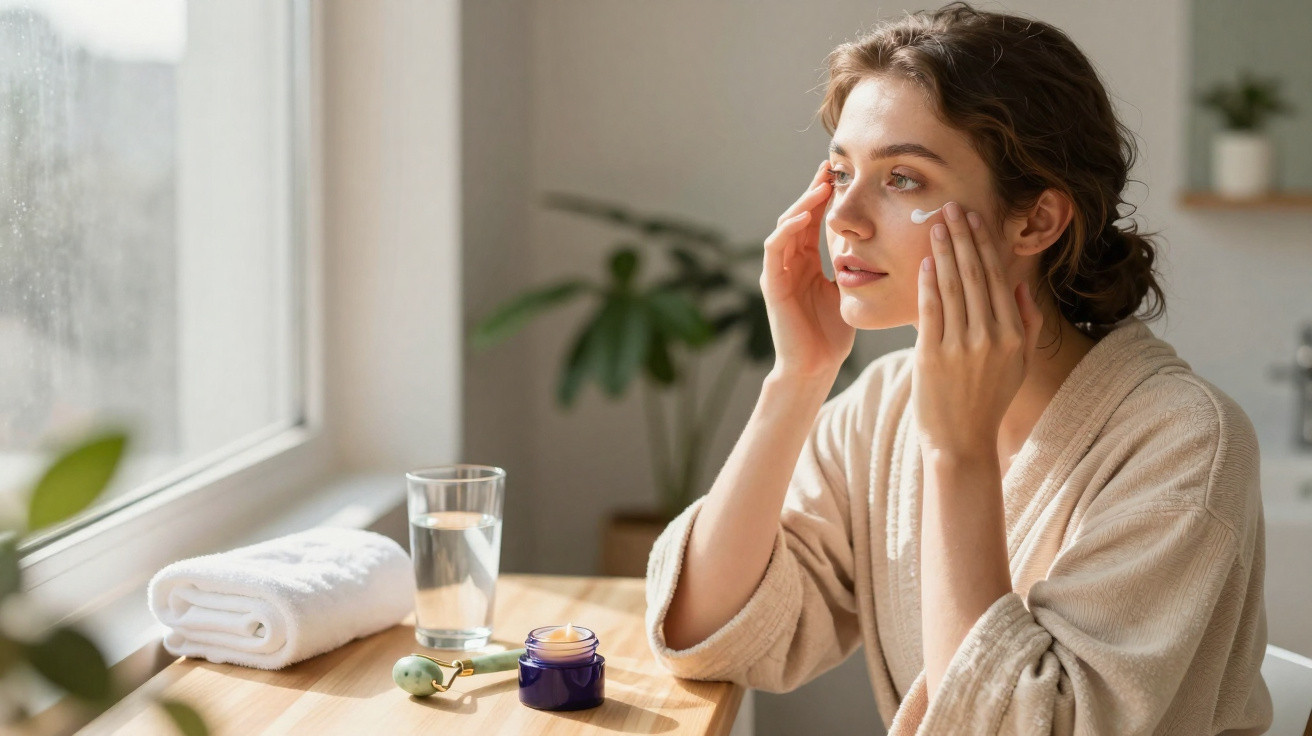
The woman staring back from the mirror looks weary, though not for the reason she thinks.
In the cool light of the bathroom, she pats on another layer of eye cream beneath her eyes. The pot cost a small fortune, its reviews were brilliant, and the influencer’s under-eyes appeared Photoshopped. So she follows the instinct many of us have: “If a pea-sized amount is good, a bit more must be better.”
Ten minutes later, the reflection looking back at her is different. Her fine lines do seem less visible, but the skin also looks slightly… puffy. Her under-eyes are swollen, glossy and almost weighed down. She puts it down to poor sleep, late-night emails or a salty evening meal. The small, indulgent pot beside the sink never enters her mind.
The real explanation is rather more uncomfortable.
Why your “miracle” eye cream can backfire
Eye creams are marketed as miniature magic potions, and the messaging is persuasive.
They claim to wipe away years, soften dark circles and lift skin that life has gradually pulled downwards. The eye area is delicate, the pot is tiny and the price is steep. When a cream feels smooth and luxurious, it is only natural to think that applying more will produce better results. Yet the skin beneath your eyes is less like a sponge and more like tissue paper.
An excess of product does not absorb. It lingers, shifts and builds up. It can hold on to fluid and block the skin, which is when puffiness can begin.
Dermatologists encounter this pattern again and again.
A 32-year-old office worker spends several weeks applying three layers: a serum, a retinol eye cream and then a dense balm “to seal it all in.” She begins waking with swollen under-eyes and assumes she has allergies. A 48-year-old teacher uses twice as much of her anti-ageing cream before an important event, hoping it will create a “tightening” effect. Her concealer settles into creases, her eyes appear tired in photographs and she privately concludes that eye creams simply do not work for her.
Some clinics say that an unexpected proportion of under-eye puffiness is neither genetic nor medical. It is cosmetic. Overly rich formulas, heavy textures and overenthusiastic application can all play a part. There is no spreadsheet that records it, but any skin therapist will tell you that too much product is one of the less obvious causes.
There is a straightforward, if slightly frustrating, reason for this.
The eye contour has very few oil glands and exceptionally thin skin. If you apply cream too generously, it can travel into the lash line, cause irritation or interfere with the delicate skin barrier. Hydrating ingredients may draw water towards the surface and retain it there, leaving the area looking inflated rather than smooth. Rich emollients may also slow natural drainage, allowing fluid to remain beneath the eyes instead of moving away.
The outcome is not a “lifted” appearance. It is the soft, cushiony puffiness that concealer cannot truly disguise. Your skin is reacting, not rejuvenating.
How to use eye cream without waking up puffy
The solution is almost surprisingly small.
Begin with the smallest amount you can reasonably collect: roughly one grain of rice for both eyes, rather than one for each side. Place tiny dots along the orbital bone instead of directly beside the lashes. That bone provides a natural boundary. Use your ring finger, as it usually applies less force, and gently tap rather than pull across the skin. You are not icing a cake. You are barely touching thin skin that takes offence easily.
Allow a full minute for it to absorb before applying make-up or another product. If a glossy, damp layer remains after that time, you have used too much. Remove the surplus with a tissue rather than rubbing it in more firmly.
On evenings when your eyes already feel puffy from screen time or crying, leave out the rich cream.
Choose a lighter gel instead, or use your usual fragrance-free moisturiser in a very small amount. If you regularly wake with swollen eyes, reserve a richer formula for the evening and keep daytime application extremely minimal. Cold tools or a chilled spoon may support drainage, but only when used gently. During a week of poor sleep, your eye cream does not need to work harder. Your habits do.
We all know the morning when we look in the mirror and think, “I swear I went to bed early, what is going on with my face?” That is when it is easy to pile on another layer, test a new “instant de-puff” stick or start mixing products. Let’s be honest: nobody truly does this every day like they do in those ultra-perfect tutorials. Your skin does not need a performance. It needs consistency and relief from overload.
One cosmetic dermatologist states it plainly:
“Most people need less eye cream, not more. They need the right texture, a tiny amount, and patience. Puffiness is often a sign of over-care, not under-care.”
Keep three simple boundaries in mind whenever you reach for that pot:
- Use a grain-of-rice amount for both eyes, never more.
- Apply on the orbital bone, not in the lashes or waterline.
- Switch to lighter textures if you wake up puffy more than two mornings a week.
Those small habits can benefit your under-eyes more than nearly any trend.
Learning to read what your under-eyes are really telling you
Puffy eyes are not only influenced by what you apply to your skin.
They can also hint at salt-heavy meals, late-night scrolling, hormonal changes, allergies and even the way you sleep on your pillow. Using heavy products can intensify all of this, much like adding water to a sponge that is already saturated. On some mornings, the swelling feels soft and fluid and has disappeared by lunchtime. At other times, it persists, feels almost rubbery and will not shift.
That distinction is important. It may be your body attempting to tell you something.
When you spot swelling beneath your eyes, look back over the previous 24 to 48 hours.
Have you tested a new cream? Applied retinol followed by a heavy balm? Eaten a particularly salty meal? Cried? Used waterproof mascara that took vigorous rubbing to remove? There is seldom only one culprit. More often, it is a combination of too much product, too little sleep, insufficient water and a warm room. Halving the amount of eye cream you use for a week is a simple test that may reveal a great deal.
If puffiness is accompanied by pain, redness or changes to your vision, however, it is not a cosmetic matter; it is one for a doctor.
There is a quiet sense of relief in making this part of your routine simpler. You do not need to pursue every new launch or complete ten steps each night. Keep one or two formulas you truly enjoy, understand how your own skin responds and allow this delicate area more room to breathe. When you stop battling your under-eyes and begin paying attention to them, the mirror becomes a little kinder.
| Key point | Detail | Why it matters to the reader |
|---|---|---|
| The amount | One “grain of rice” for both eyes is more than enough | Lowers the risk of puffiness and prevents product waste |
| Where to apply | Apply along the orbital bone, not within the lash line | Helps limit irritation and product migration |
| Texture | Use light gels in the morning and richer creams in the evening if needed | Matches skincare to genuine needs without overloading the skin |

















Comments
No comments yet. Be the first to comment!
Leave a Comment