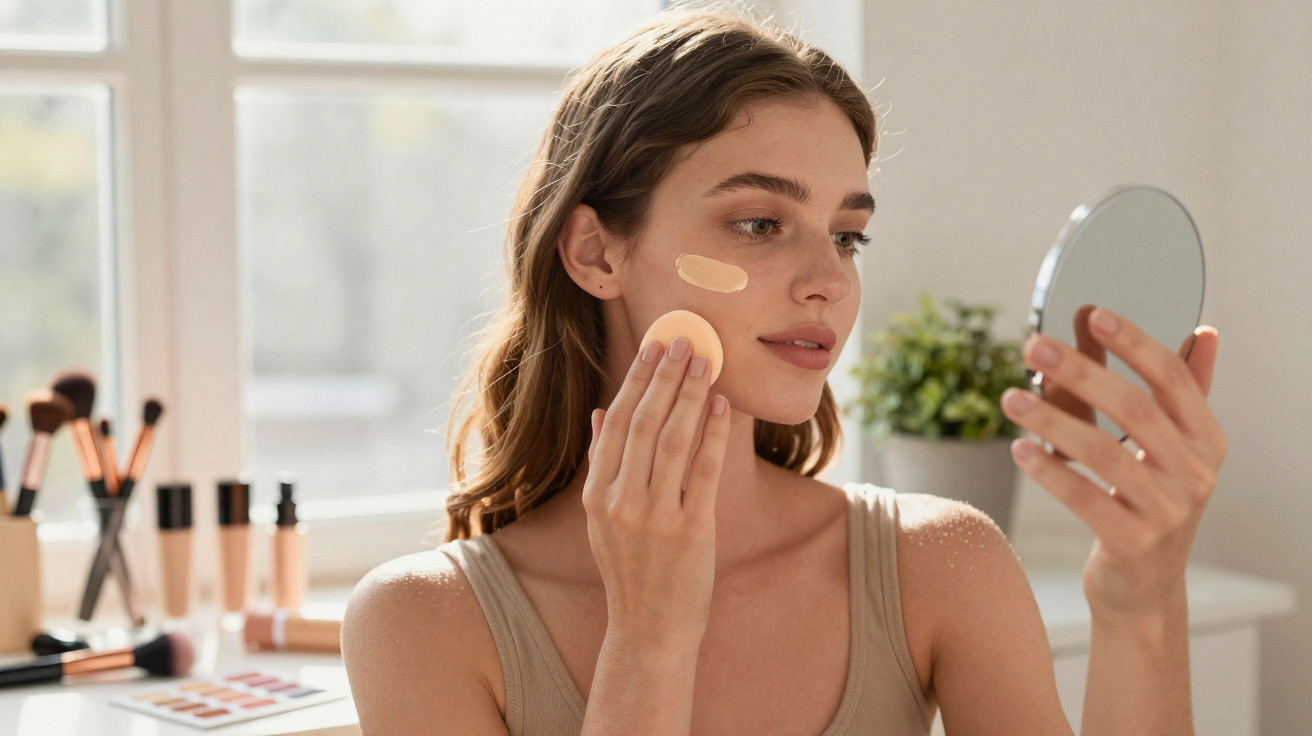
The sales assistant gives you an apologetic smile as she holds up the mirror. Your face is flawlessly made up, but your hand looks as though it belongs to someone else. The Foundation stripe you confidently brushed onto the back of your hand moments ago suddenly appears orange – while on your face it somehow looks… grey. Everything seemed fine under the shop lights, yet daylight exposes the truth within seconds once you step outside. We all know that moment when a shop window makes it crystal clear that we do not recognise ourselves. And it makes you wonder: how can a little colour go so wrong?
Why your hand keeps misleading you
Honestly, your hand is a rather unreliable adviser when it comes to Foundation. The skin there is thicker, often drier, and almost always looks different from the skin on your face. Sun exposure, washing up, hand sanitiser – your hands go through an entirely different daily routine from your cheeks and jaw. It is hardly surprising that a shade can look right on the back of your hand but wrong as soon as it reaches your face. Your hand is really telling you, “This is how the colour looks on stressed skin,” rather than, “This is how you will actually look when you leave the house.”
Even so, testing Foundation on the hand first remains a stubborn habit in the beauty world. It is convenient, easy to reach, and means you do not immediately smear product across your whole face. But convenience comes at a cost. If you only ever swatch on your hand, you risk spending the day with a subtle make-up mishap: either your neck looks lighter than your face, or the Foundation sits over your features like a mask. Neither effect exactly says “natural glow”.
I once spoke to a make-up artist who had worked for a major perfume retailer. She said that around eight out of ten customers wanted to test on their hands – and nearly all of them ended up choosing a shade that was too dark. It is not a disaster, but the difference shows in everyday life. Hands are often redder, more tanned or more uneven. Your brain may overlook those contrasts, but the camera does not. On photos, the wrong undertone is eventually revealed. That moment when you spot yourself in a group picture and your face looks like “Filter Level 1” while everyone else is “Real Life” usually starts right here.
The jaw: where your Foundation should be tested
Your Foundation does not need to match your hand; it needs to suit your face and neck. That is exactly why your jaw matters. The area along the lower jaw works like a small testing lab, because it is where your face meets your neck. If a shade blends into that point without leaving a visible line, that is an excellent sign. You want people to notice you, not your make-up. Your jaw will show you in seconds whether the shade flows naturally into your neck or creates a distinct edge.
Think of the last person you saw and thought, “Wow, the make-up is lovely, but something about the colour is off.” The mistake was probably made here. Perhaps the Foundation was tested too high up on the cheek, or only on the face, with no thought given to the neck. The jaw acts as the bridge between them. Picture an invisible line running from your earlobe to the point of your chin. Apply small Foundation stripes along that line. If one shade almost disappears and is barely visible, you are close to finding your match. The best shade is often the one you can barely see at first glance.
Let us be realistic: no one does this properly every day. Most of us simply reach for the bottle already sitting there in the morning and hope it works. Still, it is worth testing thoroughly once, especially when you are trying a new brand, a different texture, or a summer shade instead of a winter one. The jaw test can mean fewer disappointing purchases in the long run, and it also makes your look appear more expensive without costing you more. A perfectly matched skin tone can make even an affordable high-street Foundation look high-end.
How to test Foundation on your jaw – step by step
The next time you are standing in front of the shelves, select three or four shades that seem as though they could be roughly right. Take the tester straight to your jaw, rather than your hand. Apply a narrow vertical stripe of each shade, starting at the jaw and extending slightly down towards the neck. Do not make a large patch; one stripe is enough. Then take a step back and look in the mirror. The lighting does not have to be perfect, but you should be able to view your whole face. The right Foundation shade will not look whitish, yellowish or reddish. It simply settles in as though it had always belonged there.
If possible, briefly check the shades in daylight – by a shop window or, ideally, outside. Indoor lighting flatters; daylight does not compromise. This is where you discover whether a shade is actually too pink or too orange. Allow the Foundation to sit for a minute or two. Many products oxidise slightly, particularly those with fuller coverage. If it still blends in after settling and your neck does not suddenly appear lighter, you are very close to your ideal shade. You do not need clinical precision; you are looking for a balanced match, not a laboratory result.
A make-up artist friend once put it this way:
“Your Foundation should look like your skin on a very good day, not like a completely new person.”
To achieve that, it helps to follow a few simple guidelines:
- Always test stripes on the jaw, never only on the hand
- Try at least three shades side by side, rather than just one
- Check them in daylight before making your decision
- Wait one to two minutes for the shade to settle
- Pay attention to the undertone: is it neutral, yellow-toned or rosy? That makes all the difference
What your mirror is really trying to tell you
Foundation is more than simply “skin colour”. It is a quiet agreement you make with yourself: you want to recognise yourself in the mirror, only looking a little more rested, smoother and more put together. When the shade is wrong, that effect falls apart. You can quickly feel as though you have been “painted”, as if you are wearing a costume. A well-matched jaw shade does the opposite. Your reflection still feels familiar, just more polished. You need less correcting afterwards: less bronzer, less powder and fewer tricks. It takes some of the pressure out of your morning.
A small reality check may be worthwhile: how many Foundations are in your cupboard that you consider “nearly” right, but never actually wear? Those half-empty bottles are often the result of rushed hand swatches, poor lighting and no jaw testing at all. If you start testing consistently on your jaw instead, the list of bad purchases becomes much shorter. Your money will no longer end up in a drawer; it will actually make it onto your face. And your mirror will stop telling you every morning, “Hmm, something is not quite right today.”
Ultimately, this is not about following a strict beauty rule; it is about feeling more at ease every day. Once you have experienced Foundation that genuinely looks like bare skin, you will not want to lose that feeling. You begin choosing with more nuance: perhaps less coverage, perhaps a different texture. A straightforward jaw test then becomes a small ritual of self-observation. You really look at yourself. And you realise that your hand may be practical, but your jaw tells the truth.
| Key point | Detail | Reader benefit |
|---|---|---|
| Hand vs. face | Hands are more exposed and are often darker or redder than the face | Helps prevent readers from buying shades that are too dark or unsuitable |
| Jaw test | Apply Foundation in a stripe from the jaw towards the neck and assess it in daylight | Creates a seamless transition between the face and neck without a mask effect |
| Ritual rather than chance | Compare several shades, let them settle briefly and observe the undertone | Saves money, reduces poor purchases and results in more natural-looking make-up |

















Comments
No comments yet. Be the first to comment!
Leave a Comment