You can see his shoes braced against the metal plate, the veins standing out in his neck. “Just three more reps,” says the trainer beside him, calmly, almost casually. Pop music plays in the background, the mirrored wall absorbs the noise and dumbbells clink. Next to you, a young woman tightens her running shoes, shakes out her legs as though she has to persuade herself to bend her knees one final time.
We all know that point when your legs are burning and your mind says: enough already. Yet there is also that quiet thought: if they were stronger, I could do so much more. Stairs, running, everyday life. Nothing dramatic, simply a different body. A steadier one. One you can feel a little prouder of.
The encouraging news is that three exercises come up in almost every conversation with sports scientists and physiotherapists about building strong legs. They are also far easier than they may appear.
Three classics that never go out of style
Watch any training floor and you will repeatedly spot the same movements: one person lowering into a squat, another stepping up onto a bench, someone else driving a loaded barbell upwards. It can look unremarkable, even dull. That is precisely where its power lies. Squats, lunges and hip thrusts feature in the programmes of professional athletes just as they do in rehabilitation plans following knee surgery.
You do not need a high-tech gym or fancy equipment. A little room, perhaps a chair and a rucksack filled with books are enough. These three exercises engage almost every muscle fibre in the legs: the front and back of the thighs, the glutes, calves and the stabilising muscles around the knee. Doing them regularly builds not only strength, but confidence in your own body, too.
When I spoke to a sports medicine doctor in Munich, she did not hesitate: “If I were allowed to give someone only three exercises, these would be exactly the ones.” She then told me about a 58-year-old patient who worked in IT, sat for long periods, had weak knees and persistent back pain. He was no fan of gyms and had no interest in complicated programmes. She simply gave him three tasks: chair squats, slow lunges and hip thrusts on the carpet in front of the sofa.
Six weeks later, he returned. He was the same person, but his body language had changed. He stood more firmly, walked faster and climbed the stairs to the practice without becoming breathless. His knees still hurt occasionally - miracles take longer - but he said he was less worried about shopping when he had to carry crates of drinks. Such an ordinary everyday situation, yet also a small personal victory.
Why do specialists place such faith in these particular three movements? Because they make the body work as a whole. Squats develop more than muscle mass: they also improve balance and hip mobility. Lunges act like a small everyday stress test for each leg individually: does the knee stay aligned, does the hip support it, does the foot contribute? Hip thrusts strengthen the often-neglected glutes, which work like a safety belt for the back and knees.
Let us be honest: nobody truly does this every day. However, anyone who manages it two to three times weekly will soon notice that the weekly shop feels easier to carry. That is when it becomes clear why these three exercises appear time and again in so many studies, training plans and conversations with experts.
How to perform the three leg-strength exercises
Start with the squat, the classic. Stand with your feet roughly hip-width apart and your toes turned slightly outwards. Imagine slowly sitting down onto an invisible chair behind you. Keep most of your weight towards your heels, let your knees track in the same direction as your toes, stay tall through the torso and look ahead. Only lower as far as feels stable - at first, that may be halfway down, and that is completely fine.
To begin, 3 sets of 8–10 controlled repetitions are sufficient. As you become more confident, stretch your arms out in front of you or hold a rucksack containing a few books against your chest. With every repetition, your body learns: “I can control my own weight.” It may sound unspectacular, but it gradually produces stronger thighs and a more stable posture.
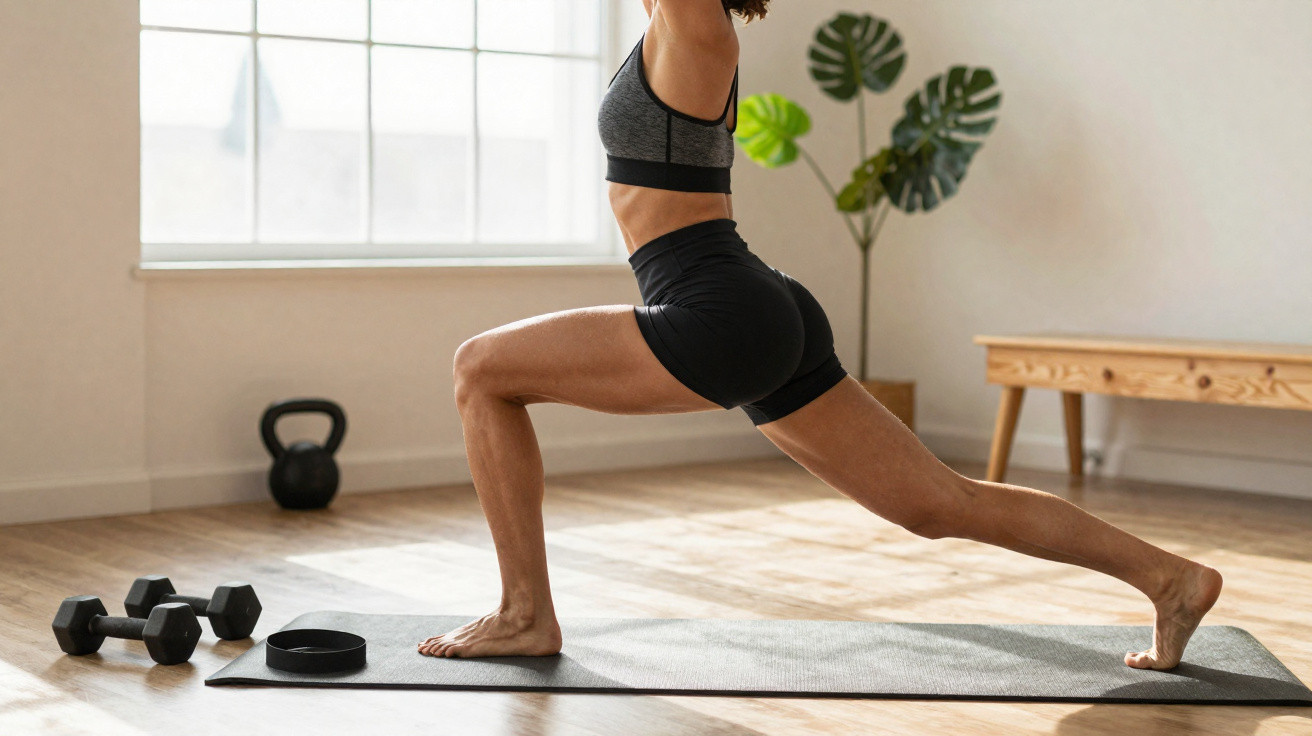
Exercise two is the lunge. Picture a narrow corridor and take one large step forwards into it. Plant the front foot firmly, while the toes of the back foot remain in contact with the floor. Now lower yourself until the rear knee nearly touches the ground. Keep the front knee above the foot rather than allowing it to collapse inwards. Then press yourself back up and switch legs.
Many people start too quickly, too unsteadily and with far too much ambition. The result is frustration, wobbly ankles and disapproving looks in the mirror. A better approach is to hold onto the kitchen worktop or the back of a chair at first, move slowly and begin with just 6–8 controlled repetitions on each side. Anyone who takes lunges seriously soon notices how uneven the body can be - one leg is stable while the other seems to be on holiday. That is exactly where genuine muscle work begins.
The third exercise looks harmless at first, but it can be a real game-changer: hip thrusts. Lie on your back with your feet planted hip-width apart and your arms relaxed by your sides. Tighten your abdomen and glutes, then lift your hips until your thighs and upper body form roughly one line. Pause briefly at the top, consciously squeeze the glutes, then lower yourself slowly without letting your lower back arch excessively.
A sports physiotherapist put it this way:
“Strong glutes are like a quiet bodyguard for your knees and lower back. You cannot see it, but it silently does the most important work.”
You can begin hip thrusts with 3 sets of 10–12 repetitions. Later, you can place a weight on your hips - for instance, that familiar rucksack full of books. During training, it is especially useful to keep a few key points in mind:
- Move slowly rather than rocking hurriedly up and down.
- At the top, deliberately squeeze your glutes.
- Do not drive into your lower back; generate power from your legs and glutes.
- Allow yourself breaks at the beginning when the muscles start to burn.
What strong legs genuinely change in daily life
Train for long enough and you will find that legs do not become stronger only in the mirror. They alter the way you move through the day. Suddenly, sprinting for the train feels less dramatic. Going up to the third floor without a lift is no longer a small project, but routine. People who build their leg muscles often describe an unusual side effect: greater trust in their body, and in their own resolve.
This is not about flawless gym selfies or records. It is about that moment after a few weeks when you carry a heavy bag and suddenly think: “I would have needed a break for that in the past.” That is the quiet reward offered by these three foundational exercises. They are simple, relentlessly honest and take you a little beyond your old limit every time.
Perhaps that is the real appeal of these movements: they can fit into almost any life. Three sets of squats after brushing your teeth. A few lunges while the coffee brews. Hip thrusts in front of the sofa in the evening while a podcast is playing. No elaborate ritual and no perfect plan. Just you, your body and three exercises working quietly but consistently to build a stronger foundation.
| Key point | Detail | Benefit for the reader |
|---|---|---|
| Squats | A full-body leg exercise that works the thighs, glutes and core stability | Greater strength for stairs, everyday walking and a more upright posture |
| Lunges | Each leg works separately, challenging balance and knee stability | Helps correct muscle imbalances, with less wobbling and uncertainty while walking |
| Hip thrusts | Targeted training for the glutes and hamstrings | Better protection for the knees and lower back, plus more explosive power in daily life and sport |













Comments
No comments yet. Be the first to comment!
Leave a Comment