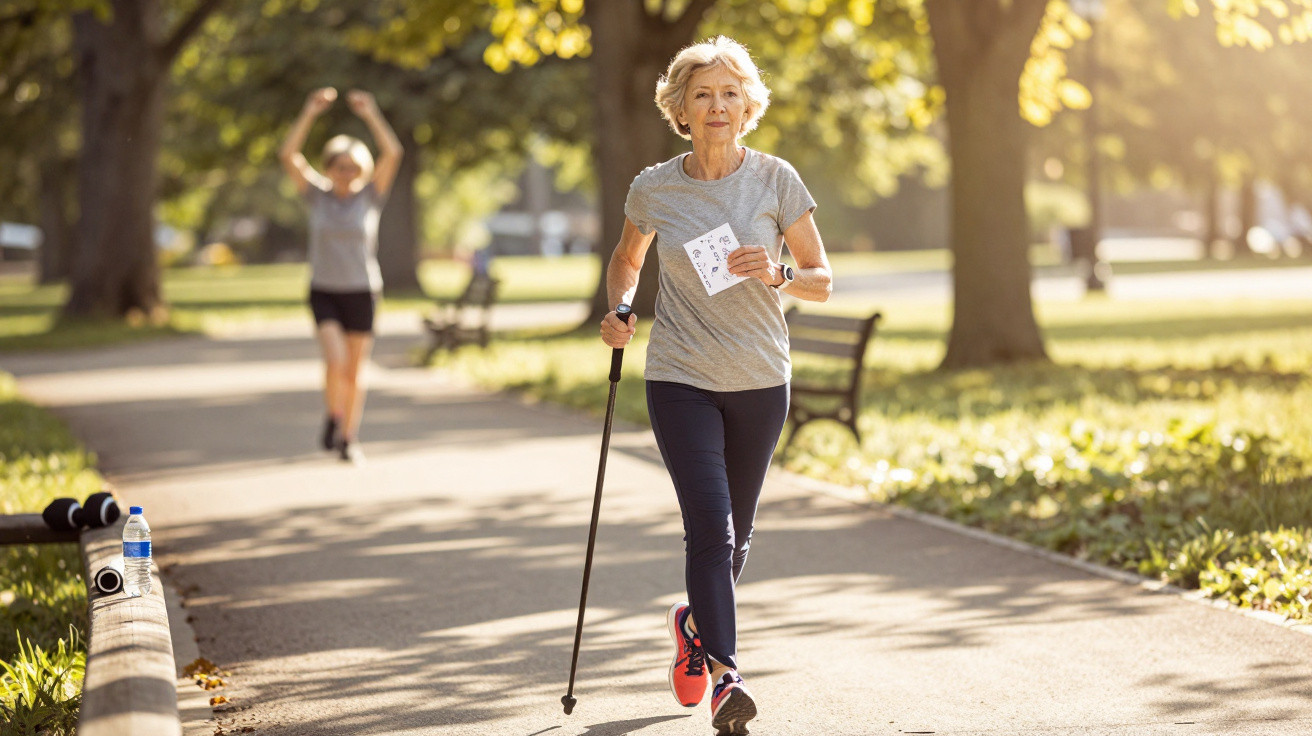
At 7.58 am, her friend is standing beside her: two years older, no walking frame, and wearing bright-red trainers. “Come on,” she says, “our 15 minutes will not wait.” They set off, tentatively at first, then with a remarkably determined rhythm. It is clear that this is not a leisurely stroll; it is a plan. A ritual. As they complete their circuit, they talk about things they might almost have forgotten last week if they had not walked together every morning. One is less frightened of tripping, while the other feels more mentally alert. Something is happening, very quietly.
Why brisk walking after 70 is a small medical miracle
When you deliberately watch people aged over 70, you will generally notice two groups. Some walk cautiously, taking short steps and looking at the ground. Others move at a good pace, swinging their arms, holding their heads high, as though an invisible beat were playing in their ears. Often, just 15 minutes a day separates these two ways of walking. Sports medicine specialists now discuss precisely this short, brisk walk with almost missionary enthusiasm. They regard it as far more than “a bit of exercise”. In their view, it is training for balance, responsiveness and brain performance, wrapped up in a walk that can be done almost anywhere.
A similar finding appears repeatedly in many studies: older adults who walk briskly for at least 15 minutes each day achieve significantly better scores in memory tests. One frequently cited study from Taiwan found that people over 70 who walked briskly for at least a quarter of an hour daily reduced their risk of early cognitive decline by around a third. No complicated equipment, no gym – simply lace up your shoes and go. Rehabilitation clinics see examples of this every day: the patient who initially shuffles unsteadily along the corridor is, a few weeks later, completing her 15 minutes in the courtyard, with a more upright gaze and a steadier step.
Sports medicine specialists explain the effect in fairly straightforward terms. Brisk walking requires joints, muscles, nerves and the inner ear to coordinate with one another in milliseconds. Balance is constantly being adjusted, even though we do not consciously notice it. This ongoing coordination strengthens the small, deep muscles that help prevent falls. At the same time, the pulse rises slightly, the heart sends more blood to the brain, and oxygen and nutrients circulate more effectively. The brain responds by creating new connections between nerve cells. Put simply, 15 minutes of brisk walking is like a daily update for the body and brain’s software – with no download and no subscription.
How to make these 15 minutes genuinely benefit balance and memory
For people over 70, sports medicine specialists suggest an uncomplicated beginning: walk normally for five minutes, briskly for ten minutes, then spend one minute winding down. Brisk means that you can still talk, but your sentences become a little shorter and your breathing is more active. A safe route is best: a circuit in the park, wide pavements or, if necessary, a long corridor in your building. Anyone struggling with balance can begin with one hand on the wall of the house, then later use a walking stick, and eventually walk freely. Two or three times a week, add small variations: walk along a line for a few seconds, weave gently around kerbs, or deliberately raise your gaze from the ground. In this way, the walk gradually becomes mobile training for the vestibular system – the balance centre in the inner ear.
Many older people stop because they expect too much of themselves all at once. Others feel embarrassed about starting slowly. Let us be honest: hardly anyone manages it every day, in rain, heat and family chaos. Even so, a week in which it happens four times matters more than one perfect January followed by eleven inactive months. Sports medicine specialists warn against the common mistake of trying to begin with 30 minutes at full speed. That usually results only in sore knees and frustration. A better approach is to divide the 15 minutes into three five-minute sections, with a rest on a park bench. It is also perfectly fine to walk with a shopping trolley, or initially take the lift to the second floor rather than the stairs. The body has no pride; it only responds to stimuli that increase gradually.
An experienced sports medicine specialist from Munich puts it this way:
“For people over 70, brisk walking combines strength training and brain training. Anyone who walks every day exercises their sense of balance and mental alertness without being tied to equipment.”
Many of his colleagues recommend deliberately adding small memory tasks while walking. It may sound simple, but it does a great deal for the mind. For example:
- Recite the days of the week backwards aloud as you walk.
- Recall five things you ate yesterday.
- At every street corner, bring to mind someone from your past.
- On a straight stretch, take ten steps while placing one foot slightly farther forward each time.
- Increase your pace for 20 steps, then return to normal – like a small wave in your rhythm.
What these 15 minutes can do for self-image, confidence and how we see ageing
Anyone who regularly sees older people walking briskly soon realises that this is no longer only about medicine. It is about dignity. It is about still feeling able to decide how quickly or slowly your own day unfolds. Many people say that after a few weeks they are not only steadier on their feet, but also find names, appointments and telephone numbers more readily available in their minds. Not because they are becoming younger, but because once a day they bring their body into a state in which the brain can organise things more effectively. For some, this walk is the first moment in a long time when they feel a sense of inner pride again.
There is another interesting side effect: people who walk briskly for 15 minutes a day often change their surroundings too. Suddenly, the neighbour wants to “just come along for a bit”. Grandchildren notice that Grandma is not “completely fragile”, but can maintain a pace worth noticing. In residential settings, small walking groups form, reminding and motivating one another. People over 70 suddenly take on a role again: not as a “potential care case”, but as someone actively working on themselves. Sports medicine specialists say that this social element further reinforces the positive effect on memory, because the brain thrives on social stimulation.
Perhaps these 15 minutes also represent a quiet rebellion against an image of ageing made up solely of limitations. By choosing to walk briskly, you are effectively saying: “I am taking back my range.” There are no enormous goals and no marathon at 75. There is simply a fixed, manageable framework, kept to day after day – as well as that particular day allows. Some people will become faster; others will simply become more secure. Both are gains. And perhaps it is exactly these short, unremarkable circuits that we will later remember by saying: there, between the bench and the corner, I regained a little balance and clarity.
| Key point | Detail | Benefit for the reader |
|---|---|---|
| Brisk walking as brain training | A slight rise in pulse improves circulation and encourages new nerve connections | Understands why 15 minutes of pace each day can benefit memory |
| Balance through micro-adjustments | Every step challenges the coordination of muscles, joints and the inner ear | Recognises how a simple routine can reduce the risk of falls |
| Everyday implementation | Begin with short, safe circuits, using an aid or companion where needed | Feels encouraged to start straight away with a realistic, achievable strategy |

















Comments
No comments yet. Be the first to comment!
Leave a Comment