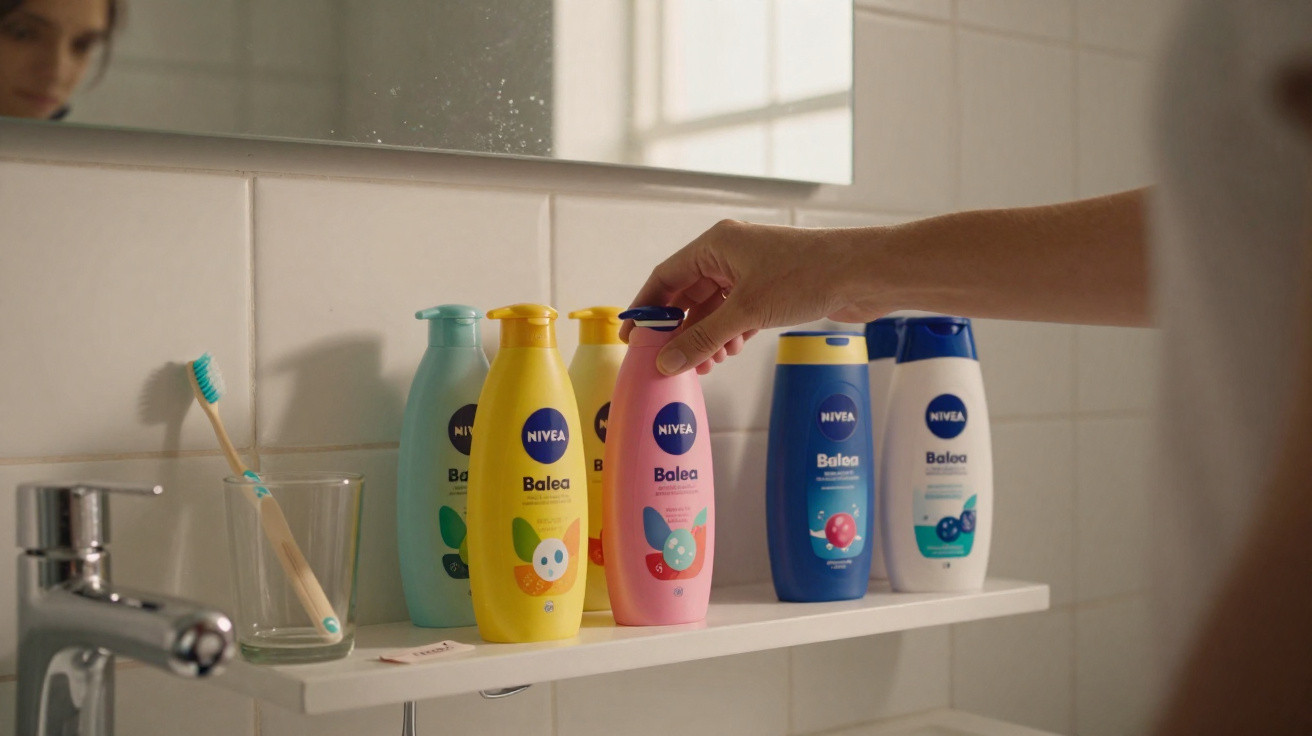
For years, many people regarded Nivea as the obvious choice: familiar fragrance, blue-and-white tin, job done. Now the balance of power in the bathroom cabinet is shifting. Balea, dm’s own-brand range, has caught up with Nivea on customer satisfaction - and has even moved ahead. There is more behind this change than price alone.
Balea overtakes Nivea on satisfaction
The latest YouGov BrandIndex analysis delivers a clear message: customers are currently more satisfied with Balea than with Nivea. This is notable because Nivea was long considered the undisputed benchmark in skincare.
Balea achieves a net satisfaction score of 65,3 points, while Nivea trails on 61,8 points.
The picture was different as recently as 2021, when Nivea was ahead. Within only a few years, the positions have reversed. What was once seen as a “cheap alternative” is now evidently viewed as a favourite brand in its own right. Many shoppers no longer choose Balea merely because it costs less, but because they genuinely like the brand.
Why losing first place hurts Nivea
Few brands in Germany represent trust, everyday practicality and instant recognition as strongly as Nivea. That is precisely why losing top spot for satisfaction strikes a sensitive point. A brand that has been seen as a safe choice for well-cared-for skin for decades does not want to find itself in second place overnight.
The significant detail is that Nivea still performs better than Balea for perceived quality. Nivea records 55,0 points in this category, compared with 42,5 points for Balea. From customers’ perspective, Nivea products therefore appear more premium. Even so, that advantage is no longer enough to secure the lead in satisfaction.
High quality on its own is no longer enough - the brand also has to “feel right” to customers.
This is exactly where Nivea is feeling pressure from below. More affordable brands are catching up emotionally without becoming firmly associated with the bargain shelf.
Value for money: Balea’s major everyday advantage
A key reason for Balea’s rise is value for money. It is not simply about a low price, but about the feeling that: “I get a great deal for my money here.”
According to the BrandIndex, Balea has made clear gains in this area. The brand reaches 42,7 points, while Nivea manages only 31,1 points. This suggests that many people see Balea as fairly priced - not as low-grade, but as an honest offer.
- Low prices, without being “cheap” in a negative sense
- A broad range spanning shower gel to anti-ageing cream
- Regular range updates featuring trends, fragrances and limited editions
- Clear shelf positioning: highly visible and easy to find
For households that watch their budgets closely, this combination is crucial. Rising living costs make value for money even more important. Anyone calculating every shop is more likely to choose the brand that feels “fair” - particularly when there seems to be little noticeable day-to-day difference from a long-established premium brand.
Awareness: Nivea remains the giant in the background
Despite the setback in satisfaction, Nivea is far from being a troubled brand. It is, and remains, a giant in the skincare market. According to the BrandIndex, 92,1 per cent of respondents know Nivea. Balea is clearly behind, at 76,9 per cent.
Nivea remains the familiar constant - Balea is the dynamic challenger.
It becomes particularly interesting when looking at purchase intent among people who know the brand. Balea reaches 23,3 per cent here, compared with 21 per cent for Nivea. Although Nivea is far better known, Balea performs marginally better when people are asked, “Would you buy it?” This demonstrates how firmly the retail brand has now established itself among its own fans.
How own brands become genuine competitors
In the past, chemist and supermarket brands primarily served one purpose: offering a cheap no-name product alongside the “proper” branded item. Those days are long gone. Retail chains now invest heavily in design, formulations, social media and the breadth of their ranges. dm in particular has developed its own brands into clearly recognisable brand worlds.
Balea benefits from this approach. The brand comes across as modern, colourful and accessible. Its packaging no longer resembles discount-store goods, but rather lifestyle products. For younger audiences, it matters less whether a brand has existed for 100 years; what matters more is whether it makes them want to “try it out” when they see it on the shelf.
What the BrandIndex figures actually measure
The YouGov BrandIndex is based on ongoing online surveys. Every day, people state how they perceive particular brands. The data feeds into a range of measures, including:
- General impression: does the brand seem likeable or unlikeable?
- Quality: how premium do respondents consider the products to be?
- Customer satisfaction: how satisfied are users in everyday life?
- Recommendation: would they mention the brand to friends?
- Value for money: is the relationship between price and practical benefit right?
- Employer image: how attractive does the manufacturer appear as an employer?
YouGov evaluates vast volumes of data for individual rankings. More than 900,000 online interviews were included in the 2026 value-for-money comparison. The figures therefore do not reflect a brief reaction following an online backlash, but a longer-term trend in perception.
Importantly, the scores do not indicate which cream performs better in a laboratory or which ingredients are objectively superior. They show how people rate the brands in everyday life. In the Balea versus Nivea contest, the issue is therefore mainly about feeling, routine and trust - rather than a scientific product test.
Nivea remains strong - but is losing momentum
Despite all the headlines, Nivea is not falling out of contention. In Handelsblatt, the brand ranks only just behind Florena for popularity value, with 89,1 points. This shows how robust its foundation remains. Nivea is not weakening dramatically; it is simply growing more slowly than competitors that are cheaper or present themselves in a fresher way.
Both brands are still found in many households: familiar Nivea cream beside an affordable Balea shower gel or shampoo. This kind of mixed purchasing shapes customers’ everyday routines - and makes it harder for heritage brands to defend the absolute top position.
What consumers can take from the ranking
For consumers, these figures provide an interesting point of reference. They show how other customers rate brands in everyday use, especially in terms of value for money and satisfaction.
| Brand | Customer satisfaction (score) | Value for money (score) | Perceived quality (score) |
|---|---|---|---|
| Balea | 65,3 | 42,7 | 42,5 |
| Nivea | 61,8 | 31,1 | 55,0 |
Anyone looking to save money will find a product in Balea that many buyers consider very fairly priced. Those who place particular importance on quality and tradition are more likely to stick with Nivea. In practice, many people try both and switch depending on the product category: Balea for shower gel and body lotion, for example, and Nivea for sun cream or facial skincare.
Brand loyalty in transition: what lies behind the trend
The change in satisfaction rankings points to a broader retail trend. People are less loyal to brands than they once were. They test new products, take inspiration from social media and pay closer attention to the till receipt. Own brands score points through fast product cycles, trends and eye-catching packaging. Heritage brands tend to rely more on trust and a consistent brand experience.
Especially during economically difficult periods, the question, “Am I getting enough in return for my money?” becomes much more important. Brands that credibly deliver on that promise rise in rankings such as the BrandIndex. Those that rest on their name lose momentum - even if product quality remains high.
For customers, this development is initially positive. More competition usually means more choice, more innovation and greater pressure on prices. The downside is that shelves become harder to navigate, while marketing claims are difficult to compare. Independent tests, a close look at ingredients and one’s own skin response can help here.
One point often gets overlooked in the debate: satisfaction depends not only on the product itself, but also on the shopping experience. Friendly staff, clearly arranged shelves and good availability - all of these factors influence perceptions of the brand displayed on a chemist’s shelf. Own brands such as Balea benefit directly from the positive image of the chain in which they are sold.
Ultimately, the daily bathroom routine decides the outcome: which cream feels good, which fragrance becomes irritating over time, and which product can be repurchased without difficulty? These many small everyday choices are what create a ranking in which a once “small” chemist brand suddenly comes ahead of a classic that has been established for decades.









Comments
No comments yet. Be the first to comment!
Leave a Comment