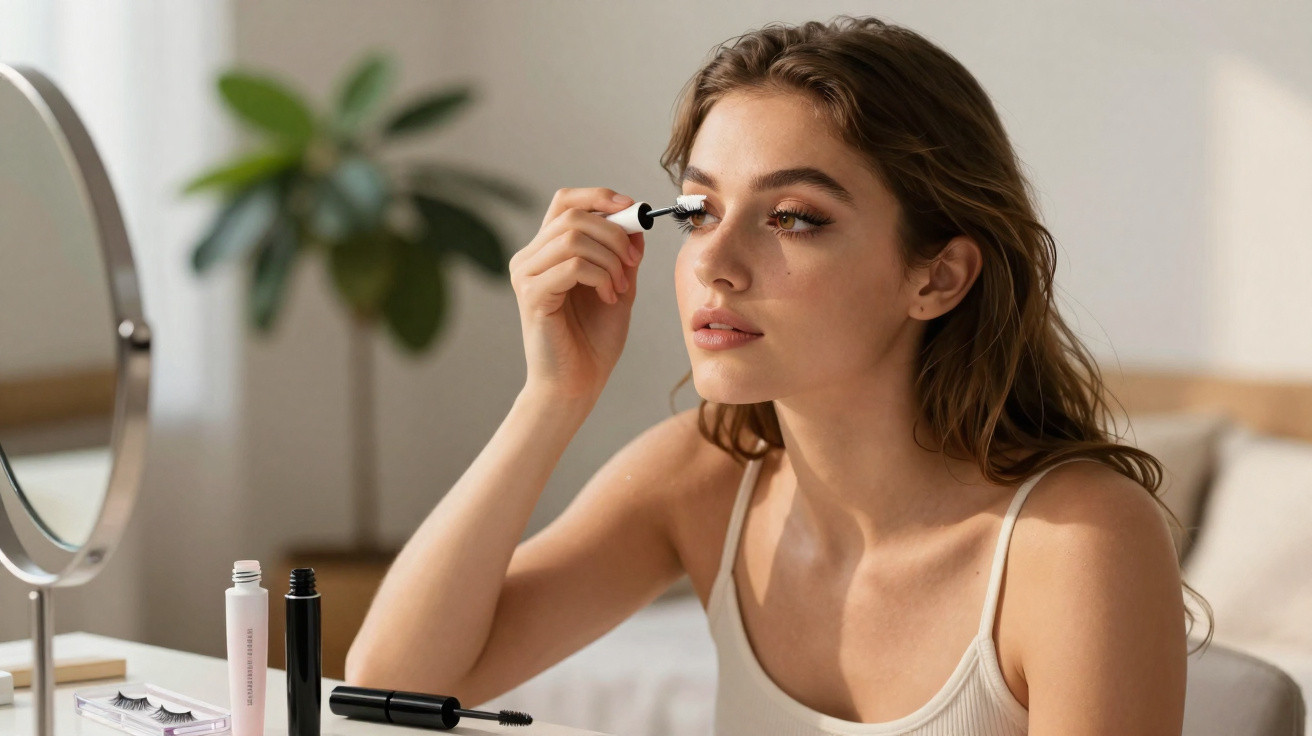
Rather than painstakingly sticking on individual lash clusters or repeatedly buying new false lashes, beauty fans are increasingly turning to a product that received little attention for years: a dedicated mascara base. One primer in particular is currently attracting attention because it boosts natural lashes so effectively that, for many, artificial lash clusters simply become unnecessary.
What a lash base actually does
A mascara base may initially sound like an extra step that merely takes up time. In reality, it acts as an invisible framework for the lashes. Its creamy, pale formula coats every individual hair, making it look thicker and extending it slightly.
“The idea is to build up the lashes first, then apply colour over them – instead of brushing mascara back and forth ten times.”
The currently hyped Eveline Cosmetics Variete Lashes Show Lash Primer works on exactly this basis. Applied before mascara, it is designed to deliver several benefits at once:
- visibly add density to the lashes
- make lashes appear longer
- separate individual hairs more effectively
- make black mascara look more intense
Its pale, slightly creamy texture offers one straightforward advantage: it is immediately clear whether every lash has been coated. Gaps and clumped areas are easy to spot and can be corrected before mascara is applied on top.
Why lash primers are trending again
Lash bases are not a new invention. Similar products were available years ago, but many ended up forgotten in drawers because they looked clumpy or made application more difficult. They are now making a return, with significantly improved formulas.
There are several reasons behind the current trend:
- Fewer coats, greater impact: Rather than applying three or four layers of mascara, one coat is often enough because the base does the underlying work.
- A more natural feel: Anyone who finds heavy false lashes or thick lash bands uncomfortable can achieve volume with a good base without the feeling of wearing something foreign.
- More economical: Instead of using mascara excessively, it is applied precisely. The tube lasts longer and the finished look appears more polished.
Particularly interesting is the fine coating created by the primer, which makes the lashes appear fanned out. They are lifted slightly, look denser at the roots and more defined at the tips at the same time. The mascara that follows only needs to provide colour and a little shape – most of the “construction work” has already been done.
How the Eveline Cosmetics Variete Lashes Show Lash Primer changes the eyes after the first stroke
The difference becomes apparent quickly during application. The Eveline primer has a pale tint, so it is easy to see exactly how the formula wraps around the lashes. After just one sweep of the brush, the hairs already look slightly fuller and more clearly separated.
Many users report that their lashes look as though they already have two coats of mascara on them after using primer – even though no colour has been applied yet. The real wow moment comes in the second stage, when black mascara is added:
- The black colour appears noticeably deeper and richer.
- The lash line looks fuller without becoming thick or paste-like.
- Fine lashes at the inner corner of the eye, which would otherwise “disappear”, become visible.
“The effect is reminiscent of several coats of mascara plus a lash comb – only with two simple steps.”
Mascara sits on the already-built base rather than clinging directly to fine natural lashes. This creates a dense fan that comes much closer to the look of false lashes, without the need to glue anything on or painstakingly remove it in the evening.
Who can really benefit from a lash base
The most noticeable change tends to appear on naturally understated lashes. Anyone with very light, fine, straight or sparse lashes will usually get far more from a primer than from yet another “even more volumising” mascara.
The following groups benefit particularly strongly:
- people with very fine lashes that quickly droop under ordinary mascara
- straight lashes that struggle to hold a curl
- lashes with small gaps along the lash line
- make-up fans who consider artificial lash clusters too time-consuming or uncomfortable
Those blessed with naturally very thick lashes will still notice a difference, but usually see it more as an added extra – a “nice-to-have” rather than a game-changer. On fine lashes, however, a primer can make the difference between “quite nice” and “Wow, where did you get those lashes?”
Can a primer really replace false lashes?
For dramatic evening looks, bridal make-up or extreme Instagram looks, false lashes often remain hard to beat. Everyday situations are different. A well-performing base can create an effect that comes close to artificial lash clusters – particularly when mascara is applied deliberately and the lashes are gently lifted while still damp.
“For a day at the office or a café date, the effect of many primers is easily enough to skip glued-on lashes.”
A simple test makes the impact especially clear: use mascara alone on one eye, then apply primer followed by the same mascara on the other. Even from half a metre away, it is obvious which eye looks denser and more “awake”. This is exactly the kind of DIY comparison many users use and share on social media.
How to apply a lash base correctly
The technique is straightforward, although a few details can enhance the result:
- Step 1: Curl the lashes as usual with lash curlers, if you use them.
- Step 2: Apply primer from root to tip, moving the wand lightly in a zigzag motion to coat every hair.
- Step 3: Let it dry briefly, but not completely – the mascara should still be able to bond with the base.
- Step 4: Apply one coat of mascara. If needed, add a targeted second coat to the outer lashes instead of overloading the entire lash line.
If clumps are a recurring issue, keep a clean lash comb nearby and comb through the lashes immediately after applying mascara. In most cases, this is enough to create a neat, fanned-out finish even on very fine lashes.
What terms such as “primer” and “base” mean
The English term “primer” has long been established in the beauty world. Essentially, it always refers to the same thing: a product that creates a kind of foundation. On the complexion, it smooths pores; beneath eyeshadow, it prevents slipping and fading; and on lashes, it gives mascara more to grip onto.
Ingredients in these lash bases are usually light wax or polymer blends, sometimes combined with conditioning ingredients such as panthenol or small amounts of nourishing oils. They are intended to coat the hairs without making them stiff or causing them to stick together. This balance is precisely what determines whether a primer works for everyday wear or is only suitable for photographs.
Risks, care and useful combinations
One question comes up repeatedly: can this additional step damage the lashes? The key is removal. Anyone who takes everything off thoroughly but gently in the evening – ideally with an oil-based remover or balm – can remove primer and mascara without residue. If the product remains on the lashes for days, they may appear brittle and break more easily.
Especially if you wear primer and mascara every day, a nourishing overnight product is worthwhile. This could be a dedicated lash serum or a simple conditioning oil applied sparingly at the roots. That way, the volume trend is not merely a visual trick, but can also support healthy lashes over time.
The combination with other beauty hacks is also interesting: anyone who likes “no make-up” looks can emphasise only the upper lashes with primer and a light mascara, while skipping bold eyeshadow altogether. The eyes look clearer, the effort remains minimal, and adhesive residue from false lashes disappears from the morning routine for good.










Comments
No comments yet. Be the first to comment!
Leave a Comment