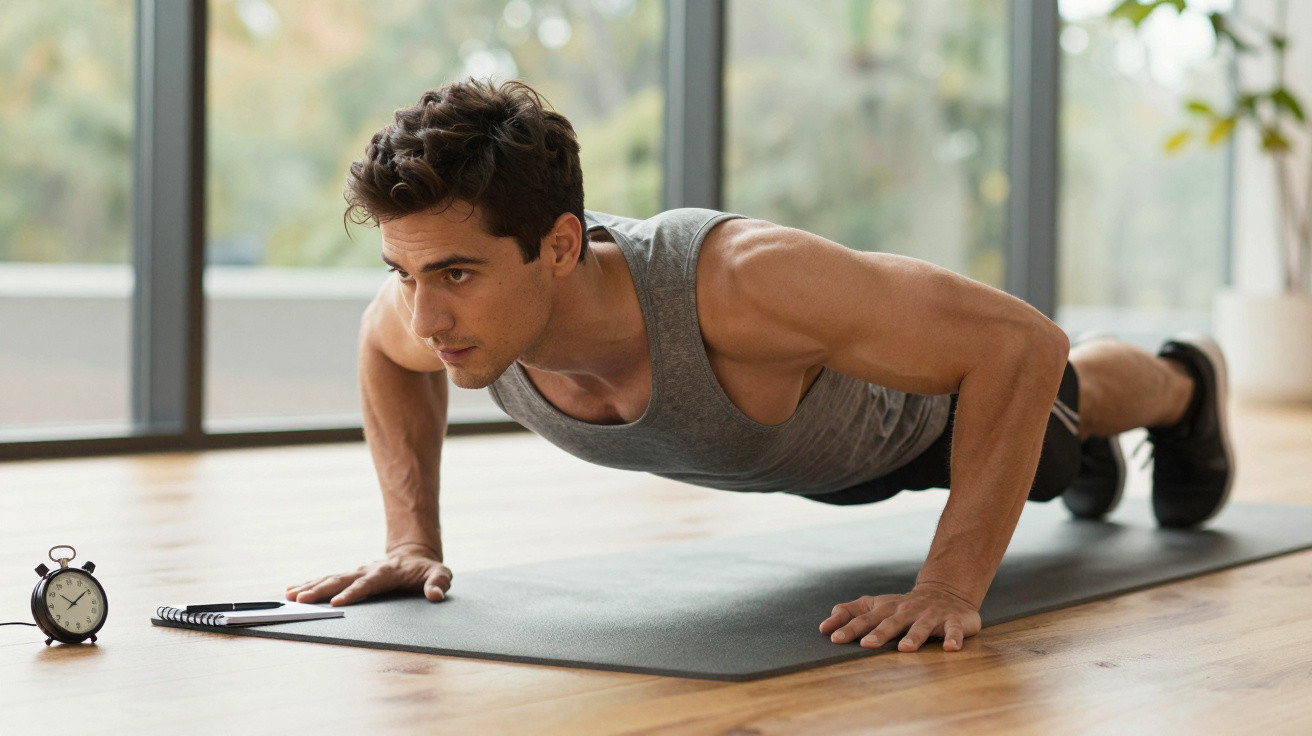
Someone beside you nearly slams their chest into the floor, elbows flared wide, face red as a traffic light. The trainer walks past, stops next to you, lightly taps your upper arm and says just one thing: “Keep your elbows closer in.”
You bring your elbows in towards your torso, just beside your ribs. Same exercise, same rep, entirely different sensation. Suddenly, a muscle on the back of your arm that you thought had been dormant for ages makes itself known: the triceps. A light sheen of sweat forms on your forehead, and you realise you have altered something small that could have major consequences.
Why a small elbow angle changes everything
Anyone who watches people train soon notices that few exercises look so simple yet are performed in such different ways as the press-up. In many gyms, you will see a kind of half-bench-press performance on the floor: elbows pushed far out, hands set much too wide and a back hanging like a suspension bridge. The aim is simply to “get back up” rather than pay attention to what is actually happening in the muscles.
Move your elbows closer to your body and that rough full-body movement suddenly becomes a precise motion that targets the triceps. The altered angle changes the leverage, shifting the load noticeably away from the chest and towards the rear of the upper arm. All at once, the rep is not merely “hard”; it becomes measurably worthwhile. You can feel that you are no longer simply pushing yourself away from the floor, but working with purpose.
The contrast is hard to miss once you have felt it. In the “classic” version, with the elbows sitting at 45–60° from the body line, the chest does much of the work and the shoulder rotates strongly forwards. At a narrow angle of around 15–30°, the load changes. The triceps performs almost all of the elbow extension and has to stabilise the entire line from wrist to shoulder. Initially, this can feel unfamiliar and sometimes even “weak” – but that is precisely what reveals your actual strength.
Turn your press-up into a triceps machine
Picture a neutral plank position: hands beneath your shoulders, body held straight like a board and eyes looking slightly forwards. Now comes the crucial element: as you lower yourself, keep your elbows close to your sides, as though you were trying to brush your ribs gently with them. Do not let them drift outwards or swing; follow one direct path down and back up.
Your hands should sit only slightly narrower than shoulder width. This is not an extremely narrow diamond position, but a placement that still allows your forearms to remain vertical to the floor. Breathe in as you descend and exhale powerfully as you press back up. Every centimetre for which you maintain a small elbow angle increases the precision of the work in your triceps. You may manage fewer repetitions, but the training effect does not decrease.
Many people struggle with this version not because they lack strength, but because their pride is bruised. We all know the moment when 20 untidy reps become six clean ones and you suddenly feel weaker. Let us be honest: hardly anyone actually does that every day. Instead, they “adjust” their technique – elbows out, body only halfway up, as long as the number looks right. The cost is lost stimulus for the triceps, often alongside a faint pull in the shoulder that becomes harder to ignore once you reach your mid-thirties.
“When I started working with close elbows, I halved my maximum number of press-ups – but my triceps changed more visibly within a few weeks than they had in the years before.”
- Keep the elbow angle small – around 15–30° from the body line
- Position your hands slightly narrower than shoulder width
- Prioritise a clean body line over the number of repetitions
What the narrow angle really demands from your triceps
When you use a narrow elbow angle, the triceps becomes a quiet hero that does more than extend the arm: it also stabilises. Every repetition requires it to guide your entire body weight through the elbow joint without letting the position give way. It is exactly this combination of pressure and control that makes it work so intensely. The muscle fibres are loaded in a way that is difficult to replicate on machines.
After their first few sessions, many people describe the same thing: a dull, deep burn on the back of the arm that usually becomes fully noticeable only hours later. It is not the superficial “pump” sensation, but a kind of muscle soreness that makes it clear that only a fraction of the potential had previously been used. Those who train this way regularly soon notice changes in everyday tasks: carrying shopping, supporting their body weight and pulling themselves up all become steadier, more controlled and less “wobbly”.
One sober statement stays with you: the small angle is not a trick; it is physics. You move the force vector closer to the joint where the movement finishes – your elbow. Your chest remains active, undoubtedly, but it no longer dominates. That shift creates the intensely noticeable work in the triceps, without needing more weight or unusual equipment. Just the floor, your own gravity and a few degrees of difference in arm position. So simple, so ruthlessly honest.
Train with a small elbow angle without wrecking your joints
There is no need for a heroic start. Anyone who begins straight away with close-elbow floor press-ups often ends up, after only a few attempts, with a mixture of frustration and elbow niggles. A smarter approach uses gradual variations: place your hands on a bench, a sturdy table or even a wall. This lowers the effective body weight and lets you focus on controlling the elbow path cleanly.
Begin with 3–4 sets of 6–10 repetitions, where the final repetition is difficult but not completely devastating. If your triceps burn in a controlled way without your lower back sagging or your elbows suddenly collapsing, you are on the right track. Raise the intensity only once you can complete 10–12 genuinely clean reps. Progress does not come through ego; it comes through control.
The most common mistake is the instinct to let the body escape the position. As strength fades, the elbows automatically begin drifting outwards, the angle opens up, the chest takes over and the effect disappears. Imagine that your upper arms are secured in invisible rails alongside your torso. Any movement away from that line is a warning sign. Another overlooked area is the wrists. Give yourself permission to use press-up handles, dumbbells or your fists if pressure through your palms feels uncomfortable.
“The body does not lie. If your triceps are screaming and your rep count drops, you have probably trained with real focus for the first time in a long while.”
- Leave your ego at the gym door and start from an elevated position
- Quality before quantity – six perfect repetitions are better than 20 crooked ones
- Build in deliberate rest periods so that tendons and joints can adapt
What this small angle does to your training self-image
There is a quiet moment after a set of close-elbow press-ups, when you briefly shake out your hands, your arms feel heavy and you realise that this was not just muscle work; it corrected some of your own training illusions. The number at the end is suddenly smaller, but for the first time the calculation is right. You stop seeing only what you can “manage” and start seeing what truly works.
At some point, you may notice that this attitude spreads into other areas. You become more sceptical of easy shortcuts – in the gym and in everyday life. In the end, the small elbow angle in a press-up is a mini lesson in growing up in training: less show, more substance. You feel how much power can sit in what appears to be a tiny detail when you take it seriously. Perhaps you will mention it to someone at the gym soon, or perhaps someone will try it at home on their living-room carpet.
Then something interesting happens: “Do a few press-ups” becomes a conversation about technique, body awareness and honesty with yourself. No grand drama and no miracle formula – just a few degrees of elbow position that force the triceps to work and remind you that progress often begins exactly where we dare to question a comfortable routine.
| Key point | Detail | Benefit for the reader |
|---|---|---|
| Small elbow angle | 15–30° close to the upper body rather than flared wide | More targeted triceps loading without additional equipment |
| Technique before rep count | Clean line, controlled descent, stable shoulders | Less joint stress and noticeably more effective training |
| Gradual progression | Elevated hands, moderate volume, deliberate rest | Sustainable strength development and a lower risk of injury |
FAQ:
- Question 1: How small should the elbow angle be for triceps press-ups exactly? Around 15–30° from the body line is a useful range: your elbows should almost brush your torso without having to touch it completely.
- Question 2: Is the narrow angle good for my shoulders, or is it more likely to harm them? With clean technique, the narrow angle eases the load on many shoulders because they tip forwards less. Pain is always a sign to review your form.
- Question 3: How often per week should I train close-elbow press-ups? Two to three times a week, with at least one day of rest in between, is enough for most people to allow the triceps and tendons to adapt.
- Question 4: Are close-elbow press-ups enough to define my triceps? They are a very strong foundation exercise. Combined with overhead extensions or cable extensions, they will usually help you get the most from their shape.
- Question 5: What if I cannot yet do a single clean close-elbow press-up? Start against a wall or on an elevated surface, then work your way gradually down. Every clean partial variation counts as genuine progress.












Comments
No comments yet. Be the first to comment!
Leave a Comment