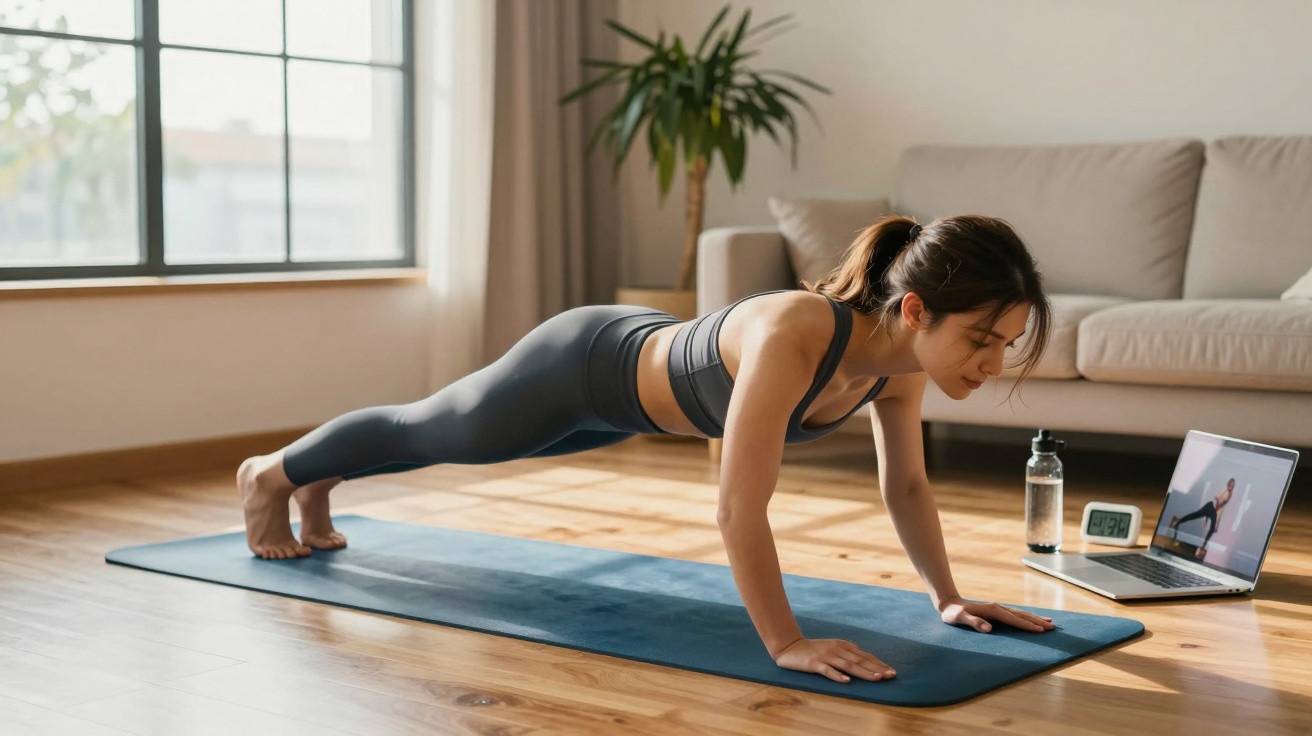
The forearm plank fits into the living room, home office and even the space beside a hotel bed. Fitness coaches around the world have recommended the same exercise for years when time is short but the whole body still needs to work: the classic plank, often known as the forearm plank. Done correctly, it challenges the abdominals, back, shoulders, glutes and legs in equal measure.
Why the forearm plank has such a strong reputation
The key benefit of the forearm plank is that it works more than the visible abdominal muscles. Above all, it trains the body’s centre, known as the core. This includes the abdominals, deep back muscles, hips and glutes. This area stabilises every everyday movement, from lifting a crate of drinks to sitting at a desk.
“When the core is strong, movements become easier, posture becomes more upright and many common areas of tension occur less often.”
During a forearm plank, the body stays in a static position. The muscles work isometrically, meaning they maintain tension without visibly shortening or lengthening. This sustained tension creates an intense training sensation, even though you appear to be “just” holding still.
At the same time, numerous muscle groups have to work together: the shoulders provide stability, the back maintains the line, the abdominals prevent the body from sagging, and the glutes and hamstrings support the lower back. The result is a full-body effect that feels much more demanding than it may first appear.
Ideal for packed schedules
Many people think strength training means spending an hour lifting weights at the gym. With the forearm plank, however, just a few minutes are enough to provide a worthwhile stimulus. Trainers often recommend short sets lasting from a few seconds up to one minute, repeated over several rounds.
- No journey to the gym
- No equipment required – a mat or carpet is enough
- Very little room needed – one body length will do
- Easy to fit into breaks, such as between two video calls
This combination is precisely what makes the exercise so appealing to beginners setting a realistic fitness goal: a short, manageable mini-workout every day is better than an ambitious plan that is abandoned after two days.
How to perform a clean forearm plank step by step
Finding the starting position
For the classic version, begin lying face down on the floor. Then support yourself on your forearms, with your elbows positioned roughly beneath your shoulders. Point your forearms forwards and rest your hands loosely. Next, place your toes on the floor.
Lift your knees and hips at the same time until your body forms as straight a line as possible from heels to head. Look down rather than ahead to keep your neck relaxed.
Key technique points
- Draw the shoulders actively down and back rather than pushing them towards the neck
- Brace the abdominals as if you were preparing for a light blow
- Lightly tighten the glutes to stabilise the pelvis
- Do not allow the hips to sag or lift them too high
- Continue breathing steadily and calmly
“Your body should feel like a plank of wood – stable, long and still. As soon as you notice your lower back dipping, it is better to stop the repetition.”
How long should you hold it? A sensible starting point for beginners
A common mistake is to focus on achieving the longest possible hold from the start. Trainers instead advise beginning with very short intervals and prioritising quality.
| Level | Duration per set | Number of rounds |
|---|---|---|
| Beginner | 15–20 seconds | 3–4 rounds with rest |
| Intermediate | 30–45 seconds | 3–5 rounds |
| Very fit | 60 seconds and more | 4–6 rounds |
Between sets, you can briefly rest on your knees, take a deep breath and return to position. Over the weeks, the holding time often increases naturally, without forcing yourself through it.
Easier forearm plank variations for beginners
Anyone who has not exercised for a long time, is overweight or experiences back problems should take a particularly gentle approach. The forearm plank can easily be adapted.
Plank on the knees
Instead of supporting yourself on your toes, place your knees on the floor. Keep the upper body aligned as described, but the lever length is reduced and so is the load. This lets you feel the correct tension without overdoing it straight away.
Plank against a wall or table
An inclined position is even gentler: place your forearms or hands against a wall or the edge of a table, with your feet positioned further back. Your body still forms a line, but in a more upright position. This variation works well for office breaks or for people with a very low strength level.
More challenge for advanced exercisers
Once the standard version feels easy, you can increase the intensity and training stimulus without using extra equipment.
- Lift one leg: In the forearm plank, raise one leg a few centimetres from the floor, hold it, then switch sides.
- Plank with shoulder taps: In the press-up position, alternately tap the opposite shoulder with one hand.
- Side plank: Support yourself sideways on one forearm, lift the hips and keep the body in a straight line.
- Moving plank: Alternately press up from the forearm plank into a high plank on your hands, then lower yourself back down.
These variations place even greater demands on balance, coordination and strength, and are intended for people who can already maintain solid core tension.
Effects you may notice in everyday life
People who make the forearm plank a regular part of daily life may notice more than muscular changes. Many report less back tension, easier upright sitting and greater confidence when lifting or carrying.
“A stable core relieves pressure on the spine, protects the joints and makes everyday movements more efficient.”
There is also a mental benefit: the exercise requires concentration and perseverance. Completing your 30 or 45 seconds brings a small sense of achievement – often enough to encourage you to continue and build new habits.
When you should take care
People with existing back problems, an acute slipped disc or shoulder injuries should seek medical advice before starting. In some cases, adjustments may be needed, such as a higher position or shorter intervals. Pain in the lower back is a warning sign; if it occurs, stop and check your technique.
It also makes sense not to view the forearm plank in isolation. Combined with short walks, a few squats and gentle mobility exercises, it becomes a compact, well-rounded routine that strengthens the whole body without taking over the day.
Even an initial investment of just three minutes – for example, three rounds of plank with rests – already provides a solid foundation. This mini-routine can gradually develop into a complete home workout that many trainers have relied on for years because it is simple, practical and surprisingly effective.













Comments
No comments yet. Be the first to comment!
Leave a Comment