You know that deflating moment when you take your favourite wool jumper from the wardrobe and it looks… worn out?
It is not marked or misshapen, but covered in tiny, persistent bobbles that make it appear as though you have had it since the early 2000s. Your hand passes over the sleeves and, rather than the soft, comforting knit you originally loved, the surface feels coarse, like sand against your palm. All at once, the sweater that made you feel polished – and quietly pleased with yourself in the changing room – leaves you feeling untidy on the morning commute. So you wonder: is it me, or the jumper?
Most people react in exactly the same way. We begin picking at it: one bobble, then the next, until a small drift of fluff has formed on our lap and we suspect that we may be worsening the problem. The twist is that we are. There is a more effective, surprisingly calming way to revive beloved woollens. All you need is an inexpensive disposable razor, a careful hand and a small piece of household magic that you may secretly start to enjoy.
The day my “good” jumper became scruffy overnight
The first time pilling genuinely irritated me involved a grey cashmere jumper I had saved for. It was the sort of buy you defend by mentally calculating the “cost per wear”. I wore it for the school run, in the office and out for dinner, feeling subtly pleased whenever its sleeves brushed against my skin. Then, one morning, I saw my reflection in a shop window and noticed them: small clumps of fluff over the chest and beneath the arms, as if the jumper had developed its own five o’clock shadow.
When I got home, I sat on the bed and did precisely what you should avoid. I began pulling off the bobbles. Initially it was strangely gratifying, rather like bursting bubble wrap, as tiny fibres collected beneath my fingernails. Yet on closer inspection, the fabric I had been working at looked thinner, a little harsher and almost bald. The more I tried to “fix” it, the worse it appeared. That is when you understand that pilling is not merely a quick cosmetic problem; handled badly, it becomes gradual sabotage.
Pilling feels oddly personal because it appears in the places where everyday life takes place: beneath the arms, where your bag catches; on cuffs pressed against a desk; and over the front, where a seat belt rests. It is your routine, recorded in fluff. There is something mildly unfair about being penalised for wearing the clothes you genuinely love, rather than preserving them for imaginary “special occasions” that never happen.
What those irritating bobbles actually mean
The science behind pilling is less appealing than knitwear itself, but knowing it makes the issue feel less personal. Bobbles are simply loose surface fibres that have tangled together. As you move, friction draws fine strands from the yarn. They twist, knot and remain attached, becoming those small woolly globes of doom. Delicate, luxurious fibres such as merino and cashmere are particularly susceptible, ironically because they are so soft.
We often assume that pilling means poor quality, and on occasion it does. Knits with high synthetic content or especially fluffy finishes may pill sooner than tighter, smoother fabrics. However, even costly, beautiful wool can pill at high-friction points. Realistically, most of us do not hand-wash every item in cold water, carefully arrange it flat on a towel and offer a little prayer to the laundry gods. We put clothes in the washing machine, remove them in a rush and hope everything will be fine.
Once you recognise pilling as an ordinary consequence of wearing a garment, rather than a crime against fashion, the question changes. It becomes less “why is my jumper doing this to me?” and more “how can I keep this under control without destroying the fabric?” That is where picking and pulling become a discreet enemy. It resembles care, but is actually damage disguised as an easy solution.
Why picking at bobbles damages wool jumpers
We have all been there: sitting in a meeting or travelling on a bus, absent-mindedly rolling a bobble between thumb and forefinger. It begins with boredom, becomes a point of focus and ends with a small pile of fluff plus a slightly ragged area on your sleeve. You may tell yourself that you are helping, that you are “cleaning it up”. In reality, you are tugging the yarn and stretching or snapping fibres that remain part of the knit.
Whenever you pull away a pill, you remove more than the loose section; some of the fabric goes with it. Eventually this wears the jumper thinner, particularly around exposed areas such as the elbows and underarms. That is when slightly bald patches begin to show, often with a near-shiny feel. The knit no longer springs back in the same manner. It is rather like removing weeds by tearing out clods of earth each time: you leave small craters behind.
Your fingers are also usually rougher than you realise. Picking has a faintly impatient quality, an urge to “let me just get this over with”. That impatience is not kind to fine fibres. The pity is that pilling can be dealt with, and even reversed in appearance, if you stop treating your jumper as though it were a scab you cannot stop scratching. The solution is not extra force; it is accuracy.
The disposable razor: a secret weapon for knitwear
The disposable-razor method tends to be passed between friends as a hushed tip. Someone confesses that they have “shaved” their jumper, and you laugh slightly as you imagine stubble on a cardigan. Then they show you the result before and after, and it suddenly seems perfectly sensible. A cheap, new disposable razor – the sort you might barely rely on for your legs – can lightly remove bobbles while leaving the fabric below virtually undisturbed. It seems almost suspiciously easy, like cheating.
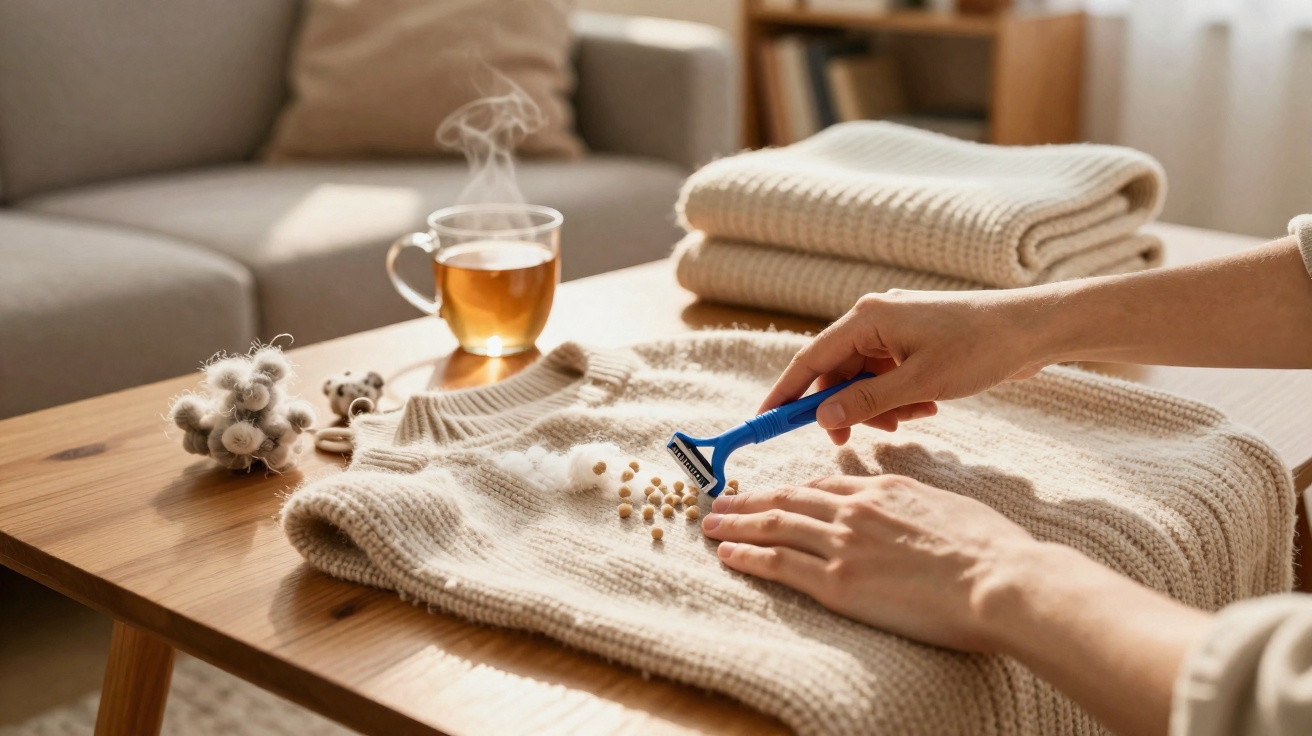
The essential thing is moderation. Put the sweater flat on a bed or table, gently smooth it with your hands and lightly hold the material so that it remains taut. Next, move the razor across its surface using short, delicate strokes in one consistent direction. Do not press or hack at it; simply glide it gently. You will hear a soft rasp as pills catch against the blade and gather there. It is unexpectedly pleasing: a quiet, whispering sound of rescue.
After several strokes, a little ridge of fluff will develop on the razor. That shows the method is working. Tap the fluff into a bin, wipe the blade and continue. The first attempt brings a combination of anxiety and delight. You may be convinced that a hole is about to appear in your favourite jumper, only to step back and find that it looks… smoother. Brighter. Closer to the version you bought than the tired version taken from the wash.
Why shaving is better than pulling
Removing pills by shaving works because it takes away only fibres that are already loose. The blade catches bobbles sitting above the fabric and cuts them off, while the yarn beneath remains intact. Instead of pulling fibres from the knit, you are simply tidying its top layer. Think of trimming split ends rather than tearing out handfuls of hair.
There is an important mental change involved, too. In contrast with picking, using a razor feels purposeful and almost ceremonial. You sit down, make time and concentrate on the job. Care turns into a considered action instead of a nervous habit. That move – away from thoughtless fiddling and towards gentle maintenance – helps clothing last beyond a single fashion cycle.
How to shave bobbles off a wool jumper safely
First, check that the razor is dry, clean and unused. A used blade may catch the material, while rust or residue introduces risks you do not need. Lay your sweater on a flat surface, preferably somewhere that will not be difficult to brush free of fluff afterwards. Use your palm to smooth the fabric in one direction. If the jumper is especially valuable or has sentimental importance, start by testing a small area inside the hem to see how it responds.
Position the razor at a shallow angle, nearly parallel with the textile. Make short, light movements in one direction rather than moving back and forth as if scraping toast. Allow the blade to do its job. If it snags a thread or you sense resistance, stop at once and adjust the fabric. Work gradually over one small section at a time – the front, then the sleeves, then the back – instead of racing to “finish” the garment all at once.
Remove fluff from the blade every few strokes. Its presence confirms that pills are being sheared away, but it also makes the razor blunter and increases the chance of snagging. Be particularly gentle near seams, embroidery and loosely knitted areas, as these are more delicate and more readily damaged. If the jumper already has thin spots, avoid them or pass over them extremely lightly. The objective is not flawless, shop-new knitwear. It is a careful refresh that encourages you to wear the sweater again rather than consigning it to the back of a drawer.
When the razor trick is not suitable
There are exceptions. Very open knits, lace designs and exceptionally fine cashmere may be more at risk. If daylight is clearly visible through the stitches, or the yarn is already feathery and delicate, a purpose-made fabric shaver could be safer. These battery-powered devices are intended to sit slightly above the material, and some include guards to prevent them from cutting holes.
Do not use this method on wool that is wet or damp, either. Moisture makes fibres stretchier and easier to deform, so dragging a razor over them can stretch or warp the garment. Allow it to dry fully, reshape it carefully and only then shave it. Trust the timing: a ten-minute shortcut immediately after laundry day can undo years of wear in the worst possible way.
The quiet satisfaction of restoring a loved jumper
There is a gentle satisfaction in sitting with a bobbly jumper and deciding not to abandon it. You are telling yourself that it deserves to be kept, tended and given your time. In a world where garments arrive in plastic bags and disappear into charity shops or bins just as quickly, that can feel almost radical. Sweaters hold memories: first dates, interviews for jobs and Sunday walks through crisp winter air. Removing the pills is rather like polishing those memories instead of discarding them.
The process itself can be soothing as well. There is the faint sound of the blade, the gradual change in texture beneath your hands and the small pile of fluff left in the bin afterwards. It offers a modest but visible success on a day otherwise blurred by emails and chores. Not everything we own needs to be replaced when it looks tired; some things just need a bit of thoughtful attention.
After you have done it a few times, it may become part of a calm routine. Perhaps every few wears you notice the sleeves becoming rough and set aside ten minutes one evening. A cup of tea, a jumper spread over the table and a razor in your hand. It is not a major task, only a gentle reset. On a hurried Monday morning, your future self will quietly appreciate that you made the effort.
Keeping wool knits in better condition for longer
Naturally, shaving pills away is only one part of caring for knitwear. How you wash, dry and store wool has a significant effect. Cooler washes, gentler spin settings and a laundry bag can all limit friction. Turning jumpers inside out before washing protects the outer face of the fabric. Drying them flat also helps them retain their shape and prevents fibres stretching under their own weight.
Rotation matters as well. Wearing the same wool jumper for two or three consecutive days does not give its fibres an opportunity to recover. They need time to spring back, much like your feet after a full day of walking. Keeping two or three favourites in regular rotation may seem luxurious, but it is simply a way to distribute the wear. Your clothes last longer when you treat them like companions, not disposable props.
You need not become someone who studies care labels as if they were poetry or hand-washes every item in a porcelain sink. Small, practical habits – choosing a gentle cycle, air-drying where possible and giving a jumper a quick shave now and again – make a difference over time. The outcome is a wardrobe that looks more “chosen” than “churned through”. And you look like someone who has considered what they are wearing, even on days when you absolutely have not.
That jumper you almost abandoned
There is probably a sweater somewhere in your wardrobe that you no longer choose because it appears slightly forlorn. Perhaps it was pricey, perhaps it was a present, or perhaps you felt especially like yourself when you wore it for the first time. It is sitting there, faintly pilled, waiting for you to decide whether it deserves the room. Before packing it up or demoting it to “just for the house”, spend ten minutes with it and a disposable razor.
Lay it flat, pause for a breath and gently shave away its bobbles. See the surface shift from fuzzy to crisp again, with its colour appearing a little deeper once the pills have gone. It will not become brand new, but it will seem looked after rather than neglected. That’s the quiet difference between clothes that fade into the background and clothes that stay part of your story.
We are so accustomed to replacing things that saving a jumper can seem unexpectedly sentimental. Perhaps that is no bad thing. A small amount of patience, an inexpensive plastic razor and the choice not to pull at bobbles with weary fingers can make a scruffy knit feel like a favourite once more. The next time those first small pills appear, you will know that this is not the beginning of the end. It is simply time for a gentle shave.
















Comments
No comments yet. Be the first to comment!
Leave a Comment