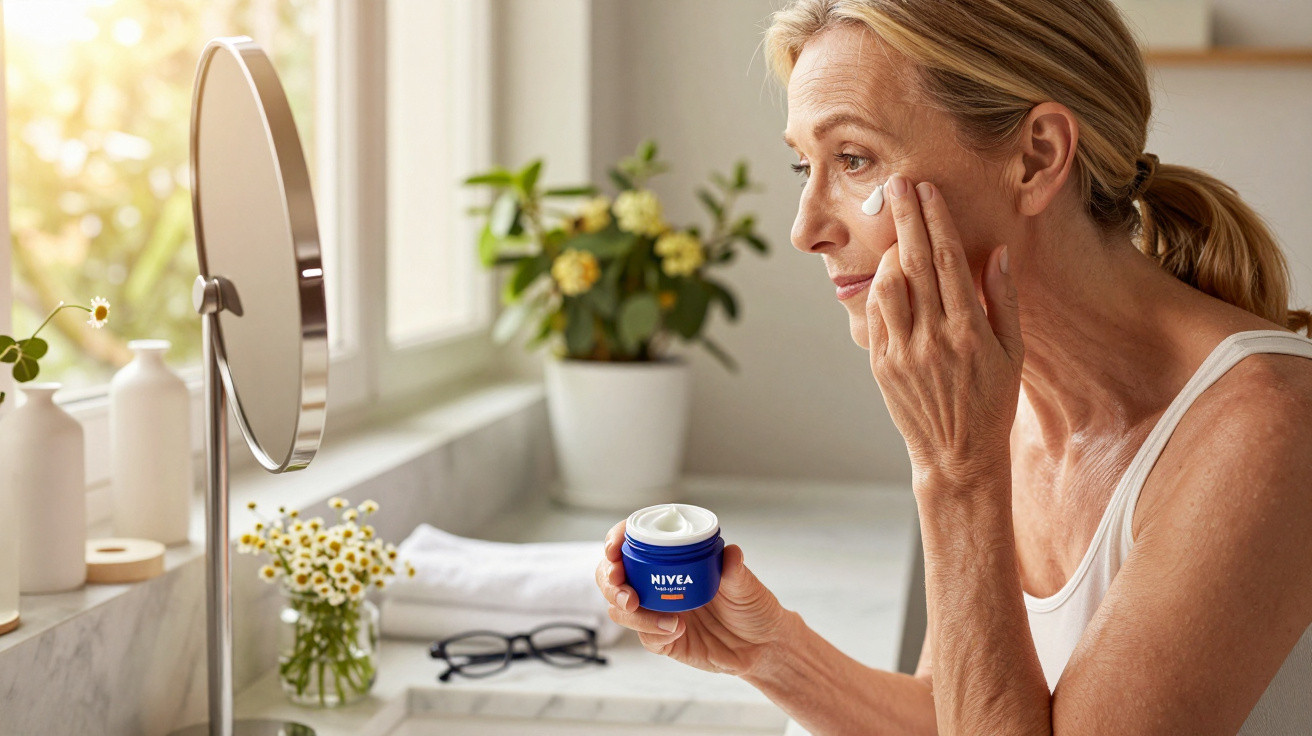
Across social media and in bathrooms throughout Europe and the US, a product once regarded as “boring” is enjoying a new role as a clever, affordable eye-area hack. At the heart of the conversation is the blue Nivea tin, now being used to soften the shadows and lines around fatigued-looking eyes.
Why the classic blue tin is trending again after 50
For years, Nivea Creme had a permanent place in bathroom cupboards as a multi-purpose moisturiser for hands, elbows and dry winter cheeks. People in their 50s and 60s are now bringing it back into focus for a more targeted purpose: addressing dark circles and crepey skin beneath the eyes.
The reasoning is straightforward. After 50, under-eye skin loses moisture, collagen and fat. Its protective barrier becomes weaker, fine blood vessels show through more clearly, and a brief night of poor sleep can leave shadows that linger. Conventional eye creams may seem too lightweight, or too costly for the results they provide.
What makes the blue tin interesting at this age is not magic, but mechanics: a dense, occlusive layer that cushions fragile skin and locks in hydration.
Its distinctive rich texture produces a soft-focus-like finish. As it creates a protective layer, it can make the skin's surface appear smoother. Improved hydration helps light reflect more evenly, making the area look less hollow and grey. For many users, this visible effect gives the traditional cream an unexpectedly current appeal.
How the “Nivea trick” for dark circles works in practice
Beauty creators on TikTok and Instagram present the routine as more of a mini treatment than a passing fad. Rather than spreading the rich cream over the entire face, they apply a very small amount around the eyes, combining it with chilled tools and an extremely light touch.
The step-by-step routine gaining traction
- Cleanse your face, then gently pat the eye area dry.
- Soften a rice-grain-sized amount of Nivea Creme between your ring fingers.
- Pat rather than pull, moving from the inner corner outwards along the orbital bone.
- Use gentle, rhythmic tapping for 30–60 seconds as a micro-massage.
- Introduce cold with a chilled teaspoon or reusable eye mask for one minute.
- Leave it briefly before putting on concealer or foundation.
Supporters of this approach describe fine lines looking softer, puffiness appearing modestly reduced and less stark contrast between the tear trough and cheek. Dermatologists discussing the trend generally identify three technical explanations.
The combination of occlusive fats, humectants and cold gives instant payoff: more moisture, less swelling, and light hitting the skin in a kinder way.
The ingredient story, without the hype
Nivea Creme uses a blend of mineral oils, waxes and Eucerit, an emulsifier made from lanolin alcohol. These ingredients work together to form a semi-occlusive layer over the skin. Glycerin functions as a humectant, attracting and retaining water in the epidermis's upper layers.
This is relevant for mature under-eyes for three reasons:
- The barrier helps reduce overnight water loss.
- A fuller-looking surface spreads light more evenly, which can reduce the appearance of shadows.
- The film may shield thin skin from irritants that frequently cause redness and dullness.
Where dark circles are colour-based and caused by excess pigment, Nivea Creme on its own cannot alter melanin production. Brands within the same corporate group, including Nivea and Eucerin, use active ingredients such as Thiamidol in selected targeted products for that longer-term concern. This is why some skincare professionals recommend “layering smart”: use a pigment-focused eye serum first, then apply the blue tin over it as a cushioning layer.
Not every type of dark circle is the same
The trick's viral popularity can obscure one important fact: under-eye shadows arise for very different reasons. Treating every type as the same issue often results in disappointment.
| Type of dark circle | Main cause | What the blue tin can realistically do |
|---|---|---|
| Blue-violet tone | Visible blood vessels, thin skin | Plumps surface, diffuses light, pairs well with cold tools |
| Brownish tone | Pigmentation, sun exposure, genetics | Gives comfort and glow, but needs pigment-targeting actives on top |
| Hollow “tear trough” | Volume loss, bone structure | Softens edges temporarily; structural loss may require medical options |
| Morning puffiness | Fluid retention, salt, sleep position | Helps protect skin while cold and massage manage swelling |
That difference explains why one person may describe the trick as “life-changing”, while another notices only a subtle glow. The cream can support the skin's surface, but it cannot restore fat pads or change bone structure.
Mistakes that can make the under-eye area look worse
Dermatology clinics in the UK and US see a modest but consistent number of patients who have used rich creams incorrectly around their eyes. The same issues occur repeatedly: itchy skin, tiny white bumps known as milia, or unexpected puffiness in the morning.
The trick works best when it is small: tiny dose, clear distance from the lash line, gentle hands, and consistent sun protection.
What to avoid with heavy creams near the eyes
- Applying an excessive amount; a fine layer works better than a heavy coating.
- Taking it directly to the lashes; body heat will naturally cause the cream to travel closer.
- Rubbing or pulling at the skin, particularly when you are tired.
- Sharing jars or using unwashed fingers to dip into them.
- Relying on it alone for persistent puffiness or pronounced pigmentation.
Daytime habits are another commonly missed factor. Sun exposure without protection is a major contributor to both pigmentation and collagen loss around the eyes. Many people use the blue tin in their evening routine but leave out SPF in the morning. Over time, that omission can determine whether shadows remain unchanged or become deeper.
What can genuinely make us appear more rested after 50
The revival of Nivea's blue tin reflects a subtle change in attitude: older consumers are becoming weary of complicated, costly routines that promise too much. Instead, they are placing greater value on products that suit achievable habits and feel comforting rather than harsh.
Eye-area specialists generally highlight four factors that carry more weight than any one cream:
- Maintaining regular sleep patterns and reducing screen time before bed.
- Cutting back on salt and alcohol in the evening to limit fluid retention.
- Applying SPF around the eyes every day, including when the sky is overcast.
- Following a mild, consistent skincare routine that reinforces the barrier rather than stripping it.
The blue tin acts as a tool, not a miracle: it supports a routine where sleep, SPF and small rituals do the heavy lifting.
The ritual may also matter psychologically. Spending 60 seconds in the evening on a short massage and cooling contact can ease stress and help the body move towards rest. For many women in their 50s balancing work, ageing parents and adult children, this pause can be just as valuable as the cream itself.
When the Nivea trick is useful – and when to seek further help
When used properly, the blue tin hack can suit several circumstances: winter-related seasonal dryness, post-menopausal skin that feels papery, or periods of intensive screen work when the eye area feels tight and sore. It may also offer an accessible option for people unable or unwilling to spend a great deal on specialist skincare.
Its limits should be recognised. Dark circles accompanied by marked itching, flaking or redness could indicate allergies or eczema. A sudden change in colour or swelling on one side around one eye requires medical assessment. Pronounced hollows, strong pigment bands and long-term puffiness can sometimes respond better to dermatological options such as fillers, peels or lasers, alongside lifestyle measures.
Readers wanting a clearer picture of their own under-eye concerns can carry out a simple home “audit”: examine the shade and shape in natural daylight, record when circles appear at their worst - in the morning, evening, after wine or after crying - and note any seasonal changes. This brief record can make discussions with a GP or skin specialist much more useful, while helping establish whether a modest blue tin is enough or a more focused plan is worth pursuing.









Comments
No comments yet. Be the first to comment!
Leave a Comment