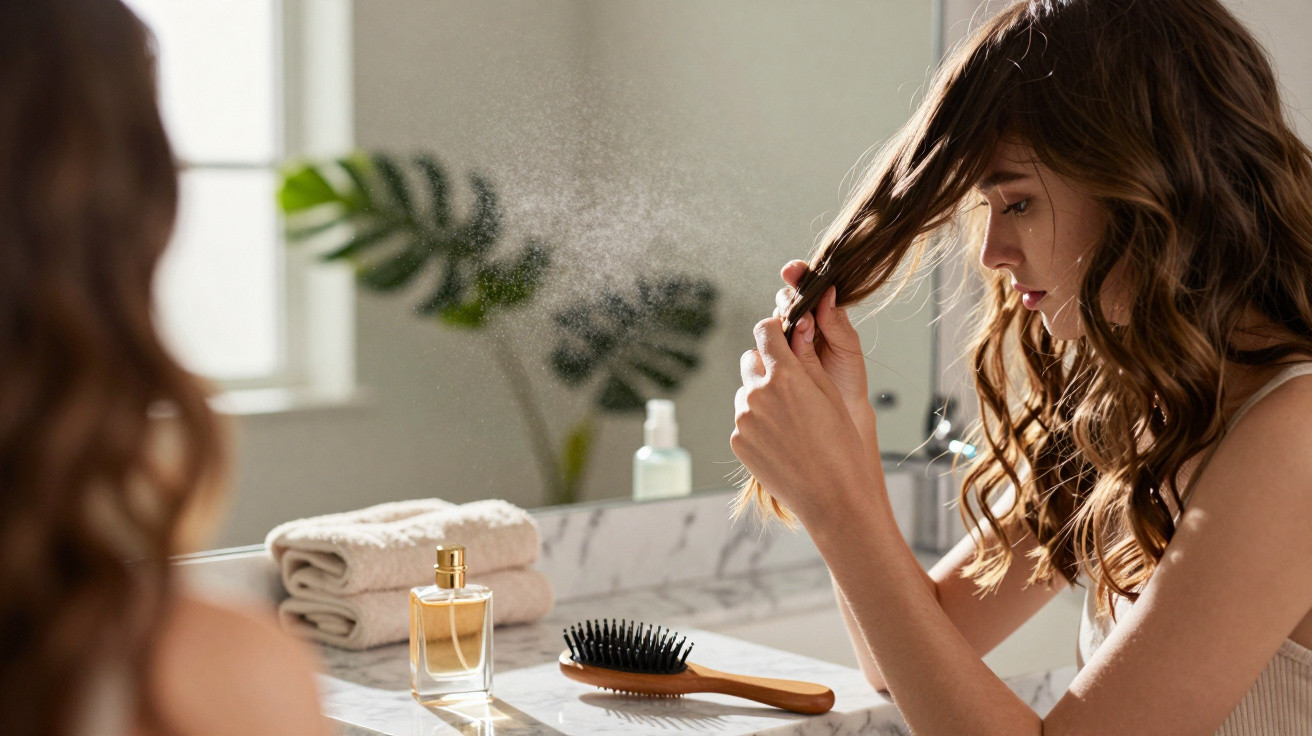
The morning rush is louder than your alarm, and you are already running two steps late. You reach for your favourite perfume, the bottle reserved for “when it matters”, and spray your wrists and neck, perhaps adding a little to your scarf because today calls for confidence. An hour later, while reaching for a file in the office lift, there is… nothing. Your fragrance has gone, as though it finished work before you arrived. You discreetly smell your wrist and feel a small, slightly ridiculous disappointment. Why does the perfume that cost half a pay cheque disappear faster than your morning coffee?
You sweep a strand of hair behind your ear and notice the faintest remnant of yesterday’s fragrance.
That is when the real question lands.
Why perfume vanishes from your skin so quickly
Applying perfume to skin feels natural, almost automatic. We have watched mothers and friends dab scent onto their pulse points, trusting body warmth to keep it alive. Yet, for many of us, that magic does not last. Skin absorbs it, clothing takes it in, and by lunchtime all that remains is the memory of a fragrance rather than the scent itself.
The unexpected truth is that skin is not always the ideal surface for this everyday ritual.
Sometimes, it is the quiet culprit.
Picture an evening out. You are in a busy bar, wearing a satin shirt, having a good hair day, and using that one perfume saved for nights that could turn into stories. You spritz your neck before leaving, admire the scent trail in the air, and then stop thinking about it. Two hours later, a friend hugs you and says, “I thought you were going to wear your usual scent tonight.” You were. It simply faded. Now think of another friend who always smells wonderful when she flicks her hair or walks by. It is not overpowering, merely noticeable. You may assume she wears a stronger fragrance. Often, she is just applying it more intelligently.
Not more. Smarter.
There is a straightforward explanation for this disappearing act. Perfume consists largely of alcohol, along with oils and aromatic molecules that settle where conditions suit them. Dry or sensitive skin behaves like a sponge: it takes in, dilutes, then quickly releases those molecules. Heat at pulse points can speed up evaporation too. Hair, by comparison, resembles a fine fabric. Its fibres hold fragrance particles and release them gradually, with each movement sending tiny wafts into the air. Your hair behaves like a gentle diffuser while your skin plays the role of impatient host.
This is where the hairbrush trick can make all the difference.
The hairbrush trick that transforms your perfume routine
The technique is almost deceptively easy. Rather than soaking your wrists, spray your perfume straight onto your hairbrush from a close distance of roughly 15–20 centimetres. One or two sprays will do. Give the bristles a few seconds for the strongest alcohol burst to evaporate, then brush through dry hair from the mid-lengths down to the ends. The aim is to fragrance the strands, not the scalp.
The effect is a light, halo-like fragrance that moves with you without entering the room before you do.
Subtle, but unmistakable.
Many people stumble across this trick accidentally. A stylist mists fragrance into the air backstage, some settles on the brushes, and models step out smelling luxurious without knowing the reason. Or you hug a friend on a windy day, notice how incredible she smells, and she shrugs, “Oh, I just sprayed my brush.” That is all it takes. No complicated layering and no hidden salon product. Fragrance adheres to the hair cuticle, particularly when hair is a little dry or textured, and every turn of the head brings it back to life.
We have all had that moment when a stranger’s fragrance lingers and you silently wonder what they are doing differently.
There is another understated advantage that your skin may appreciate. Conventional perfumes, including expensive ones, contain plenty of alcohol so that they project well and dry down quickly. For sensitive or already dehydrated skin, that can feel like hosting a party your epidermis never agreed to. Over time, redness, tightness and invisible patches of micro-dryness can develop. Moving much of your fragrance routine to your brush limits direct exposure to alcohol while still delivering the full sensory effect. Your hair is unlikely to object to that brief contact, while fragrance molecules settle into its fibres as if they have found a long-term flat.
Less irritation, more presence.
How to perfume your hairbrush without damaging your hair
Begin with a clean, dry brush. Whether it is plastic or wood makes little difference, provided the bristles are not already covered with styling residue. Keep the bottle about a forearm’s length away and spray once across the bristles, as though gently misting a houseplant. Wait two or three seconds. That brief pause gives the harsh alcohol hit time to dissipate, leaving more fragrant oil behind. Then brush your hair softly, concentrating on the lengths and ends instead of the roots.
Treat it as “combing in” a veil of fragrance, rather than attacking your scalp with perfume directly from the bottle.
One small caution: extra sprays do not equal extra elegance. Saturating the brush can dampen your hair and make it feel slightly sticky, especially when using intense scents. Begin with one spray and alter the amount next time according to the strength of the fragrance. Fresh citrus scents or airy florals may call for a second pass. Rich orientals and heavy gourmands rarely need one. Honestly, nobody really follows this routine every single day. On some days, you will simply reach for the bottle and spray your neck out of habit. That is fine. The hairbrush trick is particularly effective on days when you want your scent to last into the evening without overwhelming your skin.
Gentle, not obsessive.
“When clients ask how to smell ‘expensive’ without suffocating a room, I always tell them: perfume the hair, not the neckline,” confides a Paris-based hairstylist who works with actors and news anchors.
- Spray the brush, not the roots: Concentrate on the mid-lengths and ends to prevent scalp irritation or alcohol-related dryness.
- Choose lighter formulas for daily use: Hair responds better to gentle mists, colognes, and floral or musky scents than extremely heavy oud fragrances.
- Alternate with hair-friendly scents: When your hair feels delicate, opt for dedicated hair perfumes or dilute classic perfume with a little water in a small spray bottle.
- Do not combine five scents at once: Stay within one fragrance family so that your shampoo, conditioner and perfume do not compete.
- Refresh in the evening, not every hour: A swift brush-through using a lightly scented brush looks more refined than repeatedly spraying your wrists.
Let your perfume live where you move
Fragrance performs differently according to where it is applied. On fabric, it may cling strongly but remain static. On sweaty skin, it can change and fade in ways you did not intend. In hair, it follows your movements: turning your head, tossing a ponytail or tucking a strand behind your ear. This is why people often notice your scent when you are not talking-when you merely pass them, bend down to collect your bag, or move nearby. Your presence reaches further than words.
You no longer chase longevity; you work with it.
| Key point | Detail | Value for the reader |
|---|---|---|
| Hair holds scent longer | Perfume molecules adhere to hair fibres and release as your hair moves | Longer-lasting fragrance without repeatedly reapplying it |
| Less alcohol on skin | Spraying your brush limits direct contact with drying alcohol | Gentler for dry or sensitive skin while retaining your signature scent |
| Controlled intensity | A light mist on the brush produces a discreet, even fragrance halo | Smell noticeable and sophisticated, rather than overpowering or “cloudy” |
FAQ:
- Question 1: Can spraying perfume on my hairbrush damage my hair?
- Question 2: How often can I use this method without overdoing it?
- Question 3: Is it better to use a specific “hair perfume” instead of regular perfume?
- Question 4: Will my pillow or clothes smell too strong if I scent my hair?
- Question 5: What type of brush works best for this trick?









Comments
No comments yet. Be the first to comment!
Leave a Comment