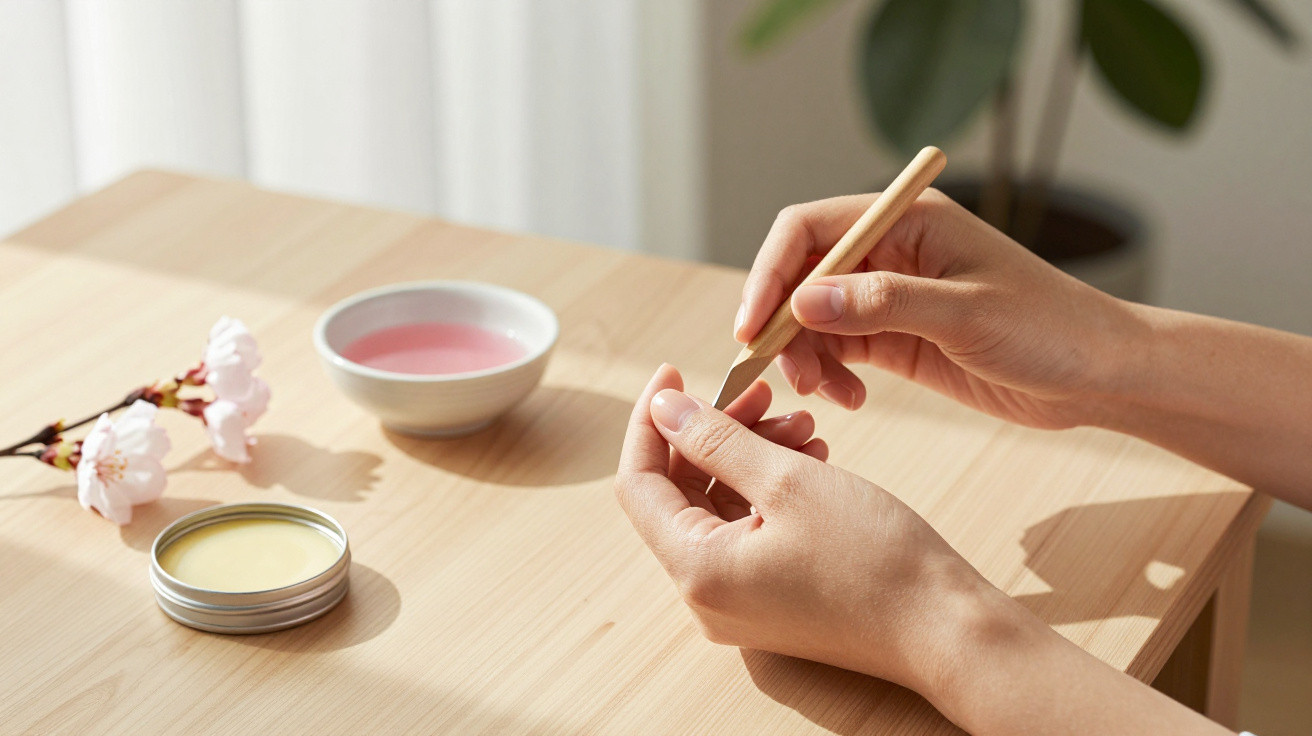
As gel nails and elaborate nail art gradually lose their appeal, an understated treatment from Japan is moving into the spotlight: the Japanese manicure. Rather than bold colours, it focuses on healthy, strong, naturally glossy nails – precisely what appeals to a generation tired of continual salon appointments and brittle, damaged nails.
What the Japanese manicure is really about
The Japanese manicure is neither a new polish nor another ‘super coating’; it is a care ritual. Everything centres on the natural nail. Its aim is to rebuild nails rather than conceal them. The finish resembles freshly polished pearls: a soft pink sheen that appears to come from within the nail itself.
This technique relies on natural active ingredients blended into a nourishing paste. It commonly contains:
- Beeswax to protect and condition
- Keratin-containing components to reinforce the nail structure
- Minerals such as silicon compounds from marine sources
- Vitamins that nourish the nail from within
The paste is carefully massaged into the nail, then ‘sealed’ with a special powder formula. Buffing produces the signature shine – without any layer of polish.
“The Japanese manicure relates to gel nails in the same way that skincare relates to make-up: first you build things up, then the beautiful effect appears on its own.”
Japanese manicure step by step: how the treatment works
Anyone wanting to try the trend at a salon or recreate it at home should understand the process. It is deliberately designed to be gentle:
- Gentle preparation: Nails are shortened, lightly filed into shape, and the cuticles are only carefully pushed back rather than aggressively cut away.
- Cleansing the nail surface: Fine buffing blocks replace coarse files to remove loose particles without damaging the nail plate.
- Massaging in the care paste: The rich paste is worked into every nail with a soft tool or fingertips – like an intensive hair mask, but for nails.
- Sealing with powder: A special powder is applied and buffed in with a polishing file. This ‘locks in’ the active ingredients and activates the shine.
- Finishing touch: A light hand and cuticle balm is usually applied at the end to complete the treatment.
The result is visible immediately: nails look pinker and smoother, reflecting the light without appearing to be ‘polished’. Instead of feeling covered by an artificial layer, the nail feels firm yet natural.
Why now? The trend is perfectly suited to 2026
One thing is becoming clear for spring 2026: a healthy body matters more than the most eye-catching look. This shift runs through every part of beauty routines, from skincare to haircare. The Japanese manicure fits this change exactly.
Many women, and an increasing number of men, are exhausted by the same recurring cycle: gel application, painful removal weeks later, fragile nails, then starting all over again. The Japanese method interrupts that pattern. Once people understand that the shine comes directly from a strengthened nail, they quickly wonder why they had kept applying artificial materials in the first place.
“The look feels like ‘your own nails, only better’ – polished, elegant and understated.”
Japanese manicure compared with gel, BIAB and traditional nail polish
Many people wonder whether a care ritual like this can really be enough. Comparing it with popular methods makes its appeal clearer.
| Method | Material | Durability | Effect on the nail |
|---|---|---|---|
| Gel nails | Synthetic polymers, cured under a UV lamp | 3–4 weeks; requires infills | High strain, frequent filing; the nail often becomes thinner |
| BIAB & strengthening systems | Synthetic resins, partly cured with UV/LED | 2–4 weeks | Can dry out the nail, particularly with prolonged use |
| Traditional nail polish | Solvent-based polishes | 3–7 days | Comparatively gentle; removed with nail polish remover but can be drying |
| Japanese manicure | Natural waxes, minerals, vitamins | Shine lasts 1–3 weeks and grows out with the nail | Restorative, strengthens the nail without an artificial layer |
Rather than worrying about a salon appointment every three weeks, with the Japanese version you simply let the nail grow. Nothing peels or chips; the effect gently fades over time while the nail continues to become stronger.
Who is the Japanese manicure suitable for?
The method is useful for a far wider range of people than many initially expect. It is particularly beneficial for those with:
- Brittle, splitting nails after long-term gel or acrylic use
- Thin nails that quickly become painful with conventional filing
- Jobs that rule out colourful nails, such as roles in healthcare
- Sensitive nail beds or a tendency to irritation from harsh products
Many people also deliberately choose gentler care during pregnancy and breastfeeding. Here, the Japanese manicure stands out through natural, food-grade ingredients. Nails look well cared for without chemical additives being involved.
“Anyone who is not allowed to wear bright colours at work can still achieve impeccably groomed hands with this technique.”
How long does the effect really last?
Depending on nail type and everyday wear, the shine remains visible for one to three weeks. Because there is no artificial layer on top, there is no conventional ‘touch-up’. Nails simply keep growing, while the shimmer gradually moves towards the tip.
Those who want to benefit from the effect long term should schedule another treatment every two to four weeks. With every repeat treatment, more nutrients are deposited in the nail. Many users report that after several months their nails feel noticeably harder, tear less often and grow more evenly.
Designs: natural only, or can there be some glamour too?
The central idea is natural and subtle, but that does not have to mean completely boring. Salons are increasingly pairing the Japanese manicure with minimalist nail designs:
- Fine micro-French lines in soft white or pastel shades
- A ‘glazed’ effect created with extra-fine pearlescent powder
- Subtle highlights on just one accent nail
- Transparent, ultra-fine embellishments that do not overpower the natural look
One point remains important: the nail breathes. The care paste and powder are always the foundation, with every design applied only minimally on top.
What to know before switching from gel to a Japanese manicure
People who have worn gel for years can experience a kind of ‘withdrawal’ when they switch. At first, nails may feel thin, soft and sensitive. This is not caused by Japanese nail care, but by the effects of the previous methods.
A little patience is worthwhile during the first few weeks. Keeping nails shorter reduces the risk of breakage, while cotton gloves offer additional protection during household chores. Each treatment adds a new layer of care ingredients to the nail plate. After two to three months, clear improvements usually emerge: fewer ridges, less chipping and considerably greater natural strength.
Risks, limitations and helpful additions
This method also has its limits. Anyone severely affected by fungal infections, inflamed nail beds or serious skin conditions should first have their nails assessed by a dermatologist. Care trends are not a replacement for medical treatment.
Straightforward at-home routines are useful additions to the Japanese manicure:
- Massage nail oil into the cuticles and nail plate every day
- Wear gloves for cleaning tasks and when handling chemicals
- Follow a diet rich in biotin and minerals to support strength from within
- Avoid harsh nail polish removers with a high acetone content
Anyone who follows these basics and repeats the salon or home treatment regularly turns this trend into more than a seasonal fashion. The Japanese manicure suits a lifestyle in which less coating and more genuine substance matter – right down to your fingertips.







Comments
No comments yet. Be the first to comment!
Leave a Comment