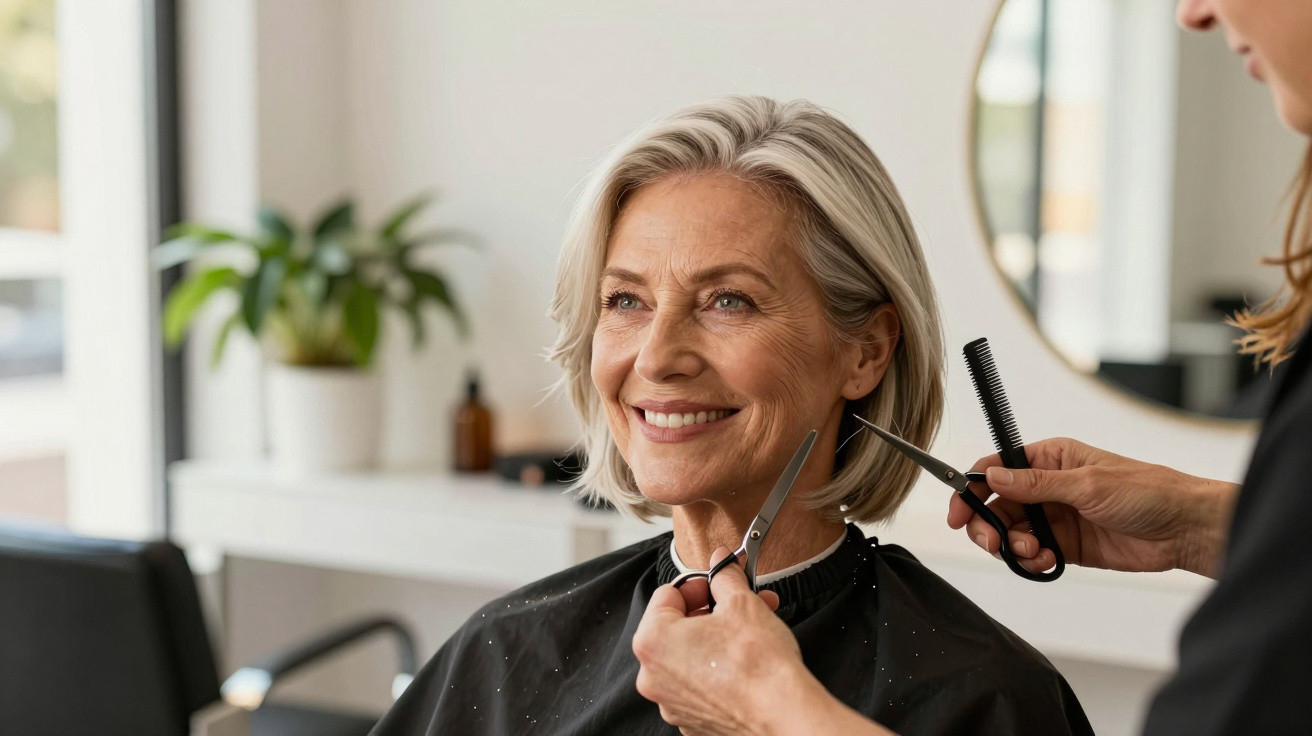
The salon had its usual gentle bustle: hairdryers murmured in the background, scissors snipped like little castanets, and the smell of hairspray lingered above magazines that were already three months old. Claire, 67, sat in the centre chair, winding her handbag strap around her fingers as she studied her reflection. “I don’t recognize this woman anymore,” she said softly to her stylist. “Inside I still feel 40.”
Ten minutes later, the first strands dropped to the floor. It was neither a dramatic pixie cut nor flowing mermaid-length hair, but something between the two: airy, fresh and slightly cheeky. When the hairdryer fell silent, Claire moved closer to the mirror. Her jawline had definition again. Her eyes seemed more luminous.
She did not look young-young. She looked refreshed.
Her stylist simply smiled and said: “Welcome back.”
The cut hairstylists swear by after 60
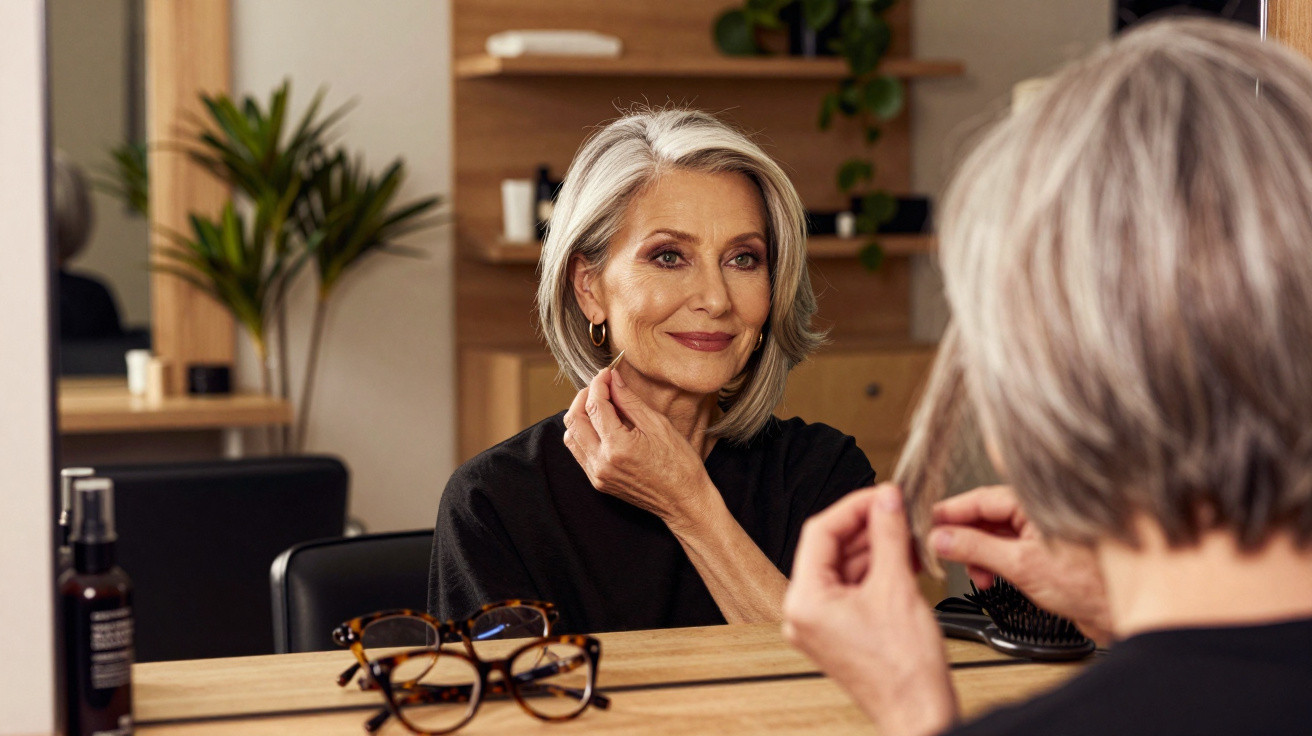
Ask five hairstylists what they suggest for women over 60 and you may hear a range of fashionable labels: long bob, soft shag or modern crop. Yet one recommendation repeatedly emerges: a gently layered, face-framing bob falling somewhere between the chin and collarbone. It feels light at the neck, with soft movement around the face.
It is neither the briefest style nor the longest. It has a sense of lift, and that is what creates the elevated effect people often mention.
The secret lies in its understated placement. The length falls where the jawline and collarbones naturally provide definition, allowing the haircut to complement rather than fight your bone structure.
Hairstylists frequently describe a familiar situation. A woman in her sixties or beyond arrives with photographs of herself from 20 years earlier, usually pointing to hair that was long and thick but no longer suits either her texture or her life. The stylist listens, agrees, and then draws the mirror a little nearer.
They propose lifting the length. “Just to the collarbone,” they say, marking the line with a comb. They may also recommend a soft side fringe or a few discreet layers around the front.
Then comes a brief pause of uncertainty, followed by: “Alright, let’s do it.” Many professionals say this is where they see the most striking changes: not when hair is cut exceptionally short, but when it no longer drags the face visually downwards.
There is a straightforward reason this style is so effective. With age, hair commonly becomes finer, particularly at the ends, while facial features tend to soften. Long, weighty hair can emphasise that softness and create a downward visual pull.
A mid-length, face-framing bob reverses that effect. It removes heaviness from the lower lengths and brings attention back towards the cheekbones and eyes. Delicate layers soften strong edges without concealing the face.
It’s less about cutting off years and more about cutting off what weighs you down. This is why many hairstylists describe it as the most rejuvenating choice after 60: not because it follows a trend, but because it is forgiving.
How to ask for this “rejuvenating” bob at the salon
Most hairstylists agree on one point: rather than arriving with the name of a celebrity hairstyle, explain how you want the cut to make you feel. Ask for a bob that falls between the chin and collarbone, with gentle layers concentrated around the face rather than throughout. Say that you want movement, not a helmet-like shape.
Request that the back is kept a little shorter than the front, which is left slightly longer. This opens up the neck and prevents a blunt, square-looking finish.
For very fine hair, your stylist may advise more solid, blunt ends, with only the lightest layering around the cheekbones. For thicker hair, they may add discreet texture to stop it becoming too wide or puffy.
Frustration often arises when the image in your mind does not match what appears in the mirror. You might show a picture of a 30-year-old with thick, highlighted hair and hope for the same outcome with white, delicate strands. Your stylist then feels under pressure and may take off either too much or too little. Neither person is pleased.
Start by discussing the reality of your hair. Is it becoming thinner at the crown? Does it frizz at the back? Do cowlicks appear at the front? Once these details are clear, the bob can be subtly customised for you.
And realistically, hardly anyone gives themselves a complete round-brush blow-dry every day. Ask how the haircut will sit when you simply wash it and allow it to air-dry.
“People think rejuvenation is about length,” explains Sophie, a Paris-trained stylist now working in Miami. “It’s rarely about that. It’s about where the eye is drawn. A collarbone bob with light face framing pulls attention to the eyes, the smile, the expression. That’s what reads as ‘alive’ on someone’s face, not an extra five centimeters of hair.”
- Ask for: “a collarbone or slightly shorter bob with soft face-framing layers”
- Bring one or two reference photographs that reflect your own hair texture and colour, rather than only your ideal overall look.
- Decide together whether you want a fringe: curtain bangs are softer than a full, straight fringe.
- Talk about maintenance: trims every 6–8 weeks keep it sharp without growing out harshly
- Discuss styling options: a large round brush, a flat brush or simply your fingers – the cut should suit your normal routine.
What really makes a haircut feel “younger”
The interesting thing about this supposedly rejuvenating cut is that it is not magic. In theory, it is simply a mid-length bob with light layers. What makes the difference is how well it suits the person you are today: being able to dry it in five minutes rather than twenty, or feeling a lighter neck as you fasten up your coat.
Many women say that the real transformation is not what they notice in the mirror, but what they no longer feel obliged to do. They stop concealing themselves behind long, weary-looking hair. They stop apologising for choosing a shorter style. They stop waiting until “after I lose five kilos” or “after the next big event”.
A collarbone-skimming cut can feel surprisingly liberating. You can tuck it behind your ears for a neat outline, tousle it with a little styling cream for softness, or clip back only the front on days when you need to focus.
Older photographs no longer need to feel like a benchmark you have failed to meet; they can simply be earlier chapters. This new length does not imitate them; it responds to them. You are not claiming to be 42 again. You are saying: this is 62, and it comes with its own style code.
Some readers will instantly feel that this is right for them. Others may notice a small feeling of resistance. Both reactions are valid. Hair holds memories: childhood plaits, a partner who loved your ponytail, or a mother who never wore her hair short.
There is no rule stating that you have to choose a mid-length cut at 60. The only real question is whether your present style reflects the person you have become.
If it already does, keep it. If the answer is no, or “I don’t know anymore”, then the mid-length, face-framing bob can quietly join your list of possibilities. It is a gentle trial rather than a radical statement. Sometimes, that is all the courage required.
| Key point | Detail | Value for the reader |
|---|---|---|
| Mid-length, face-framing bob | Falls between the chin and collarbone, with soft layers around the face | Visually raises the features and lightens the overall shape without seeming extreme |
| Adapted to your texture | Blunter ends for fine hair, discreet texturising for thicker hair | Provides movement and fullness while remaining easy to style at home |
| Conversation with your stylist | Explain how you want to feel, rather than relying only on a celebrity photograph | Results in a cut you can genuinely wear, not merely admire on the day of your appointment |












Comments
No comments yet. Be the first to comment!
Leave a Comment