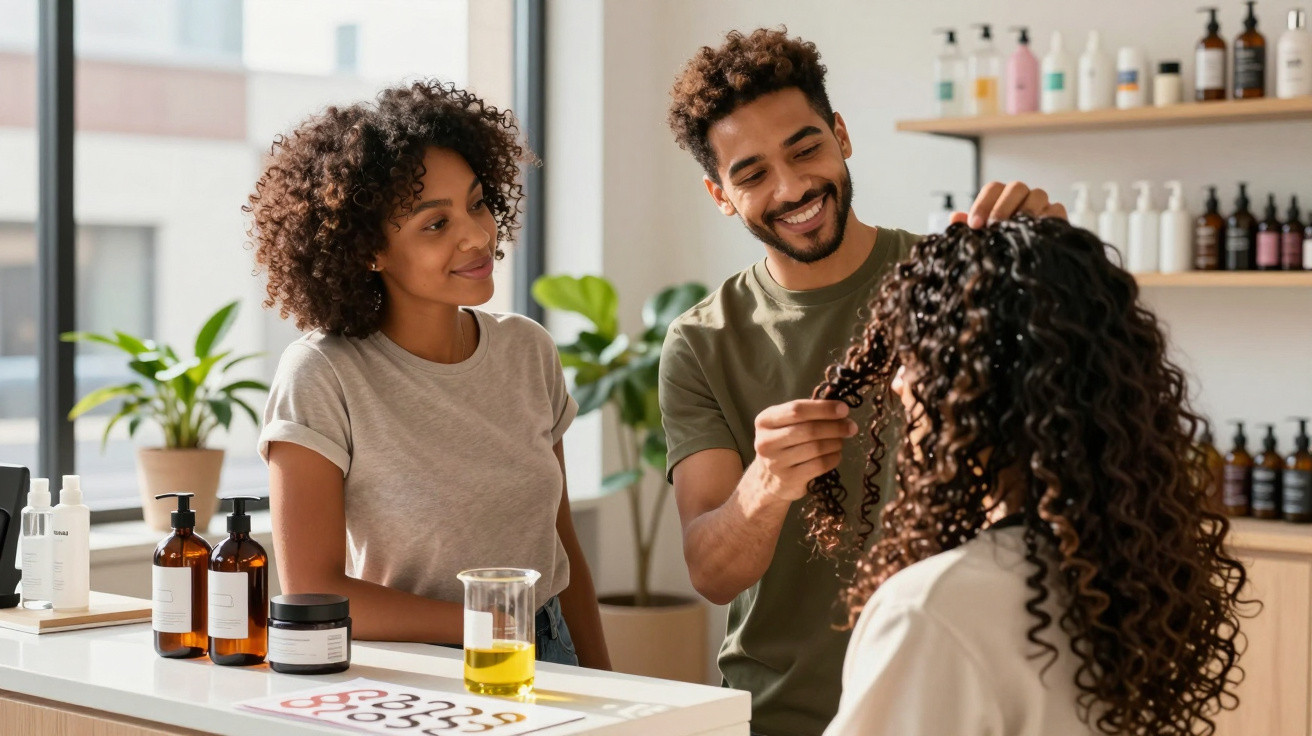
Two founders are radically changing that.
Millions of people in France have coily, curly or highly textured hair, yet for years they were virtually invisible on cosmetics shelves. From this lack of representation, two founders built a brand that is now seen as a benchmark for natural care for textured hair and is shaking up the market far beyond its original community.
How frustration became a business idea
When Rebecca Cathline began looking for suitable hair products in 2015, she found an empty shelf. Shampoos and care ranges for straight hair were available in every possible variation, but there were hardly any professional options for Afro-textured, coily or very curly hair.
Rebecca, whose family roots are in Guadeloupe and Côte d’Ivoire, knew the everyday struggle of dry ends, breakage and painful salon appointments. Rather than accepting it, she turned to the tool that came most naturally to her: her entrepreneurial drive.
Together with her partner Didier Derozin, she initially created a digital solution: the Ma Coiffeuse Afro app. It enabled customers to book hairdressers who genuinely understood Afro, curly and coily hair, including appointments in their own homes.
“A personal hair problem first created a community – and later a haircare brand of its own.”
The app quickly revealed the true scale of demand. People with textured hair were not only looking for skilled hairdressers, but also for products that respected their natural hair texture.
From an app to the In Haircare haircare brand
Over the years, feedback from the community developed into a new ambition: haircare that anyone could use at home, without spending hours studying ingredients or compromising on quality.
In 2020, right in the middle of the COVID-19 lockdown, the pair took their next step. Hair salons were shut, people were spending more time in their bathrooms, trying new routines and questioning established beauty standards. For Rebecca and Didier, it was the ideal time to launch their brand, In Haircare.
Their concept was simple: natural, effective products designed to reduce breakage, encourage growth and respect both the scalp and hair texture. There was no greenwashing or guesswork involved; the products were the result of laboratory work.
A laboratory, not kitchen-made blends
To bring their vision to life, the pair partnered with a specialist cosmetics laboratory in France. Working alongside its research team, they refined formulas, tested prototypes and refused to settle for something that was merely “quite good”.
- 100% natural ingredients
- Vegan and cruelty-free
- Manufactured in France
- A focus on hair growth and strengthening the hair fibre
A key focus was on food supplements for healthy hair growth. Capsules and treatment products were intended to work from within, while oils, serums and conditioning treatments provided external support.
“The approach: haircare not only from the outside, but as a holistic ritual for the scalp, hair and self-image.”
When haircare restores confidence
Many customers contact the brand with similar experiences: hair loss after pregnancy, thinning hair caused by workplace stress, or patches following illness and treatment. In such situations, appearance is not the only issue; identity is involved too.
For someone who loves their curls, bald patches can quickly leave them feeling vulnerable. Rebecca describes this precise feeling as the motivation behind her work: people should be able to enjoy looking at themselves in the mirror again.
In Haircare products therefore target three core concerns:
- Breakage caused by dry, overworked ends
- Slower growth or increased hair loss
- An irritated, dry or neglected scalp
By addressing these issues, the brand offers more than simply “beautiful hair”. It also touches on self-love, representation and the freedom not to hide one’s natural hair texture.
Inspiration from women with textured hair
In Haircare does not present itself as an anonymous corporate brand, but as a project created by the community for the community. Ideas for new products often emerge through conversations with customers: in social-media comments, at events or through personal testimonials.
Rebecca has received several awards for her approach, including an award for digital beauty and recognition as one of France’s influential “Digital Women”. Its success is also visible in retail: the brand is now stocked by chains including Nocibé, Mademoiselle Bio and Blissim, as well as pharmacies and hair salons.
“What began as a niche project for Afro hair is now reaching the shelves of major beauty chains.”
Rebecca and Didier plan to keep expanding the brand across France before bringing it to other countries over the longer term. After all, the lack of product variety for textured hair is not an issue limited to France.
Why textured hair needs dedicated care
To understand the brand’s approach, it helps to consider the basics. Textured hair – from loose waves to tight coils – has different requirements from straight hair:
- Its natural curves make it harder for sebum to travel from the scalp to the ends, meaning the lengths dry out more quickly.
- Coily or tightly curled hair is more prone to breakage when exposed to heavy mechanical stress or harsh treatment.
- Many people with Afro hair wear protective styles, such as braids, twists and weaves, which require considered care underneath and between styles.
Products containing high levels of alcohol, harsh surfactants or heavy silicones often work less well in these cases. Instead, conditioning ingredients such as plant oils, proteins, vitamins and gentle cleansing bases can help.
What consumers can learn from In Haircare’s success
The brand’s rise first demonstrates how substantial the market for specialist care really is. Secondly, it highlights what people with textured hair can look for when buying products, even if they choose other brands.
Key points for the checklist:
- Read the ingredients: favour short, understandable lists without harsh sulphates or drying alcohols.
- Combine internal and external care: maintain a balanced diet, use food supplements only when needed, and choose suitable oils, serums and masks.
- Be patient: hair growth takes time, and visible results usually appear only after several weeks of consistent use.
Anyone experiencing hair loss should seek medical advice if changes are severe or sudden. Care products can provide support, but they cannot replace a diagnosis where hormonal or illness-related causes are involved.
Textured hair in German-speaking countries
Germany, Austria and Switzerland are also seeing growing pressure on the cosmetics industry to reflect diversity not only in advertising campaigns, but in product ranges too. An increasing number of specialist salons, online communities and start-ups are filling gaps that established brands ignored for years.
The example of In Haircare shows that when genuine needs are overlooked for a long time, there is room for business ideas – particularly when founders combine their own experiences, community knowledge and scientific development.
For customers with curls, coils and kinks, this means they no longer have to make do with “stopgap solutions”. Those who want to care for their natural hair texture can increasingly find products and brands made specifically for that purpose – and perhaps, before long, see them more often in retail across German-speaking countries than they do today.






Comments
No comments yet. Be the first to comment!
Leave a Comment