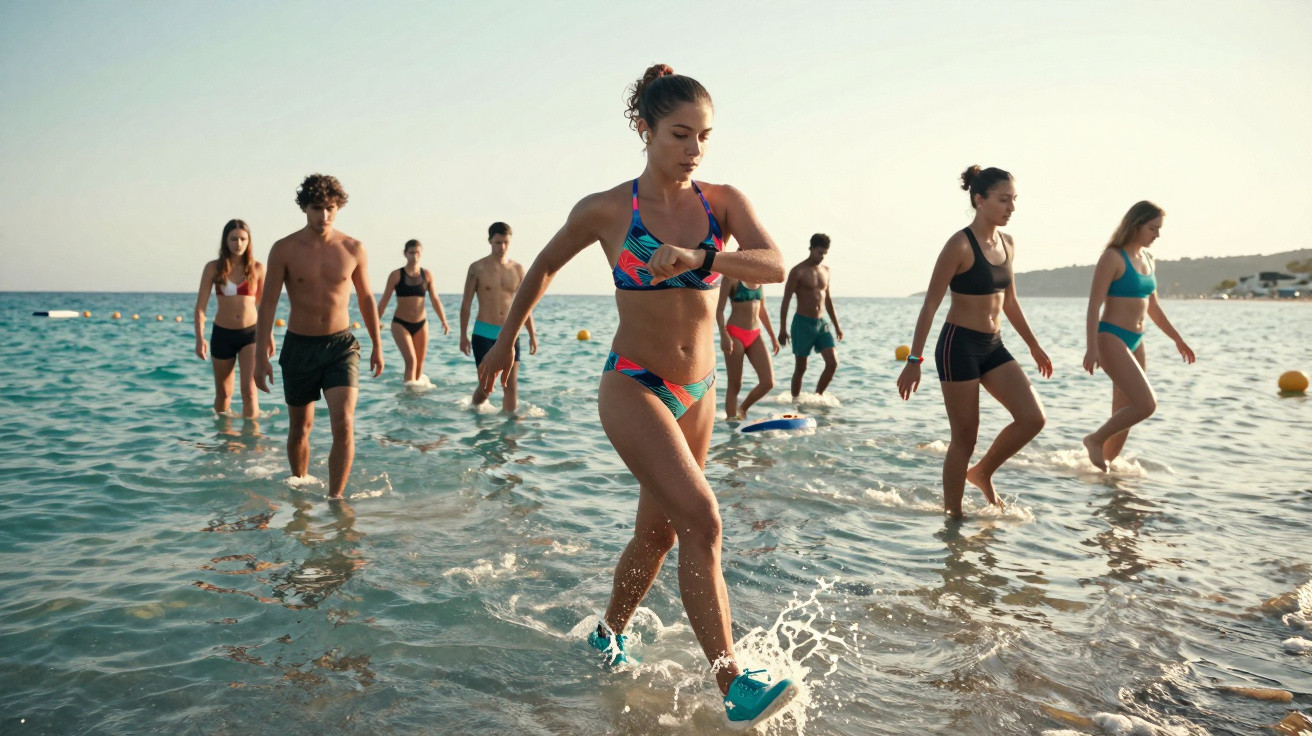
When people think of exercise for weight loss, jogging, the gym or HIIT usually come to mind. Yet another activity has quietly become established on beaches and lakesides: groups in wetsuits apparently strolling comfortably through the water. Although it looks harmless, a closer look reveals remarkably effective exercise for shedding excess weight and tackling stubborn cellulite.
What the Aquawalking trend really involves
Known as Aquawalking – often called “Longe-Côte” in French – this activity is based on a very simple principle: walking in water. Ideally, the water should reach somewhere between the navel and the armpits. Sessions take place in the sea, a lake or a large bathing lake, usually in groups and often while wearing a wetsuit.
The movement itself may seem unremarkable: you walk forwards against the resistance of the water, sometimes using poles and sometimes without them. However, that resistance is exactly what makes it effective. Muscles have to work much harder than they do on land, while the joints and spine are significantly relieved at the same time.
The body feels noticeably lighter in water, reducing the strain on the knees and hips – while the training effect remains.
Buoyancy in the water supports much of the body’s weight. Experts estimate that only around one tenth of actual body weight is still placed on the joints. For people who are overweight, have osteoarthritis or sensitive knees, this can be a real game changer: intensive exercise without ending up on the sofa afterwards with aching joints.
Why Aquawalking is more than “a sport for grannies”
Because older people in colourful swimming caps are often seen along many coastlines, Aquawalking is readily labelled “a sport for grannies”. That label is misleading. The deciding factor is pace. Anyone shuffling through the water at a leisurely strolling speed will naturally get only a moderate workout. But those who walk briskly, use their arms actively and genuinely push against the waves will soon be out of breath.
It primarily works the following areas:
- Thigh and glute muscles, through powerful leg drive
- Abdominal and core muscles, which keep the body stable in the water
- Back muscles, which support posture and balance
- The cardiovascular system, through continuous endurance work
The deeper the water, the greater the resistance. Anyone venturing into deeper water will quickly feel how intensely their leg and glute muscles are working. This also explains why many participants describe a more toned silhouette after several weeks – even if the number on the scales does not fall dramatically.
Calorie burning: what Aquawalking can really deliver
Specialist fitness websites estimate that a person weighing around 70 kg can burn approximately 500 to 550 kilocalories per hour of brisk Aquawalking. That is comparable to an easy running session, but is considerably kinder to the joints.
The key is the so-called endurance zone. Sports educators recommend raising the heart rate to around 60 to 70 per cent of the individual maximum. In this range, the body obtains a large proportion of its energy from fat reserves.
The ideal range is reached when you are breathing noticeably harder but can still hold a conversation without difficulty.
In water, this usually means a pace of roughly 5 to 8 km/h – faster than many people initially expect. To encourage the body to burn more fat, this pace should be maintained for at least 45 minutes after a short warm-up.
What a typical Aquawalking session can look like
- 10–15 minutes of warming up: brisk walking along the shore or in shallower water, a few gentle high knees and arm circles
- 30–45 minutes for the main section: walk briskly in chest-deep water, maintain the pace while still being able to talk
- 5–10 minutes of cooling down: reduce the pace gradually, slow down and finish with some light stretching on land
Those new to the activity should begin with shorter sessions of 20 to 30 minutes in the water, then increase the duration gradually. Two sessions a week are often enough for the first visible effects, while three are ideal.
How water exercise can help with cellulite
Alongside calorie expenditure, Aquawalking has a second, very practical benefit: water acts like a gentle, continuous massage. Every movement presses water against the legs, buttocks and hips, so the skin is constantly lightly kneaded. This pressure supports lymphatic flow and circulation in the tissues.
This is where its anti-cellulite effect comes in. Improved circulation and greater muscle tone can noticeably reduce the appearance of the typical dimples on the thighs. After several weeks, many women report that their skin appears smoother and their legs feel “lighter”.
The combination of resistance, massage effect and continuous movement makes Aquawalking a genuine all-rounder for body shape and skin appearance.
Nobody should expect miracles overnight. However, those who get into the water regularly while also following a reasonably balanced diet can gradually reduce fat, strengthen connective tissue and promote a firmer body.
How beginners can start safely
Before getting started, it is worth considering a few basic rules:
- Choose a suitable location: a calm stretch of beach or a lake with a shallow entry, no strong currents and ideally a supervised bathing area
- Check your equipment: depending on the water temperature, wear a wetsuit, water shoes for better footing and possibly gloves in cold conditions
- Never begin alone: particularly in the sea, always go with someone else or join a guided group
- Do not skip the warm-up: cold muscles are more prone to injury, so a few minutes of preparation pays off
Anyone with pre-existing heart conditions, serious joint problems or a chronic illness should briefly discuss their plans with their treating doctor first. The answer is usually positive, as the activity remains comparatively gentle on the joints.
How often should you train to see real changes?
Reports from trainers indicate that, after around four to six weeks of regular Aquawalking, many participants feel noticeably fitter. Endurance improves, resting heart rate and blood pressure get better, and the first visible changes to the legs and waist become apparent.
A rough plan could look like this:
| Training week | Frequency | Duration per session | Goal |
|---|---|---|---|
| 1–2 | 1–2 times per week | 20–30 minutes in the water | Get used to the feeling of water and its temperature |
| 3–4 | 2 times per week | 35–40 minutes in the water | Increase pace and bring heart rate into the endurance zone |
| From 5 | 2–3 times per week | 45–60 minutes in the water | Specifically stimulate fat burning and toning |
Related activities and useful combinations
Anyone who enjoys moving in water can combine Aquawalking effectively with other gentle forms of exercise. Many training plans use a mix of:
- Aquawalking or Aqua Jogging for endurance and body shape
- Light bodyweight strength training for the back, arms and shoulders
- Stretching exercises or yoga for mobility and relaxation
This combination not only increases calorie expenditure but also stabilises the joints and core. It is an especially body-friendly alternative for people who repeatedly struggle with conventional jogging because their knees or back object.
What beginners often underestimate
Two aspects are frequently overlooked at the start: cold and currents. Cold water uses energy and makes the heart rate rise more quickly. A wetsuit keeps the body warm and significantly extends the possible training duration. At the same time, even a light current can dramatically increase the effort – rather like walking uphill in water.
Wearing a sports watch with heart-rate monitoring helps you stay in control. It makes it easier to check whether you are exercising in the desired range of 60 to 70 per cent of your maximum heart rate or are well above it.
Perhaps the biggest surprise is this: from the outside, Aquawalking may look like a sedate activity for older holidaymakers, but it actually provides a serious training effect that can noticeably change weight, body shape and skin – as long as you stick with it consistently and do not choose too leisurely a pace.





Comments
No comments yet. Be the first to comment!
Leave a Comment