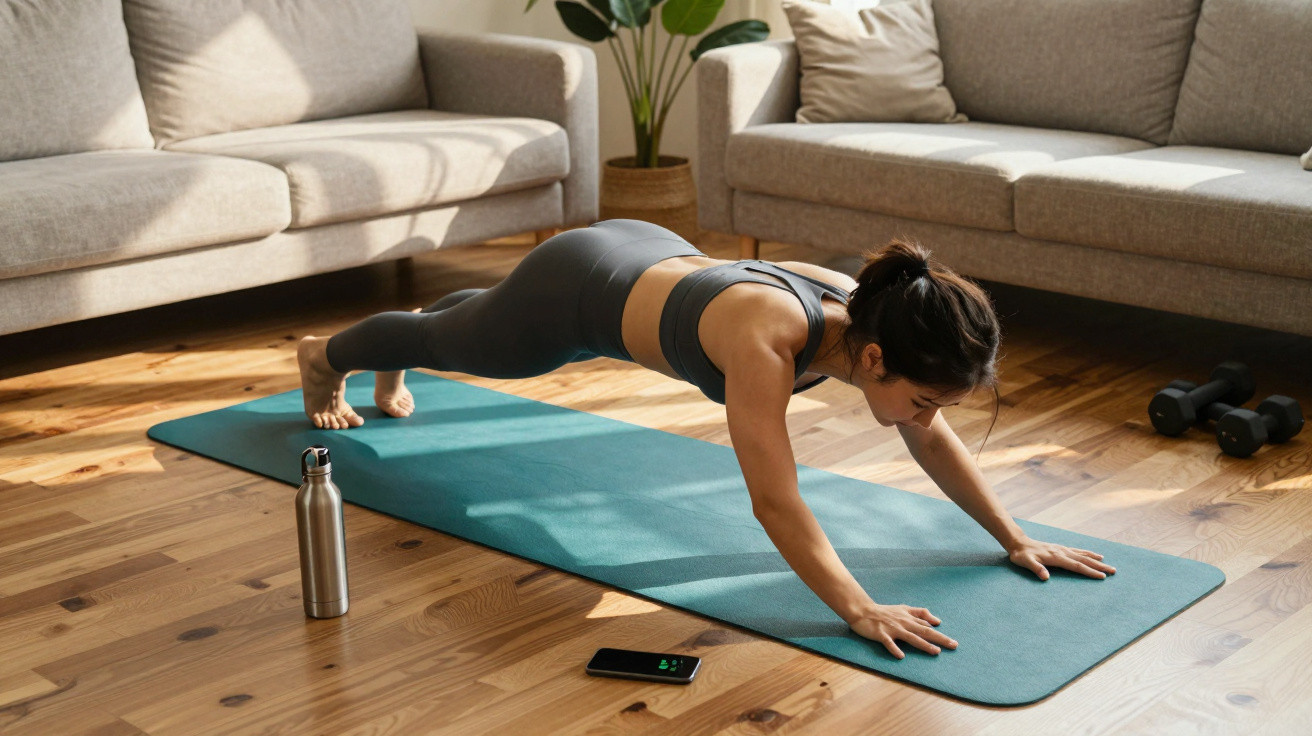
Many people are stressed, spend much of the day sitting and have little time – and the first place they feel it is often their back or neck. This is exactly where an understated exercise comes in, one trainers around the world agree on: it needs hardly any space, no equipment at all, works the abs, back, shoulders, glutes and legs at the same time, and even fits into a short gap between appointments.
Why trainers swear by the plank
The exercise is called the plank, also known as a forearm plank or forearm support. At first glance, it seems harmless: you hover almost horizontally above the floor, supported by your hands or forearms and toes, and simply stay still. There is no jumping, pulling or lifting weights.
“The plank is a static full-body exercise that activates more muscles in a few seconds than many complex training machines.”
Its secret lies in how it loads the body. Unlike sit-ups or crunches, it does not work only the visible abdominal muscles. The plank challenges the entire torso – the so-called core – including the deeper stabilising muscles. These muscles support the spine during everyday movement: when lifting a crate of drinks, carrying a child or even turning quickly in an office chair.
At the same time, the shoulders, upper back, glutes, hips and leg muscles all tense to keep the body aligned. This creates a kind of full-body tension arc – like a human plank.
Better posture, less back pain
Training planks regularly primarily strengthens the centre of the body. This can improve posture, relieve pressure on the lower back and noticeably reduce tension. Trainers repeatedly report that people with desk jobs find, after just a few weeks, that they sit more upright and tire less quickly.
The second major benefit is that the plank is isometric. In other words, the muscles maintain tension without the joints moving. This type of training is particularly gentle on the knees and back, while still being highly effective for strength and stability.
How to perform a proper plank at home
Technique determines both the benefits and the risks. Many people hold a forearm plank for much longer than necessary, but allow their hips or shoulders to drop in the process. This removes the training effect and shifts the strain to where it does not belong, such as the lower back.
Step-by-step guide to the forearm plank
- Lie face down with your forearms on the floor and your elbows directly beneath your shoulders.
- Place your toes on the floor, then brace your glutes and abdominals.
- Lift your body from the floor until only your forearms and toes remain in contact with it.
- Aim to create as straight a line as possible from your head to your heels.
- Look slightly downwards and keep your neck in line with your spine.
- Continue breathing calmly, and slowly release the tension as soon as your form breaks down.
A common mistake is allowing the pelvis to sag downwards. This transfers pressure into the lower back. A “mountain” in the middle is just as unhelpful: if the hips are held too high, it takes tension away from the core.
“Quality comes before duration: ten seconds in a perfect position achieve more than a minute with an arched lower back.”
How long should you hold it and how often should you repeat it?
Trainers often advise beginners to use short, controlled intervals. Rather than aiming for a full minute immediately, many start with 10 to 20 seconds, followed by a brief rest. Three to five well-executed rounds are entirely sufficient at the beginning.
| Training level | Hold time | Repetitions |
|---|---|---|
| Beginner | 10–20 seconds | 3–4 sets |
| Intermediate | 30–45 seconds | 4–5 sets |
| Highly experienced | 60+ seconds | 3 sets are often enough |
One rule is crucial: end the exercise as soon as you can no longer maintain a line from head to heels. Anyone who keeps “pushing through” beyond that point is usually no longer training towards the intended goal.
Plank variations for every fitness level
As the forearm plank is so versatile, it suits both beginners and very fit people. Small adjustments make it possible to tailor the difficulty precisely.
Easier ways to get started
- Kneeling plank: Rest your knees on the floor rather than your toes. This reduces the leverage and makes the exercise considerably easier.
- Plank against a wall or table: Place your forearms on a sturdy table or against a wall, with your legs angled backwards. This is ideal for people with significant excess weight or back problems.
More challenging options for advanced exercisers
- Side plank: Position your body sideways, supported by one forearm and the outer edges of your feet. This variation particularly targets the side core muscles.
- Plank with leg lifts: From a standard forearm plank, lift one leg a few centimetres at a time, alternating sides. This makes the hips work even harder to remain stable.
- Plank with shoulder taps: In a high plank on your hands, alternately tap the opposite shoulder with one hand without tilting sideways.
These variations keep the exercise interesting and turn it into a mini workout that remains demanding even after months.
How to fit the plank into everyday life
As it requires neither equipment nor much space, the plank can be added almost anywhere: in the morning before a shower, in the evening before watching television or during a home-working break. Many trainers recommend combining it with two or three other exercises, such as squats and a simple back extension.
Anyone who spends five to eight minutes on such a short routine three times a week builds a solid foundation for greater strength and stability. The plank acts as its centrepiece, “switching on” the whole body.
Risks, limits and useful additions
People with acute back problems, shoulder injuries or high blood pressure should speak to a doctor before starting training. The static load may be too much where existing complaints are present, particularly if the technique is not yet sound. A mirror or mobile phone recording can help you check your own posture.
The plank alone is not enough for building muscle mass; this requires additional strength exercises with progressively greater resistance. As a foundation for a stable body that copes better with everyday demands, however, it is hard to beat.
It combines well with:
- Walking or gentle jogging for cardiovascular fitness
- Squats or lunges for the legs and glutes
- Pulling exercises using a simple resistance band for the upper back
Those who are new to it often feel the plank within the first few seconds: the muscles shake, breathing becomes stronger and time seems to drag. That is precisely what shows how much is happening in the body – without a machine, without a subscription, just a patch of floor and a few minutes of concentration.








Comments
No comments yet. Be the first to comment!
Leave a Comment