
As skin changes with age, the mirror can feel unforgiving: fine lines, redness and pigmentation marks appear – while much-loved make-up can often make them stand out even more. Increasingly, make-up artists are moving away from full-coverage foundation for mature skin and opting instead for modern tinted skincare products such as CC creams. They promise a smoother-looking complexion, less emphasis on wrinkles and a natural finish that does not look mask-like.
Why traditional foundation can make mature skin look older
Over time, skin tends to become thinner, drier and more sensitive. What looked flawless at 25 can suddenly appear “cakey” at 50: make-up gathers in lines, pores look more pronounced, dry patches become flaky and redness shows through.
- Finer skin texture: Products settle more noticeably into lines and wrinkles.
- Greater dryness: Powder and matt formulas can look dull and draw attention to flakes.
- Uneven complexion: Redness, dark marks and visible blood vessels become more common.
- Sensitivity: Applying too much product can irritate the skin and make it appear stressed.
Many make-up artists say they are less likely to achieve a satisfying result with traditional foundation on clients from around 45 to 50 onwards. The skin can quickly look overloaded, the complexion becomes flat and facial expression loses its liveliness.
The aim of modern make-up professionals: skin should look like skin – simply calmer, smoother and fresher.
What makes CC creams so appealing for mature skin
CC originally stands for “Colour Correcting”. The abbreviation describes a blend of tinted skincare, light foundation, serum and often sun protection – making it a genuine all-rounder for anyone who prefers an uncomplicated routine.
Gentle correction rather than full coverage
Unlike many classic foundations, CC creams generally offer light to medium coverage. They glide over the skin instead of settling into every pore, primarily evening out variations in colour:
- redness around the nose and cheeks is neutralised,
- pigmentation marks look softer,
- the overall appearance is calmer without looking overly “made up”.
Mature skin benefits particularly well from this, as it often needs less “perfection” and more balance and freshness. Professionals report that CC creams can visually soften wrinkles by diffusing light and giving skin a subtly plumped appearance.
Skincare, protection and make-up in one step
Many CC creams combine several benefits:
| Function | Benefit for mature skin |
|---|---|
| Moisturising care | Plumps fine lines and helps prevent tightness |
| Serum actives | Anti-ageing ingredients such as peptides, antioxidants and niacinamide |
| Tint | Light to medium coverage for a natural-looking complexion |
| Sun protection | SPF, often 30 or 50, helps protect against sun-induced skin ageing |
For many women, this can remove several steps from their morning routine. Rather than applying serum, day cream, sun protection and foundation, they use one product on the face – saving time and avoiding layer upon layer that can otherwise quickly look mask-like.
Popular CC creams professionals favour for mature skin
Make-up artists repeatedly mention several products that have proved especially effective on mature skin. These include internationally recognised brands that are readily available in the UK.
Full coverage and high protection
“IT Cosmetics Your Skin But Better CC+ Cream SPF 50+” is considered a classic for those wanting several benefits in one step. It offers:
- a high sun protection factor,
- a broad shade range – including shades for deeper skin tones,
- coverage closer to that of a foundation,
- a creamy texture that reliably conceals redness.
Despite its stronger coverage, the finish usually remains lively rather than completely matte, which suits mature skin.
A light “second-skin” feel
Those who prefer an even more natural result often choose very fine-textured options, such as Erborian’s CC cream with Centella Asiatica. It is almost invisible on the skin, yet delivers plenty of radiance. Skin appears more translucent while also looking fresher – like it does after a good night’s sleep.
Budget-friendly high-street alternatives
Not every mature complexion needs an expensive luxury pot. Brands such as L’Oréal Paris offer CC creams tailored to the needs of mature skin, for example with:
- extra care for dryness,
- formulas that do not accentuate wrinkles,
- colour-adapting pigments that blend with the complexion.
Dermocosmetic brands such as La Roche-Posay also pair high sun protection, at around SPF 50, with tinted anti-ageing skincare. This can be especially appealing for sensitive and sun-damaged skin types.
Mature skin does not need a thick layer of make-up – it benefits from light, intelligent textures that care for it and correct only where needed.
How make-up professionals apply CC cream to mature skin
Even the best texture achieves little if it is not applied correctly. Make-up artists use different methods, but always tailor them to the skin.
Preparation comes first
Skin should be thoroughly hydrated before applying CC cream. Ideally, use:
- a gentle serum, for instance with hyaluronic acid or niacinamide,
- a nourishing but not overly rich day cream,
- additional sun protection if the CC cream has a low SPF.
Applying tint directly to dry skin risks a patchy finish or product settling into fine lines.
Brush, fingers or sponge?
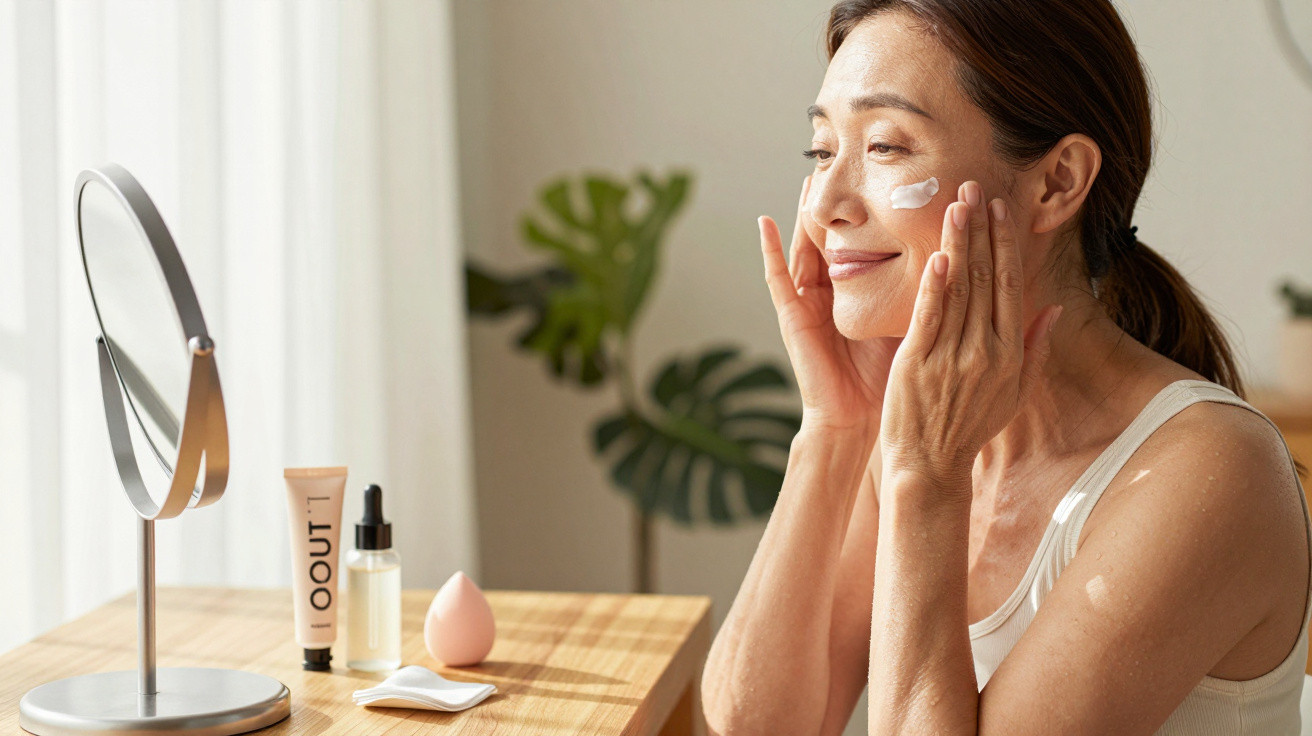
Some professionals use a dense brush to work CC cream into the skin first. They then go over it with a lightly dampened make-up sponge to soften edges and blend the product seamlessly into the complexion. The result resembles a gentle “airbrush” effect.
Others favour applying it directly with their fingers: body heat helps the cream melt into the skin, creating an even more natural finish. The important thing is to begin with a small amount of product, particularly at the centre of the face, then blend outwards.
How much powder can mature skin handle?
Powder can set the complexion, but it can also quickly take radiance away from mature skin. Make-up artists therefore recommend:
- lightly powdering only the T-zone (forehead, nose and chin),
- choosing a transparent, very finely milled powder,
- picking up as little product as possible with a large, soft brush.
Too much powder can sit over fine lines like a veil and make them appear more noticeable. Anyone prone to shine can touch up during the day with blotting papers rather than applying more powder.
BB, CC or foundation – what really suits skin over 50?
The terminology often causes confusion. In brief:
- BB cream: Lightly tinted skincare with barely any coverage; more of a “Your skin but better” option for very natural looks.
- CC cream: Focuses on colour correction and balancing redness, offers medium coverage and often contains anti-ageing actives.
- Foundation: A dedicated make-up base with light to high coverage depending on the product – it generally needs additional skincare underneath.
Many skin types over 50 do well with a combination: on calmer days, a light BB or CC cream is enough; for special occasions, concealer or a thin layer of foundation can be added selectively where more coverage is needed, such as over pronounced pigmentation marks.
Can a CC cream replace day cream?
Experts advise retaining serum and moisturiser, particularly for dry or sensitive skin. Although most CC creams offer skincare benefits, they are not designed as a complete skincare routine on their own. Wearing them solo can lead to dryness and a tight feeling as the day goes on.
A sensible order for mature skin could look like this:
- Gentle morning cleanse
- Serum (for example, hydration or anti-ageing actives)
- Day cream suited to the skin type
- Sun protection, if the CC cream does not provide enough
- CC cream as the tinted finishing step
Practical tips for a smooth, fresh-looking complexion after 50
Anyone changing from foundation to CC cream may need a little fine-tuning. A few techniques make the transition easier:
- Less is more: It is better to work in two very thin layers than apply one thick layer.
- Conceal selectively: First work on redness locally with a small brush, then gently blend out the rest.
- Place glow deliberately: A cream highlighter on the cheekbones and above the lip line adds freshness without drawing attention to fine lines.
- Treat the eye area gently: Use only a small amount of product beneath the eyes, otherwise the area can look tired and dry.
Anyone with very visible pores can use a pore-refining primer only on those areas before applying CC cream. This keeps the rest of the face natural while making problem areas appear smoother.
What really creates the “soft-focus effect”
Many CC creams rely on optical effects. Tiny reflective pigments refract light so that wrinkles and uneven texture appear softer. This is not Photoshop but physics: light is dispersed more broadly, allowing contours to fade into the background.
They also often contain ingredients that may offer longer-term support, such as antioxidants against free radicals or substances that strengthen the skin barrier. They are not miracle products, but they provide a small bonus alongside proper skincare.
Using products with high sun protection regularly also helps slow sun-induced skin ageing over the long term. This is precisely where many modern CC creams stand out with SPF 30 or 50 – a detail that can make a real difference, especially after decades of sunbathing.













Comments
No comments yet. Be the first to comment!
Leave a Comment