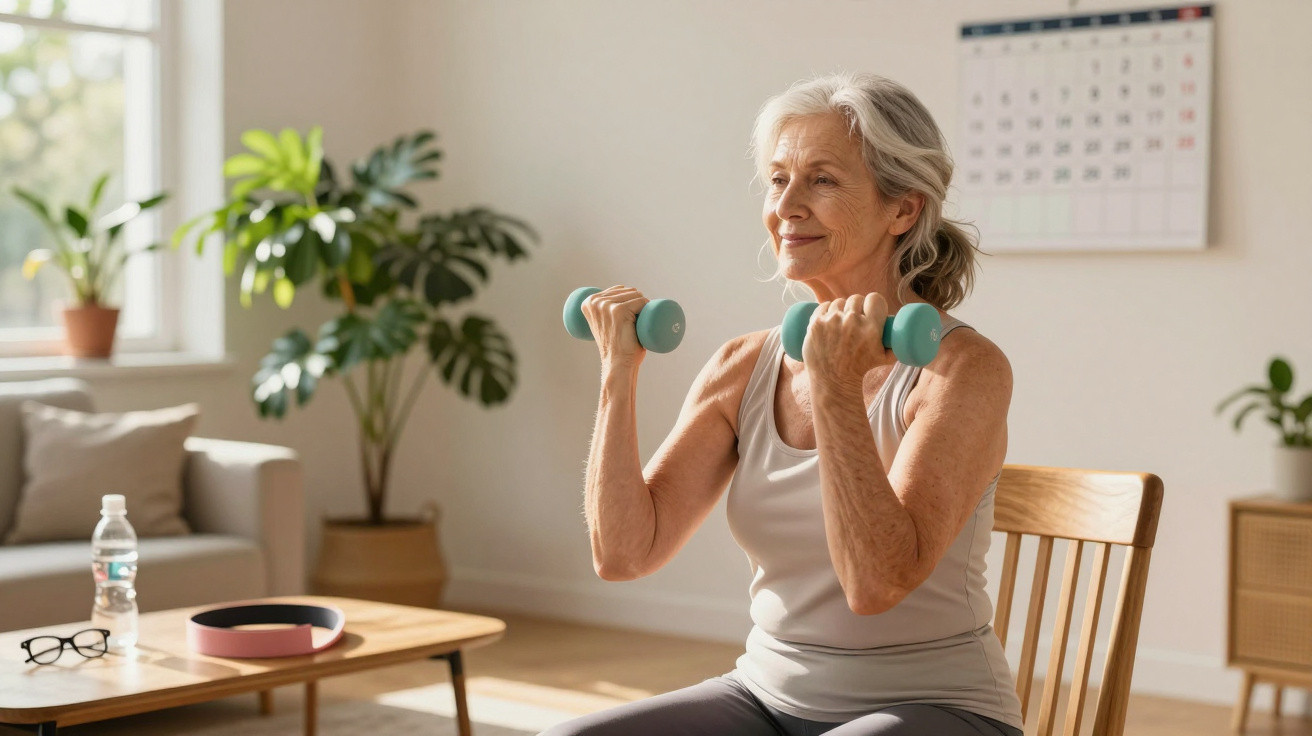
At the front of the room, a slim trainer lifts two small dumbbells as though they were paper cups. In the second row sits Mr L., 72, once an office legend, with a slight belly and a doubtful expression. “Strength training? At my age?” he mutters to the woman beside him, who simply grins and tightens her resistance band. After ten minutes, his arms are shaking; after twenty, so is his pride. Then something changes: he smiles. Not because it is easy, but because he realises his body can still respond. Six weeks later, he is carrying his shopping upstairs on his own again. No heroic tale involved. Just gentle strength exercises. And that is where the real change begins.
When the body grows quieter – but calls ever louder for help
Anyone in their early sixties may recognise the moment: you rise from the sofa and need an extra second before you are properly upright. Nothing alarming, no appointment with the GP, no major drama. Just that quiet “oof”. That slight hesitation in the knees. This is where time does its work – not in the calendar, but in the muscles. And it works at it every day.
From around the age of 30, we begin to lose muscle mass. It happens silently, with no notification arriving in your inbox. By 60, it can easily mean 30 to 40 per cent less muscle than in younger years if we do nothing. Suddenly, the kerb seems higher, the suitcase feels heavier and a fall becomes more dangerous. Muscles are not merely decorative; they are our everyday safety belt. When they weaken, it shows in small tasks: getting out of the bath, carrying a crate of water or turning over in bed.
Strength training does not have to mean a gym with booming music. Gentle exercises using your own body weight, water bottles or resistance bands are often enough to halt the decline. The aim is not bigger upper arms. It is being able to carry your shopping bag up to the third floor yourself in ten years’ time. It is getting up from your armchair unaided in the morning. It is making sure a trip does not automatically become a reason to call an ambulance.
Small weights, major benefits: how little can be enough
It is Tuesday morning, 9:00 am. In a sports hall on the edge of town, twelve people are sitting in a circle on chairs. They are aged between 61 and 82; there are a few replacement knees, an artificial hip and plenty of life stories. In front of them sit two water bottles. “Those are your dumbbells today,” says the trainer. There are sceptical looks and a quiet giggle. Then they begin: lift the arms out to the sides, lower them slowly. Raise the heels, then place them back down. Keep the back straight and breathe.
After 15 minutes, their faces are focused. Some shake out their hands. No one here is taking selfies. At the end of the session, the trainer asks, “Who can feel their shoulders?” Almost everyone puts up a hand. After eight weeks, several say they suddenly “need” the escalator at the shopping centre less. One participant says she got up from the floor for the first time in years without having to pull herself up on something. The remark lingers in the room like a small victory: entirely unshowy, yet enormous.
Scientists refer to this as “functional ageing”. It means how well a person can still manage everyday activities in reality, rather than how old they are on their identity card. This is exactly where gentle strength exercises excel. They primarily develop the muscles we use every day: legs for standing up, the core for posture and arms for carrying. Even two brief sessions a week can reduce the risk of falls, improve walking speed and extend independence. Let us be honest: no one truly does it every day. But people who start at all often push their limits much further back than they expected.
How to start strength exercises without overdoing it
Starting gentle strength exercises does not need to become a project involving a spreadsheet. For the first few weeks, a sturdy chair, a little space in the living room and comfortable clothes are almost all you need. A straightforward beginning is 15 to 20 minutes twice a week. Not an obligatory marathon, but a fixed appointment with yourself. Ideally, schedule it at the same time each day, like a small diary commitment that cannot be negotiated away.
Start with three basic movements: sitting down and standing up from a chair for the legs; lifting water bottles out to the sides for the shoulders; and slowly rolling down and straightening up while seated for the core. Do 8 to 10 repetitions of each exercise, keeping the pace calm throughout. At first, it may seem almost too easy. By the third round, many people notice that the body agrees – but makes its presence very clear.
Many people over 60 begin full of enthusiasm, then stop abruptly at the first twinge. The first typical mistake is going too quickly, doing too much and making it too complicated. Muscles thrive on repetition, not spectacle. A simple programme that actually gets done is better than a perfect routine that disappears into nothing after three days. The second typical mistake is comparing yourself with your 40-year-old self. That can only be frustrating. What matters is not what you used to manage, but what changes over the next four weeks.
Anyone already dealing with osteoarthritis, back problems or heart concerns should get approval from their doctor before starting. This is not about fear; it is a safety net. One more point: short breaks are not a sign of weakness, but part of the plan. If breathing becomes too rapid or your pulse races, that is a signal, not a failure. The body is speaking, and it is worth listening.
“At 68, I thought there was no point working on my muscles any more. Now, one year later, I am carrying the potting compost into the garden myself again. It feels like my own little personal jackpot,” says Mrs B., who takes part in senior exercise classes every week.
If you are wondering where to begin, this simple list can provide some guidance:
- Legs: sit-to-stands and standing calf raises
- Core: sit upright and reach the arms forwards; gently rotate the upper body
- Arms: lift water bottles out to the sides and forwards
- Posture: stand with your back against a wall and briefly rest the back of your head against it
- Balance: stand on one leg beside a chair, resting your hand on it only lightly
Age, pride and the quiet freedom held in the muscles
There is a moment when you realise you may become a burden to other people. Someone carrying your shopping bags upstairs. A stranger suddenly lifting your suitcase on the train. The kindness feels good – but it can still sting a little. Beneath many jokes about “getting old” lies precisely this fear: what if I can no longer manage on my own? Gentle strength exercises do not remove that concern entirely. But they move back the point at which help becomes essential.
Muscles are more than tissue; they are independence in action. Strong thighs mean another flight of stairs you can still manage alone. A stable core means a more secure step on uneven ground. Those who begin at 60 are not training for summer on the beach, but for winter on an icy road. It is an unglamorous goal, but a very real one.
It is striking how rapidly the view of your own body changes once you have started. Suddenly, it is no longer crucial whether your stomach becomes flatter. The more interesting question becomes: “How many times can I get up from the chair without using my arms for support?” This kind of monitoring is quiet but honest. And it offers a new form of dignity: rather than leaving everything to the calendar, you still have a say yourself.
| Key point | Detail | Benefit for the reader |
|---|---|---|
| Muscle loss from 60 | Up to 30–40% less muscle mass without training | Understands why everyday tasks become more tiring |
| Gentle exercises are enough | 2× a week for 15–20 minutes, using a chair and water bottles | Sees that a realistic start is possible without a gym |
| Focus on daily life | Legs, core and balance rather than “bodybuilding” | Learns how training can specifically prevent falls and preserve independence |







Comments
No comments yet. Be the first to comment!
Leave a Comment