
That silver strand appeared out of nowhere since last week and now seems to be mocking you. You twist it, press it flat and even attempt to tuck it behind the rest of your hair. Yet it gleams like a miniature neon sign.
In the kitchen of a London suburb, a woman in a worn T-shirt stirs a mixture that could easily be mistaken for salad dressing. A bowl, spoon, jar of instant coffee, bottle of apple cider vinegar and two tea bags sit on the table. There is no ammonia and no salon gloves, only low-cost cupboard staples and a quietly defiant mood.
She runs her fingers through the mixture and applies it along her temples, where the white hairs gather. The scent is more coffee shop than chemistry laboratory. A professional hairdresser somewhere would probably sigh. By the following morning, those grey hairs may not appear quite as they did before.
And this is precisely when the story begins to bite.
Why a “kitchen trick” is worrying hairdressers
Grey hair is not, in itself, the problem. What can be unsettling is the sense that control is slipping away, strand after strand and month after month. For hairdressers, the concern is seeing that control move from the salon to the kitchen.
During the past two years, TikTok and Instagram have made at-home hair “hacks” into a low-key revolution. People are trying everything from rice water to onion juice in pursuit of darker, fuller-looking hair without a €120 salon appointment. Among the most widely shared formulas is a straightforward mix of black tea or coffee, vinegar and a little natural oil, repeatedly applied to give grey hair a subtle stain.
Hairdressers see the before-and-after images and groan. It is not because the method is magic, but because it is inexpensive, repeatable and, with enough patience, can visibly soften grey hair.
The figures help explain the feeling. The global hair-colour market is worth billions, with much of its value tied to people seeking to cover grey. Then inflation arrived, alongside higher rents and energy bills. A full-head colour service that cost €70 in 2019 now often exceeds €100 in major cities.
Browse Facebook groups and you will find women discussing not only brown shades but also electricity tariffs and supermarket vouchers. Between tips on stretching the budget for school lunches, someone shares a fuzzy image of a jar of strong, cooled coffee, ready to pour over freshly washed hair. The replies quickly follow. “Tried this, my white roots look like light highlights now.” “I do it every Sunday, my husband thinks I went to the salon.”
A Parisian colourist told me she had lost several long-standing clients who said they were extending the gap between appointments with “tea rinses.” It is not an outright rejection of salons, but a gradual and quiet move away from reliance on them.
Beneath the social-media buzz is a more practical reality. Hair consists of keratin, a protein that cannot “heal” after damage. Strong chemical dyes lift the cuticle, add synthetic pigment and can make strands more prone to dryness and breakage. Coffee and dark tea work in another way. They neither reach deeply into the hair nor remain for long; instead, their naturally occurring tannins and pigments attach to the surface, gradually creating a mild stain.
Is it as powerful as professional salon colour? No. Will it remove a stubborn silver hair overnight? No again. What it can do is alter the overall look: grey hairs can resemble gentle highlights rather than abrupt white lines. Once people realise they can make that adjustment at home using ingredients already in the cupboard, the emotional hold of frequent colouring appointments can weaken.
That is one reason hair professionals find it irritating. They have devoted years to mastering shade charts and developer strengths, only to see someone tip a jug of chilled coffee over their head at the sink and label it a “routine.”
The cheap kitchen trick: what people are actually doing
The online “greying cure” is remarkably uncomplicated. Make very strong black tea or coffee, allow it to cool completely, and use it as a rinse after washing your hair. Some people include a spoonful of apple cider vinegar to help the colour adhere, along with a little olive or coconut oil to reduce the drying effect.
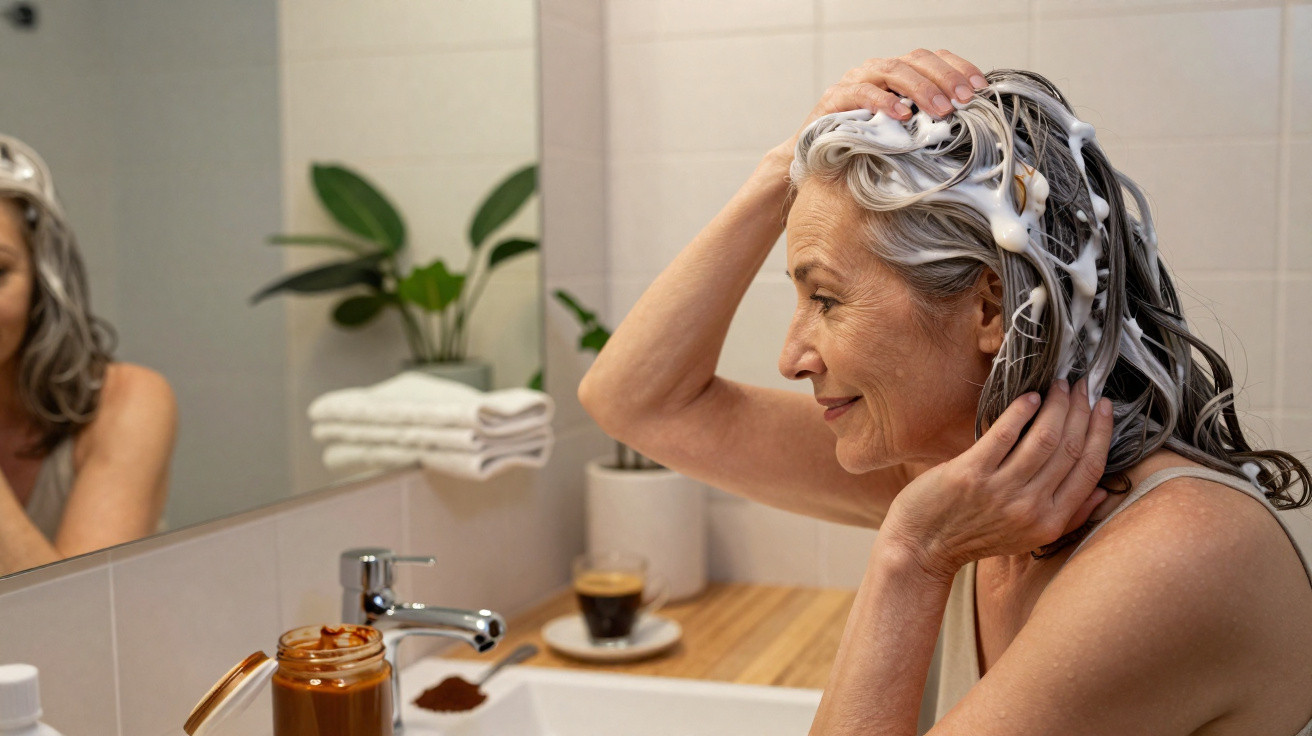
After shampooing, gently towel your hair until it is damp, then slowly pour the mixture over the scalp and lengths. Catch the run-off in a bowl and pour it over again several times. The aim is full saturation rather than a brief splash. Next, cover your hair with an old T-shirt or shower cap and leave the mixture in place for 20 to 45 minutes. No Netflix advert mentions it, but the smell resembles a café after closing time.
Rinse only with cool water and do not shampoo afterwards. The first application may produce a restrained result: grey hairs can look faintly beige or pale brown instead of bright white. Following four or five weekly treatments, many users say the difference is clear in natural light.
Everyday results rarely resemble a perfectly filtered “after” photo. A 52-year-old teacher from Lyon told me she began applying a strong tea rinse only around her hairline because she disliked the vivid white halo appearing in staff-room selfies. She steeped four black tea bags in a mug until the liquid was nearly cold, then mixed in a splash of cider vinegar and a teaspoon of argan oil.
On Sunday evenings, she worked it into her roots, wrapped a small towel around her head and dealt with emails while it developed. A month later, her husband asked whether she had “gone back to colouring.” She had not. The greys remained, but their warmer shade blended into her natural brown. Instead of colouring every five weeks, she started doing so every three months.
A Reddit thread includes close-up photos of one man’s temples before and after eight coffee rinses. At the start, his hair is distinctly salt-and-pepper. Eight weeks later, the white strands resemble subdued ash, almost as though they were deliberate highlights. It is not miraculous, but it was enough for friends to notice “something different.” For him, the main benefit was not vanity: it was the money saved and the reduced time spent beneath harsh salon lights.
From a biological perspective, no beverage or rinse can “reverse” grey hair. When a follicle stops making melanin, the hair growing from it has no colour. Natural pigments in tea and coffee can only stain the outer cuticle, much as red wine can gradually darken a white T-shirt.
Apple cider vinegar makes the blend more acidic, encouraging the hair cuticle to sit flatter. This may help pigment settle more evenly and can leave the hair looking shinier. The oils are included to offset drying caused by tannins and hot water. Salon colour ranges use sophisticated chemistry and stabilisers to retain pigment inside the hair for weeks. This kitchen approach follows the reverse principle: it is light, gradual, imperfect and temporary.
From a commercial standpoint, that is exactly what hurts. If a person swaps every other salon visit for a €0.30 serving of coffee and an undisturbed hour at home, their annual spending on colour falls considerably. Repeat that across dozens of clients, and it is understandable that stylists may feel anxious.
How to try a coffee or tea rinse without ruining your hair or bathroom
If you want to test it, approach it like a careful scientist rather than a TikTok challenge. Choose strong black tea for naturally light to medium-brown hair, and coffee for deeper brown hair. Use one large mug of boiling water with three to four tea bags, or three heaped teaspoons of instant coffee. Leave it to steep for 15–20 minutes, then let it cool fully to avoid scalding your scalp.
Mix in one tablespoon of apple cider vinegar and, if your hair is prone to dryness, one teaspoon of a light oil. Wear an old T-shirt, position yourself over the sink or bath, and pour the liquid slowly onto clean, damp hair. Collect the drips in a bowl and reapply them two or three times. Gently massage the blend into the roots, where grey is most noticeable. Cover with a shower cap, leave for 20–40 minutes, and rinse with cool water only.
The two errors most often reported are using too much and expecting a dramatic transformation. There is no need to repeat this daily. Once or twice weekly is generally sufficient to build a gentle tone. Let’s be honest: nobody really does this every day. If your hair is particularly dry, coloured or delicate, begin once every two weeks and see how it responds.
Applying it to freshly bleached or highly porous hair is another frequent mistake. Pigment may take unevenly, producing patchy streaks. First test a small section behind your ear. If you dislike the outcome, regular washing generally fades the stain within a week or two. If you are receiving treatment for scalp conditions, consult a dermatologist before applying anything unfamiliar to your skin, even something from your kitchen.
Grey hair is often coarser and more wiry, so it needs plenty of moisture. When experimenting with tea or coffee rinses, offset them with mild hydrating masks on the days in between. Treat this method as a soft-focus filter rather than a Photoshop tool. With expectations set accordingly, it can feel less pressured and more like a peaceful ritual.
“My clients are curious about these hacks,” admits Carla, a colourist in Brussels. “I tell them: try it, but come back if you want a real colour change. What scares salons isn’t tea or coffee. It’s the idea that people might realise they don’t need us every month.”
Here is a quick overview of the points that genuinely matter when trying it at home:
- Let the liquid cool completely before applying it to your scalp.
- Try it on a small concealed section first, particularly if your hair is bleached or highly porous.
- Cover towels and tiles, as coffee can stain surfaces just as readily as hair.
- Pair it with a gentle conditioning routine to prevent hair from becoming dry.
| Key point | Details | Why it matters to readers |
|---|---|---|
| Which base to choose | Choose strong black tea for light to medium brunettes, and coffee for dark brown and black hair. Do not use it on very light blonde or bleached hair unless you are prepared for a noticeable tonal change. | Selecting a suitable base lowers the chance of unusual shades and makes the result look “natural” rather than like a DIY disaster. |
| How often to rinse | Most people notice a subtle change after 3–5 weekly rinses. For upkeep, once every 1–2 weeks is generally enough, especially if you also have salon colour from time to time. | Understanding the schedule helps avoid overuse, saves time and creates realistic expectations about how quickly greys may become less prominent. |
| Protecting hair health | Counter staining rinses with moisturising masks and mild shampoos. Add a teaspoon of oil if your hair feels dry or frizzy, and avoid very hot water throughout the process. | Keeping hair hydrated means you are not exchanging fewer visible greys for additional breakage, a common concern with both salon and at-home colour. |
Grey hair, quiet rebellion, and what you really want
Behind the recipes and clickbait headlines lies something more personal than simply “cheap trick upsets salons.” The issue is about who decides how your ageing should look. Depending on the day and the light, a grey streak can feel like a small betrayal in the mirror or a mark of experience.
One day, you may enjoy working a warm coffee rinse through your roots, pleased to have outsmarted the system with supermarket ingredients. On another, you may book a salon visit and leave with glossy, even colour because that is the boost you need. Both are valid choices. We have all looked at our reflection and thought, I just want to feel like myself again.
What this kitchen method truly provides is not a miracle treatment, but some breathing room. It creates a space between “I have to colour every five weeks or I look terrible” and “I give up completely.” It offers a middle option in which grey hairs are softened rather than removed, and you choose when they are visible.
Hairdressers will continue to roll their eyes at coffee and tea. Some may adjust by offering softer, plant-based glosses that fall between kitchen remedies and laboratory formulas. Friends will continue exchanging recipes in group chats, interested, optimistic and slightly doubtful. In countless small bathrooms, people will still lean towards the mirror, turn a strand under the light and ask the quiet question beneath it all: not “How do I hide my age?” but How do I want to see myself today?












Comments
No comments yet. Be the first to comment!
Leave a Comment