The woman sitting in the waiting room repeatedly smoothed the sleeve of her pale-grey jumper. Her handbag was beige, as was the cover of her notebook; her nails were painted a translucent pink that barely seemed like a colour. When the psychologist gently asked what her favourite colour was, she paused before replying, “I don’t know… something neutral. I don’t want to stand out.”
Her response settled heavily in the room, carrying an all-too-familiar meaning.
By conventional standards, she was doing well: a good job, a settled life and nothing obviously “wrong.” But every choice she made seemed to minimise her presence. The shades she wore had the quiet quality of an apology.
That is where the pattern begins to reveal itself.
The quiet link between your colour palette and your inner critic
Ask a psychologist who notices the smallest details - someone’s shoes, phone case or the coat they choose for a wet Tuesday - and many will describe the same recurring theme. People who live with persistent self-doubt rarely announce it openly. Instead, it often shows through their colour choices.
It is not simply about what they wear on one occasion, but the colours they select time after time.
That repeated palette can communicate more than words do: gentle greys in place of confident blues, faded pastels rather than rich greens, or black without end “because it goes with everything.”
The point is not fashion. It is about feeling permitted to be seen.
A therapist in Lyon told me about a client who arrived in almost exactly the same outfit each time: black jeans, a black jumper and black trainers. The client joked that she looked like a background character in her own life. Behind that joke was a painful belief that she “didn’t deserve to attract attention.”
When the therapist asked her to bring in three photographs in which she genuinely liked her appearance, every image included a vivid flash of colour.
In one, she was laughing with friends in a red coat. Another showed her wearing a bright green dress to a summer wedding. In the third, a deep-blue scarf was wrapped around her neck during a trip to the mountains. She acknowledged that she had felt more alive in those moments.
She also admitted that she almost never gave herself permission to wear those colours day to day, “not to look like I’m trying too hard.”
Psychologists who research colour preferences are usually careful to stress one point: colours do not “cause” low self-esteem. They can reflect it.
Repeatedly opting for very low-saturation shades that seem to make a person disappear is often seen in people whose internal dialogue says: “Don’t be too much. Don’t bother anyone. Don’t get it wrong.”
Safe, neutral shades can function as a kind of armour. They lessen the possibility of being judged, remarked upon or even simply noticed.
When you doubt your own value, blending into the background feels like a strategy.
Eventually, that strategy can start to feel like identity. Your clothes, your home and even your phone wallpaper may all quietly repeat the same message: stay small, stay soft, don’t take space.
How to read your colours without falling into superstition
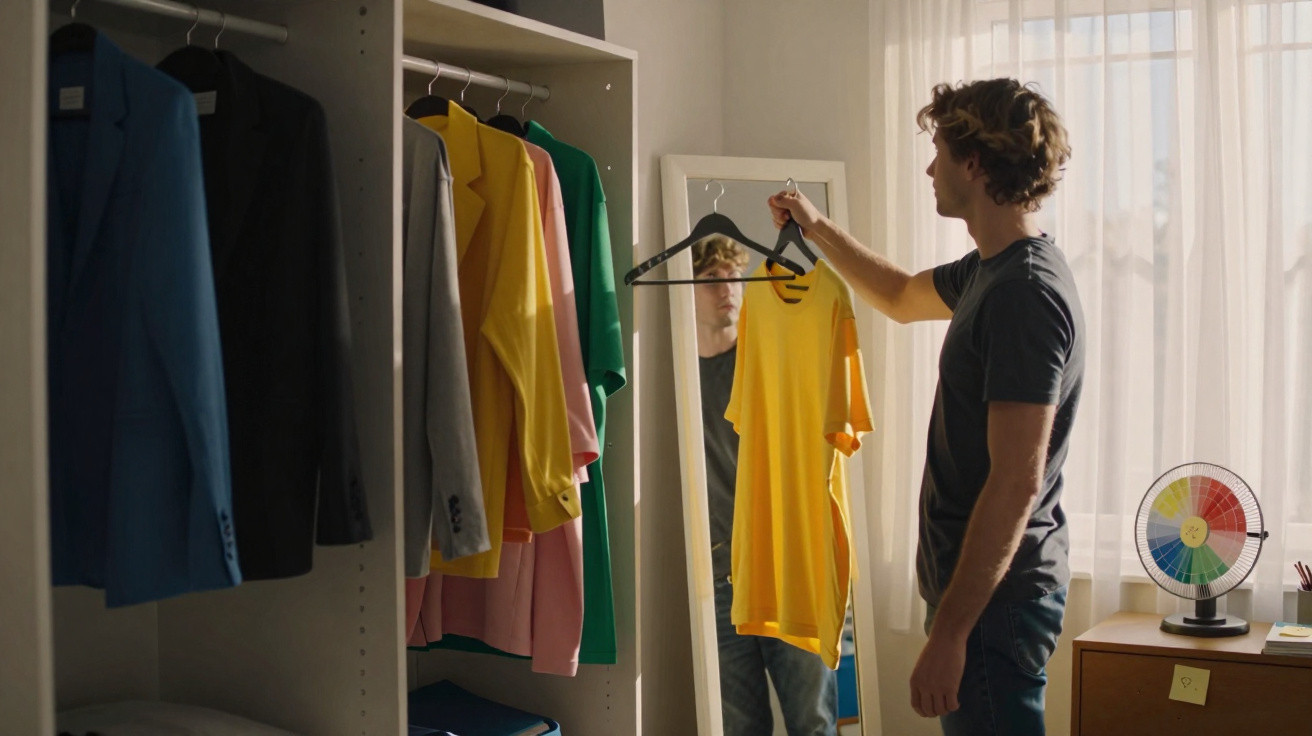
Many therapists use a straightforward exercise. Look through your wardrobe, make-up bag or even your digital world - your wallpapers, Instagram grid and favourite emojis. Divide what you find into three groups: bright and bold, medium and soft, and dark and muted.
There is no theory required, only honest observation.
Then ask yourself a single question: which group do you really wear or use most often in everyday life, rather than only for special occasions? That is often where the pattern sits.
If nearly all of your daily choices are very dark or intensely neutral, while colours you love “in theory” remain unused in a drawer, that difference can point towards a deeper story about self-permission and confidence.
It is easy to dismiss this as “just taste.” Naturally, personal taste matters. Some people truly prefer minimalist colour schemes or Scandinavian-style beige. The important clue is not the shade itself.
It is how much freedom you feel to move beyond it.
If wearing a bright jumper at work makes your chest feel tight, or if you repeatedly tell yourself that coloured lipstick is “not for people like me,” you may be doing more than managing your look. You may be managing anxiety.
The truth is that almost nobody makes these decisions with complete awareness every day. We fall into routines. After years of choosing not to be noticed, it can feel like an essential part of who we are, even when it may be self-doubt that has simply been rehearsed for a long time.
Several psychologists I spoke to called this “visual self-silencing.” One described it like this:
“Color is often the first language we use to negotiate with the world. When someone constantly picks colors that erase them from the scene, it usually means they’re trying to feel safe from judgment or rejection.”
She identified three patterns that she encounters repeatedly, particularly among people with low self-confidence:
- Wearing black constantly “to look thinner” or “more professional,” which can conceal a fear of being judged.
- Choosing extremely pale, faded tones to avoid “looking loud” or “drawing attention.”
- Reserving more daring, joyful shades for unusual occasions, as though everyday life does not merit them.
These are not fashion offences. They are emotional coping strategies in a stylish disguise.
From invisible palette to conscious choice: tiny colour experiments
One gentle approach now suggested by many therapists is almost embarrassingly simple. Choose one small object and change its colour. Do not alter your whole outfit or repaint your living-room wall. Start with a pen, mug or phone case.
Then pay attention to what happens internally.
If opting for a stronger blue or warmer red starts a quiet internal argument - “Is this too much? Will people comment?” - you have encountered your inner critic in the moment. That unease is useful information.
Colour can become a low-risk space in which to practise visibility, assertiveness and even joy before trying those qualities in more significant areas of life.
One common error is attempting to undo years of self-effacement through a dramatic colour revolution. Throwing away every beige item overnight and purchasing a neon wardrobe is more likely to feel punitive than restorative.
Psychologists generally advise the reverse: small shifts.
Try a deeper green scarf instead of a grey one. Choose a lipstick that is slightly brighter than your usual shade. Add a cushion that genuinely reflects a colour you secretly enjoy.
Such small experiments show your nervous system that becoming a little more visible does not automatically result in shame or criticism. Confidence develops through these minor negotiations, rather than only through grand statements.
One therapist put it in a way that stayed with me:
“When you let yourself wear the colors you truly love, you’re not being superficial. You’re sending your brain daily proof that you’re allowed to exist as you are.”
If you would like to turn this into practical action, try a simple weekly “colour check-in”:
- Review what you have worn or surrounded yourself with over the previous seven days.
- Consider whether you have repeatedly selected colours that conceal you more than they express you.
- Introduce one item in a shade that feels a little bolder, while still being safe enough to attempt.
This is not about dressing like a highlighter pen. It is about gradually easing the hold of that quiet, persistent voice telling you that you do not deserve to be seen.
What your favourite colour might be asking you to explore
At this stage, many readers may find themselves defending their affection for black, beige or soft greys - and rightly so. Colour psychology is not a rigid horoscope. No credible psychologist would insist that “people who love blue are always confident” or that “those who pick brown lack self-worth.”
The meaning lies in repetition, avoidance and emotion.
If the thought of wearing something a little brighter makes you curious, you are probably in a flexible place. If it fills you with dread, or immediately brings up a harsh inner voice that ridicules you, something deeper may need attention.
Sometimes the boldest act is not changing careers or making a dramatic speech. It may be replacing an “invisible” jumper with one small touch of colour, then noticing which parts of you object.
| Key point | Detail | Value for the reader |
|---|---|---|
| Recurring colour patterns | Frequently choosing highly neutral or dark shades can reflect ongoing self-doubt, rather than fashion taste alone. | Helps you identify subtle signs of low self-confidence in daily life. |
| Gap between “loved” and “used” colours | Colours you enjoy in photographs but avoid wearing can reveal where you censor yourself. | Provides a gentle place to begin personal exploration and change. |
| Micro colour experiments | Small adjustments, such as accessories or objects, can steadily help your mind tolerate greater visibility. | Offers a practical, low-risk route towards rebuilding self-confidence. |
FAQ:
Question 1: Does liking black automatically mean I have low self-esteem?
Not at all. Black may feel elegant, practical or comforting. Psychologists consider rigidity and anxiety: if you feel unable to wear anything but black, or frightened of brighter shades, it may indicate deeper self-doubt.Question 2: Can changing my colours really change my confidence?
Colour alone will not solve everything, but it can be a valuable supportive tool. Every small, deliberate decision that challenges your usual self-effacing pattern works like behavioural practice for becoming more visible and self-assured.Question 3: What if I genuinely love neutrals and feel good in them?
In that case, they may simply be part of your authentic style. The central question is whether you can experiment freely, without panic or shame. If you can, your neutrals are probably expression rather than concealment.Question 4: How can I start if I feel ridiculous in bold colours?
Begin very small: try socks, notebooks, keyrings or a mug. Pick shades only one step brighter than normal, rather than a complete contrast, so that your nervous system remains within a tolerable range.Question 5: Should I talk about this with my therapist?
Many therapists welcome these specific details. Bringing photographs of your wardrobe, room or favourite outfits can lead to valuable conversations about identity, visibility and the beliefs influencing your choices.








Comments
No comments yet. Be the first to comment!
Leave a Comment