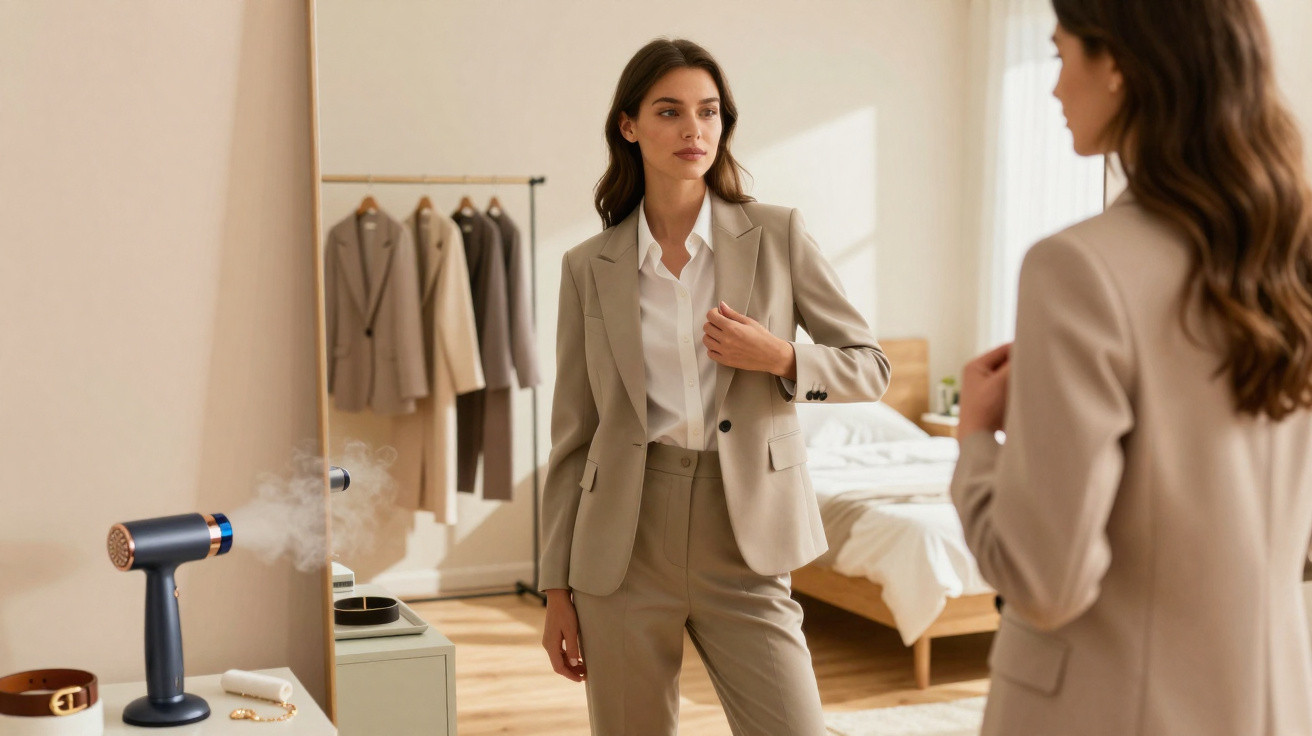
1. Give every outfit more structure
“When it comes to instant transformation, adding shoulder pads to almost anything works every time,” says celebrity stylist Deborah Sheridan-Taylor.
Add them to a jumper, blouse, blazer or even a coat, and the shape will instantly look sleeker.
“Watch the price point multiply before your eyes,” she says. Although Eighties shoulders have been prominent on fashion-week catwalks, the additional structure also sharpens the shoulder line, making the waist and overall proportions appear more deliberate - and therefore more luxurious.
Luxury fashion stylist Oriona Robb similarly believes that subtle adjustments to proportion make all the difference. “It’s about looking like you meant to wear it that way,” she says.
“A half tuck, pushing sleeves up properly, adding a belt or swapping the shoe can suddenly make an outfit feel properly styled and more expensive.”
2. Tailoring is essential
While many people reserve tailoring for investment purchases, paying to taper a pair of high-street jeans can make them appear as though they cost three times as much.
Sheridan-Taylor calls tailoring “Transformative, non-negotiable and wildly underestimated”.
The length of trousers is especially important, she says. “Even the most luxurious trousers can look off if they’re hemmed too short. Go super long, or go home.”
She also advises making discreet alterations, including reshaping sleeves - or “banana-ing”, as she calls it, which changes a cuff into a curved hem - taking in a blazer at the waist, or removing thick pocket bags from trousers to create a smoother front.
Robb points to comparable finishing details. “If trousers are bunching or dragging it immediately looks off.
In high-street tailoring, arm and leg lengths are often shorter, to save on fabric costs, but this can often make a piece look cheaper, such as if it’s short in the arm.
However, it’s more difficult to make a piece longer in tailoring, so the stylists suggest buying bigger, then paying for clothes to get hemmed or shortened.
A good tailor can make an average piece feel bespoke.”
3. Go up a size for a better drape
This brings us to one of Sheridan-Taylor’s most frequently repeated principles: “Size up.”
“When fabric is under strain, every weakness becomes visible – seams, lining, stitching. It immediately lowers the perceived value,” she explains.
Choosing a size larger - or occasionally two sizes larger - lets the material drape rather than cling.
The result is a looser, more fluid silhouette that looks more expensive. The fit can then be refined through carefully considered alterations.
Robb says that garments which are too tight, or do not sit properly over the layers beneath, can immediately make an outfit look cheaper.
Ignore the number on the label and concentrate instead on how the garment’s lines look when worn. As sizing differs between shops, trying clothes on in person is essential.
4. Select fabrics carefully
“Fabric is usually the giveaway,” says Robb.
Materials with substance and texture, such as proper cotton shirting, 100% wool and linen, generally retain their shape and photograph well.
Sheridan-Taylor would always choose a luxury second-hand item over an average new one, favouring natural fibres including cashmere, camel hair, merino wool, silk and gabardine.
Synthetic materials, she says, can hang poorly on the body and seldom improve over time. “Natural fibres soften and develop character.”
Print is another element worth considering.
“High-street prints are often overly recognisable and date quickly,” she says. Bold plain colours are usually more enduring and, as a result, look more expensive.
5. Perfect a tonal colour palette
Print naturally leads to colour, which can create more perceived value than expected.
“I am a firm believer that going tonally – committing to one colour from head to toe – is the single fastest route to an expensive finish,” says Sheridan-Taylor.
Dressing tonally is not the same as wearing one single colour. Rather than matching everything exactly, combine chalk with ivory, olive with moss, or navy with cobalt.
Robb also feels that restrained colour pairings are most effective. “Creams, browns, soft greys and navy layered together look effortless and timeless.”
That is not to say bold shades must be avoided altogether. Sheridan-Taylor recommends combining unexpected colours while keeping within primary, secondary and tertiary colour palettes - for example, a brown pencil skirt, Oxford-blue shirt and tomato-red knit.
This approach keeps the overall look harmonious instead of chaotic.
6. Let accessories do the work
Sheridan-Taylor describes accessories as having “An absolutely integral and entirely underestimated role”.
Large Seventies-inspired sunglasses or petite Nineties-style frames can immediately lift an outfit.
Mixed-metal layered jewellery, substantial earrings and long pendants can bring depth and richness.
Wearing brooches instead of ordinary buttons can make a classic cardigan feel cooler and more refined.
Robb says belts are another useful option, adding structure while breaking up proportions in a flattering manner.
A vintage leather bag with a naturally developed patina, teamed with straightforward jeans and a white T-shirt, can close the gap between high-street and high-end style.
7. Steer clear of small errors
Overcomplicating an outfit is the quickest way to weaken its impact.
“Creases, worn-out shoes, too many trends layered together,” Robb says, can all make your look appear cheaper.
“The outfits that feel the most expensive are often the simplest ones.” It is crucial to invest in essentials, such as good-quality cotton T-shirts.
Sheridan-Taylor also cautions against wearing high street from head to toe. Adding something vintage - whether a Seventies blouse or an Eighties bag - gives an outfit a distinctiveness that fast fashion cannot reproduce.
In the end, looking expensive is not about logos or labels, but proportion, fabric, colour and care.
As both stylists suggest, an outfit that feels individual will always come across as premium.





Comments
No comments yet. Be the first to comment!
Leave a Comment