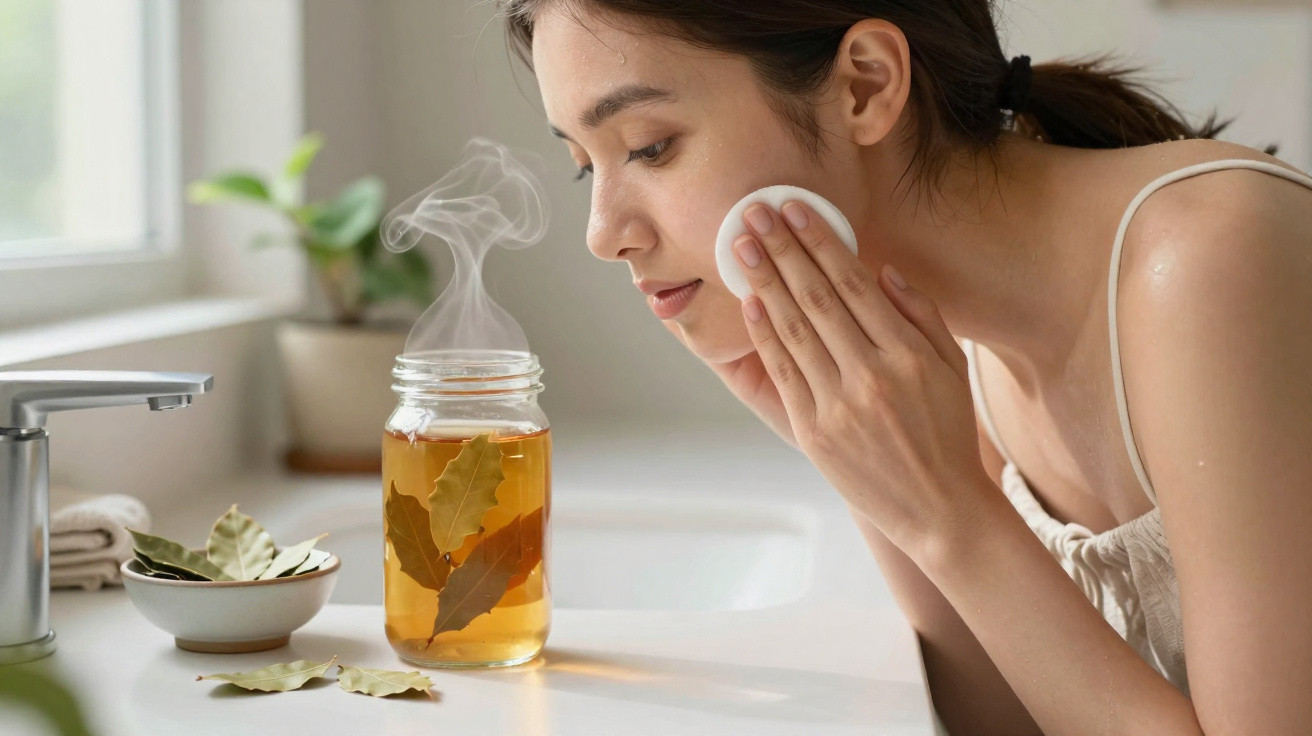
Trends move quickly, yet this one began in a kitchen drawer rather than a laboratory. Beauty professionals are increasingly finding that bay leaf infusions may refine skin texture and restore a soft, naturally radiant look-occasionally within just days.
A friend once simmered a handful of bay leaves in a small pan, filling the kitchen with the balsamic, green fragrance that usually signals a promising stew. Once the water had cooled, she soaked a cotton pad in it and pressed it against her cheeks, as though following a ritual she had almost forgotten.
By the following morning, her complexion did not appear filtered; it simply looked well rested. Its edges seemed softer, while light caught areas where shadows had lingered for weeks. She dismissed it casually, then sent me a photograph at lunchtime because the radiance had lasted beyond her commute. The glow had appeared without any fuss.
Why bay leaf is having a moment with skin professionals
Speak to an aesthetician and a similar story emerges: curiosity has become confidence that laurel water can provide a real glow-lift in a few days when skin feels dull or uneven. What appeals is the combination-mild astringency from tannins, calming aromatic compounds such as eugenol, and gentle antioxidants. There is nothing dramatic about it, only a quiet push towards balance.
A London facialist told me that she set up a bay infusion station alongside routine extractions for one month. Twenty-one clients took part. By day four, most said their cheeks felt smoother, and by the end of the week they found make-up applied more easily. A stylist friend used it to wipe down her face after exercise and insisted that her T-zone looked less irritated by Friday. It was a small sample, with human results, but it built genuine momentum.
The reasoning makes sense. A warm compress encourages microcirculation and can help release the tiny bonds that cause dead skin cells to cling on. Bay leaf’s gentle astringent effect may remove surplus oil without leaving skin stripped, often making pores appear tighter. Antioxidant polyphenols offer a subtle protective presence in the background. It will not remove breakouts or melasma, but it may help “good skin days” happen more frequently.
How to use a bay leaf infusion for a quick, skin-friendly glow
You will need 6–8 dried bay leaves, 350 ml of water and a small saucepan. Simmer gently for 10 minutes, cover the pan, then leave the infusion to steep away from the heat for 20 minutes. Strain it and allow it to cool until lukewarm. Use it as a facial steam for five minutes, or soak cotton pads and press them over the face and neck for 90 seconds in each area. Refrigerate any remaining liquid in a bottle for up to two days. Take a moment to let the fragrance slow you down.
Stay gentle with it. Do not try to “enhance” the mixture with essential oils: bay essential oil is powerful, should be diluted and kept well away from the eyes. If your skin is sensitive, begin with a shorter steeping time and use the infusion as a quick rinse rather than a prolonged compress. We have all experienced how a small ritual can bring us back to ourselves. Allow it to be that, rather than turning it into a marathon. Honestly, nobody keeps that up every day.
Professionals recommend trying it nightly for three to five days before pausing to assess your skin. The colour should resemble tea rather than espresso, as an overly dark infusion can leave skin feeling tight. The dermatology professionals I spoke to took a practical approach: patch test on the jawline, stop if stinging persists, and do not pursue radiance at the expense of comfort.
“Warm, dilute plant waters can be lovely as a sensory ritual,” said Dr. L., a board-certified dermatologist. “For some, bay leaf’s mild astringency and aromatic profile make skin look more refined-quickly. Keep it simple, listen to your skin, and step back if redness shows up.”
- Patch test on the jaw or behind the ear for 24 hours.
- Keep it away from the eyes and mucous membranes.
- Apply once each evening for 3–5 days, then move to every other night.
- Avoid it during pregnancy or while nursing if uncertainty feels stressful, and do not use it if you have known Lauraceae allergies.
- Bay essential oil ≠ a kitchen infusion. Stick with the tea.
What this small ritual reveals about beauty right now
There is a reason this idea spreads by word of mouth rather than only through social feeds. Straightforward, inexpensive, sensory rituals narrow the gap between “good advice” and what people can realistically do on a weekday evening. The scent signals calm, the warmth encourages a slower pace, and the result appears quickly enough to sustain interest.
There is another element, too. When texture becomes smoother and light returns to the skin you already have, other modest improvements stand out: better sleep, fewer strokes of highlighter and a little satisfaction in being consistent. Your skin remembers simple things. Fast improvements can create space for stronger habits. That is the spark people continue to discuss.
| Key point | Detail | Why it matters to the reader |
|---|---|---|
| Bay infusion basics | 6–8 dried leaves, simmer for 10 minutes, steep for 20, cool, then compress or steam | Clear instructions to try tonight without buying new products |
| Results timeline | Softer texture and a brighter tone are often noticed within 3–5 days | Creates realistic expectations and helps maintain motivation |
| Safety notes | Patch test, avoid the eyes, skip essential oils and stop if irritation occurs | Helps protect the skin barrier while you experiment |













Comments
No comments yet. Be the first to comment!
Leave a Comment