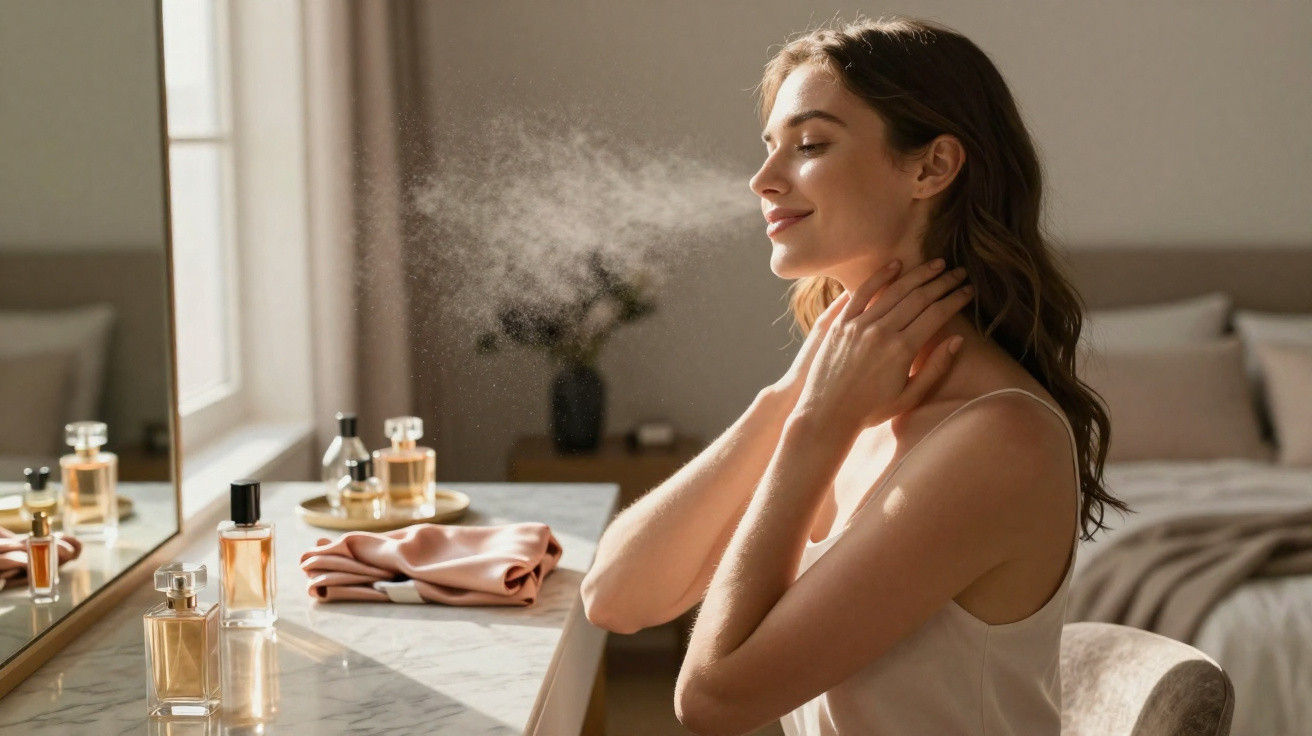
Not merely “nice”, but the sort of scent trail that has three strangers quietly breathing it in. I watched her press the atomiser with complete composure, while my own pricey perfume had faded before lunchtime… yet again.
At close range, the difference was obvious. She gave her neck two swift sprays. No rubbing. No desperate cloud sprayed in front of her face. It was a calm, almost effortless routine that she had clearly perfected years earlier. Meanwhile, I was the person filling the bathroom with fragrance mist, then wondering why it had barely survived until 11 a.m.
There is one small habit that nearly everyone gets wrong. And it happens precisely where you assume you are doing everything properly.
“You should never rub or spray there”: the mistake hiding in plain sight
Spend a few minutes watching shoppers at any perfume counter and the same routine appears again and again. They spray their wrists, press them together, sweep the fragrance onto their necks and perhaps finish with a mist over their hair. It looks polished. It feels sophisticated. Yet it quietly destroys your fragrance.
This urge to rub is so deeply learned that we rarely stop to challenge it. We watched a parent do it, copied a friend at school or noticed that fashionable colleague who always smells like a luxury boutique. So we repeat it. But perfume has no interest in habit or appearances. It follows chemistry, not Instagram.
The reality is unforgiving: you may have flawless skin and a fragrance that costs half your rent, yet a single incorrect movement can reduce its staying power by half.
One afternoon in a Paris department store, I saw a sales assistant wince whenever a customer rubbed their wrists. She said nothing unless someone asked her outright. But when a customer complained that their fragrance did not last, her expression changed. “Show me how you apply it,” she’d say.
In nine cases out of ten, the pattern was identical. They had used three sprays on their wrists, rubbed them rapidly until the liquid dried, then dabbed a little behind their ears. The customer would proudly say they were “activating” the scent. The consultant would kindly tell them that they were breaking it down instead.
She brought out two matching tester strips. She sprayed one and left it untouched. On the other, she sprayed the perfume before vigorously rubbing it between her fingers. After ten minutes, the two smelled entirely unlike one another. One remained full and layered. The other was flat, like a song missing half its instruments.
A perfume is composed in stages: top notes, heart notes and base notes. Every molecule is intended to evaporate at its own pace. Rubbing skin immediately after spraying creates warmth and friction. That friction damages the more delicate molecules and makes some evaporate too soon.
The consequence is that the bright opening vanishes more quickly, while the deeper notes fail to develop seamlessly. Your fragrance appears to “die” on the skin, although you have actually rushed its development. It is rather like putting a slow-cooked meal in a microwave on full power. You still have food, but not the experience you paid for.
Watching perfume dry naturally may be dull, but it is the only way to allow the formula to develop as the perfumer intended.
Where to spray perfume so your scent actually lasts all day
The easiest improvement is also the least glamorous-looking. Apply perfume to warm pulse points that are less exposed to movement. Consider the sides of your neck, just beneath the ears. If your hair is longer, use the back of your neck. You can also spray the décolletage beneath your clothing, or the inner elbows rather than your wrists.
Usually, two to four carefully placed sprays will do the job. One on the chest, one at the back of the neck and one on each side of the neck makes a strong combination. Allow the mist to settle, then do nothing. No rubbing, patting or wiping away “just a little”. Your skin should remain faintly damp for a few seconds.
Fabric is a useful secret weapon. A delicate spray on a scarf, inside a jacket lining or across the back of a jumper can retain perfume for longer than bare skin. As you move, the material releases small bursts of scent throughout the day, like a gentle echo of the first application.
Many people apply too much perfume because their technique is poor. They spray their wrists, rub them together, fill the air with fragrance and walk through it, then question why the scent vanishes. Let’s be honest: nobody really does that every day with care and patience. We are rushed. We want immediate results. So we use more perfume rather than applying it more intelligently.
Your skin type matters as well. Extremely dry skin often seems to absorb perfume. Applying a quick layer of unperfumed moisturiser beforehand can make a noticeable difference. It does not need to become a full spa routine; a light coating is enough. Oily or well-moisturised skin retains fragrance more effectively, so you may require fewer sprays than expected.
Another frequent error is using perfume only on uncovered skin in summer. Sunlight, warmth and perspiration speed up evaporation. Applying it to covered areas - beneath a T-shirt or inside a collar - shields the scent and creates a deeper, more intimate trail. On a cold day, one spray on a wool scarf may outlast five sprays on bare arms.
“Perfume shouldn’t shout when you enter a room,” confided one niche perfumer. “It should make people lean in a little closer.”
Timing matters too. After a hot shower, your pores are open and your skin is warm. Once you have dried yourself and applied a light moisturiser, it is an ideal time to use perfume. Rushing in the morning? That is fine. Spray it on, then allow it to settle while you drink your coffee. Your fragrance does not need a film-worthy ritual to work harder for you.
- Avoid the wrists if you regularly rub them together or wash your hands often.
- Apply 2–4 sprays to pulse points that are mainly protected by clothing.
- If your skin is very dry, use a small amount of unscented moisturiser first.
- Leave the mist on your skin: no tapping, rubbing or wiping.
- For a longer-lasting trail, give clothing one light spray from 20–30 cm away.
The places you never thought about… and the ones to avoid
There is a reason certain people seem to leave a pleasant trace behind them, almost like a memory. They are not always wearing more powerful perfumes. They have simply chosen their application points more wisely. The back of the neck, for example, is often overlooked. It warms gently beneath hair or a collar and releases just enough scent as you move.
Behind the knees can work remarkably well when you wear skirts or dresses. As warmth rises, the fragrance rises with it. The inner elbow is another subtle favourite: it flexes less sharply than the wrist and is not repeatedly exposed to soap and hand sanitiser. For a date night, a single spray on the lower back beneath clothing can create an especially discreet aura.
Then there are the spots people choose out of habit that offer little benefit. Spraying straight onto the face is unwise for both your skin and the fragrance. Alcohol can sting freshly shaved skin and change how the perfume settles. Those heavy sprays directly onto hair can also dry it out, while clinging to product build-up rather than clean strands.
| Key point | Details | Why it matters to readers |
|---|---|---|
| Stop rubbing your wrists | Friction warms the skin and crushes delicate top notes, changing the way the perfume develops. | Your scent will last longer and smell closer to what you tested in the store. |
| Prioritise covered pulse points | Spraying on chest, back of neck and inner elbows keeps perfume away from sun, wind and constant washing. | You need fewer sprays for all-day wear, and the result feels more refined than overloading exposed skin. |
| Use fabric as a fragrance amplifier | One light mist on scarves, jacket lining or sweater backs holds scent for hours without overwhelming anyone nearby. | Your perfume lingers through commutes, offices and evenings, instead of fading by mid-morning. |
We have all experienced that moment when we catch a faint trace of our own perfume hours later and feel strangely comforted. It can soften a grey day or make an ordinary commute feel slightly cinematic. The good news is that it is not simply luck. It is technique.
Altering one movement - avoiding a spray here or resisting a rub there - can transform a fragrance you believed was “too light” or “doesn’t last on me”. Suddenly, the scent seems made for you rather than for the tester strip in the shop. Your skin, clothing and daily rhythm all become part of its story.
There is something personal about this. It is in the way your perfume lingers in the air when you hug someone, clings to a scarf left over a chair or prompts a friend to say, “I knew you were here, I smelled you.” When you stop working against your fragrance and allow it to perform as designed, those small, invisible moments begin to multiply.








Comments
No comments yet. Be the first to comment!
Leave a Comment