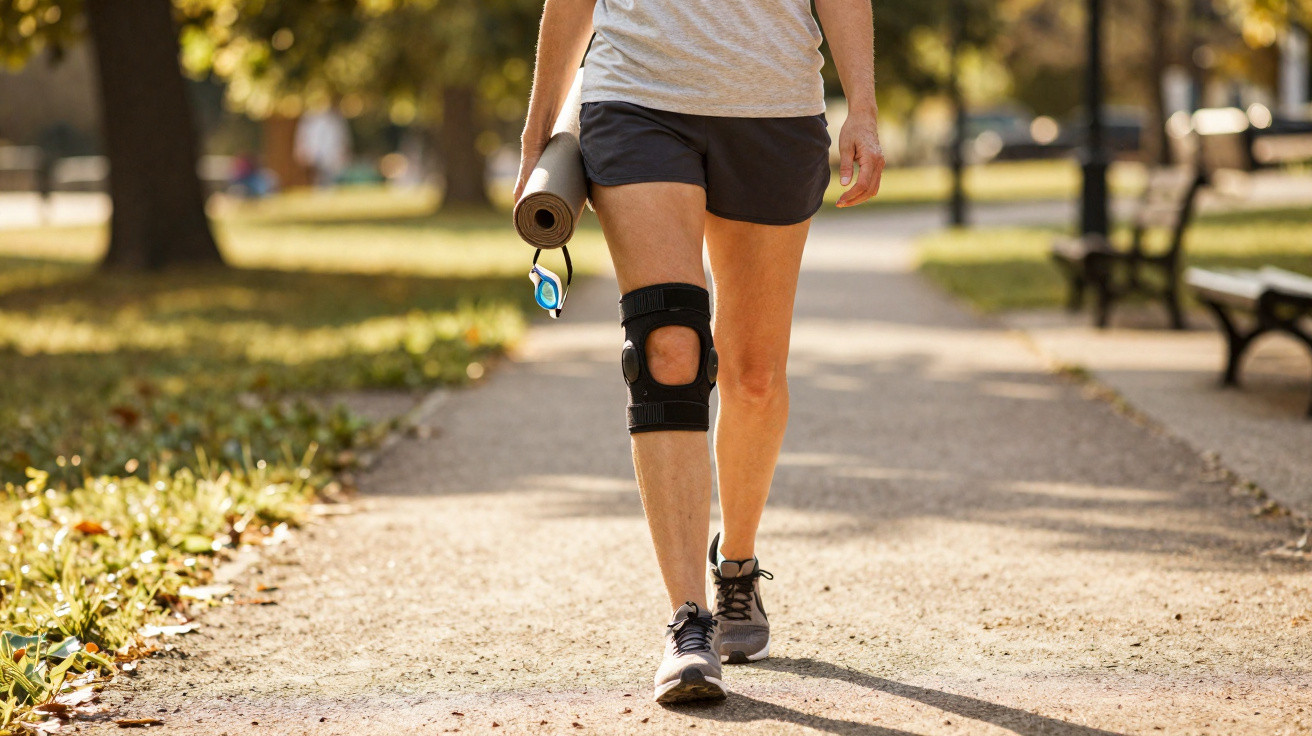
The waiting room is crowded with knees. Some are covered by elastic supports, others rest on tote bags, while more peek out from beneath work trousers and gym leggings. A man in his fifties massages the outside of his right knee with the absent-minded accuracy of someone who has done it for years. Opposite him, a yoga teacher looks through her phone with one ankle perched on the other thigh, flinching every few moments.
Each person has heard a different version of the story. “Swim more.” “Do Pilates.” “Don’t squat.” “Definitely squat.” The guidance is murky, and most are simply waiting for somebody to explain what genuinely helps.
Then a fresh study arrives on the receptionist’s desk, printed out with red circles around its key finding: one straightforward daily activity provides better knee pain relief than both swimming and Pilates.
The debate in the corridor begins almost at once.
Doctors split as walking steps into the spotlight
Within the relatively small field of knee specialists, the study landed like a stone in still water. On one side are clinicians who have spent years recommending swimming and Pilates as the “gold standard” for gentle joint care. On the other is an increasing number looking at the evidence and arguing that ordinary walking may actually come out ahead.
This does not mean marathon-style power walking. Nor does it mean Nordic walking performed with flawless technique. It means normal, steady walking at an easy pace, maintained over weeks and months rather than a handful of days.
For people who need the handrail to manage a flight of stairs, that prospect can seem encouraging and a little frustrating. Could the solution really have been this… ordinary all along?
The new research followed thousands of middle-aged and older adults with knee osteoarthritis for several years and produced a simple, unexpected result. Participants who walked regularly – including those walking only 10 to 20 minutes at a time on several days each week – described less pain, improved function and slower structural damage on scans than people relying chiefly on non-weight-bearing activity such as swimming or boutique routines such as mat Pilates.
One rheumatologist I spoke to captured the idea with a shrug: “The knees like being used for what they were built for.” Rather than being battered with HIIT or guarded like delicate porcelain, they should be loaded gently, day after day.
That does not make swimming or Pilates ineffective. It simply suggests that they may not be the leading character in the knee story we have been told.
Why might walking do better than exercises widely described as “easy on the joints”? The explanation lies in biomechanics as well as common sense. During a walk, body weight passes through the knee in a controlled, repeated movement. This mild, regular loading encourages cartilage cells to remain active, supports circulation around the joint and keeps the knee-stabilising muscles working.
Water-based exercise and Pilates can certainly build strength, but they do not always reproduce the precise forces the knee manages in daily life. You can have strong abdominal muscles and still limp up the stairs.
The study’s authors argue that consistent, comfortable walking is closer to “real‑world training” for your knees than any carefully choreographed class.
How to walk for knee pain relief without making things worse
Doctors enthusiastic about the study are not advising anyone to leap from the sofa to a 10k. Their recommendation is more measured and more achievable: begin at your current level, then walk a little further than that on most days.
If your knee is already sore, that could mean walking five minutes down the road and back on the flattest pavement available. Repeat it the next day. After several days, add a few minutes or continue for one more street corner.
The benefit is not about intensity; it is about regularity. Knees respond far better to predictable, repeated loading than to an ambitious effort once a week followed by days spent limping.
Many people undermine their efforts before they have even started. They hold out for the “perfect” footwear, the “right” park or a spare block of time that never materialises. Then, at the weekend, they put the knee to the test on a long hike and spend Monday applying ice at their desk.
In reality, hardly anyone manages this every day. Work and life intervene, pain flares and motivation disappears. The useful perspective is to measure progress by weeks rather than individual days. Walking on four of seven days still sends a meaningful message to your knees.
If pain rises above its normal level and remains worse for longer than 24 hours, treat that as a sign that you progressed too far, too quickly. Reduce the distance, but do not abandon the habit.
Doctors may disagree forcefully in conference rooms, but their tone is often gentler in private consultations. One sports medicine specialist told me:
“Patients hear ‘walk’ and think we’re dismissing their pain. We’re not. We’re saying, ‘Your knee isn’t broken glass. It’s a living structure that improves when you use it the right way.’”
To make “the right way” more concrete, many clinicians now recommend this straightforward walking checklist:
- Begin on level, predictable surfaces before moving on to hills.
- Choose shoes that feel reliably supportive rather than fashion-forward.
- Keep to a pace at which you can speak in full sentences.
- Finish while your knee still feels “okay”, instead of waiting until it begins shouting.
- Combine walking with 2–3 brief weekly strength sessions for the thighs and hips.
That final recommendation is where swimming and Pilates can still make a quiet contribution, even if walking occupies centre stage.
Beyond the study: what your own knees are trying to tell you
The strongest disputes about knee pain do not truly play out on scientific panels. They happen in people’s minds at 7 a.m., as they look at their trainers and wonder whether today’s walk will relieve pain or make it worse.
The new research does not eliminate that uncertainty, but it changes the balance of the discussion. Walking is no longer merely the “lazy” alternative for days when the pool or class is out of reach. It is a valid, evidence-backed treatment, carrying its own quiet seriousness alongside medication or a surgical plan.
Everything else is highly personal: the amount you can walk without aggravating symptoms; whether a cane or trekking poles feel like useful support or a defeat; and whether you can exchange the idea of “protecting” your knees for the more daunting prospect of training them again.
| Key point | Detail | Value for the reader |
|---|---|---|
| Regular walking often beats “gentle” workouts | Steady, comfortable walking loads the knee in a natural pattern that is closer to everyday life than swimming or mat Pilates alone. | Offers a low-cost, accessible choice that does not require classes, pools or equipment. |
| Start tiny, progress slowly | Start with short walks on flat ground, then gradually extend the time or distance while monitoring your knee’s response over 24 hours. | Lowers the chance of flare-ups and lets you develop confidence one step at a time. |
| Combine walking with simple strength work | Including basic thigh and hip exercises helps the knee track more effectively and cope with greater walking distances over time. | Maximizes pain relief and function so everyday movements become easier and steadier. |













Comments
No comments yet. Be the first to comment!
Leave a Comment