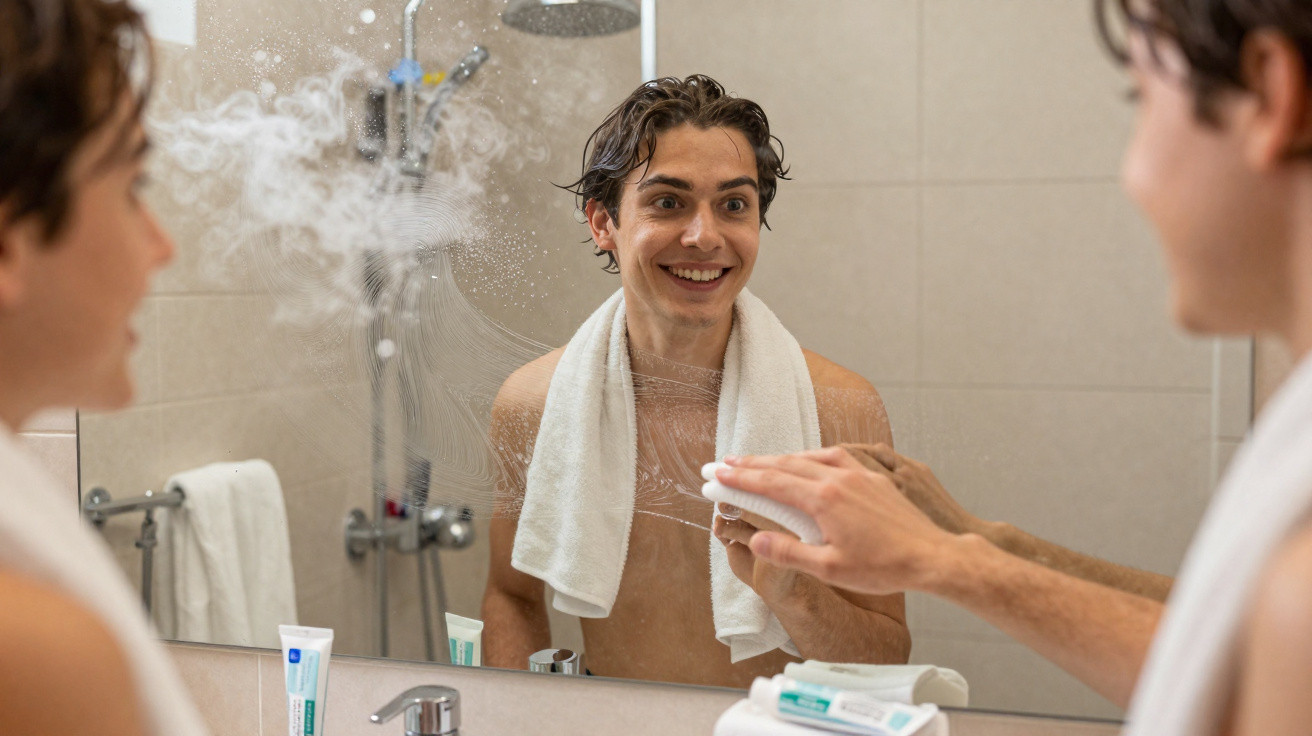
Steam has its own agenda. You clear a patch in the mirror, it clouds over again, and the clock is still demanding your attention. Everyone knows the routine: a sleeve, a towel, perhaps an exasperated breath.
The flat buzzed with the usual morning rush: the shower poured, the kettle murmured and the city was not quite awake. As the mirror turned a milky grey, I felt the familiar resignation - fine, I’ll shave by guesswork. Then a friend picked up the toothpaste rather than the cloth. He used a pea-sized amount, buffed it gently and polished it slowly. He stepped away with the air of a stagehand revealing a trick. While the bathroom filled with mist, the glass remained clear, almost smugly so. I stared at my reflection as though it had produced a rabbit from a hat. Using toothpaste.
The simple science of a clearer mirror
Hot water fills the room with vapour, while a cooler mirror provides the surface on which it settles. The resulting droplets scatter light, hiding your face from view. The toothpaste anti-fog method changes how water behaves on the glass: rather than forming separate beads, it spreads into a thin layer. Your reflection remains visible. It may look like a parlour trick, but a neat piece of chemistry is doing the real work.
I first came across it in a hectic Birmingham home, where two children karate-kick their way through every morning routine. Their father, a joiner, relies on the dab-and-buff method before school. He had tested shaving foam, washing-up liquid and even a rubbed-on bar of soap before wiping it away. In that bathroom, toothpaste was easily the best option: fewer streaks, less odour and a longer-lasting result. He said the mirror stayed usable for two showers in succession, which is exactly what matters when the train leaves in nine minutes.
Condensation appears when warm, humid air meets a colder surface, reaches its dew point and changes from vapour into tiny droplets. These droplets work like countless miniature lenses, dispersing the light. A fine coating of toothpaste introduces surfactants - similar to those that make it foam in your mouth - along with a trace of silica. The surfactants reduce water’s surface tension, encouraging moisture to form a transparent sheet instead of beads. The silica helps the coating adhere to the glass more effectively than your breath can disturb it. It is not magic; it simply gives water a different way to settle.
How to apply toothpaste anti-fog step by step
Choose a straightforward, non-gel toothpaste. For a standard mirror tile, a pea-sized amount is sufficient. Put it on a dry, clean mirror with your finger, then work it into a thin layer using a microfibre cloth in close circular movements. Continue polishing until the cloudy residue disappears and the glass has a glossy finish. Use less than you expect, and keep polishing until the cloth squeaks. The job takes two minutes and leaves your face visible through the steam.
Two mistakes come up repeatedly: choosing a whitening toothpaste containing abrasive particles, or leaving behind a chalky coating. Select a mild, minty formula without whitening ingredients. Streaks usually mean that too much toothpaste was applied. Use a barely damp corner of the cloth to remove the excess, then polish again with a dry section. Apply it again once the mirror begins fogging up; in a busy household, that could mean once a week. Realistically, nobody keeps up with it every day. Treat it as part of a Sunday reset, or do it the evening before an especially early start.
Think of the process as seasoning a pan: the layer should be thin, even and invisible when you stand back. A bathroom fitter once told me something memorable.
“It’s the lightest coat that wins. The moment you can’t see it, it’s there.”
- Choose: plain, non-gel toothpaste without whitening ingredients.
- Amount: a pea-sized blob for around 0.09 m² of glass.
- Tools: a soft microfibre cloth, dry at first, with a second clean side for the final polish.
- Motion: use small circles from the edges towards the centre until the mirror looks normal again.
- Refresh: once fog returns, give it a quick rebuff or add a tiny amount more.
When the toothpaste anti-fog works - and when it does not
Toothpaste is not a complete solution for every bathroom. It works particularly well in compact bathrooms, rented flats and during colder winter months, when mirrors are more likely to stay cool. It is less worthwhile if you have a powerful extractor fan or a mirror with a factory-applied anti-fog coating. Such coatings can be fragile, so test a small corner first and use an exceptionally light touch. Vinegar or ammonia-based cleaning sprays will remove the film more quickly, meaning it will need more frequent attention.
Some mirror frames trap moisture around their edges, so a ring of mist may still appear. That is not a problem - focus on the section where your face is reflected rather than pursuing a flawless finish. Open a window by a finger’s width while showering, and leave the fan running for longer than seems necessary. Ending your shower with 30 seconds of cooler water reduces the room’s dew point and helps the method last longer. Avoid whitening, charcoal or “micro-crystal” toothpastes on antique or tinted mirrors.
If toothpaste is not for you, several similar options are available. Shaving foam works in much the same way, although it can leave a waxy sheen. Washing-up liquid is quick to use but often wears off within a day. A small amount of baby shampoo lasts reasonably well and has a mild fragrance. A dedicated anti-fog spray is the simplest choice for a bathroom shared with flatmates, especially if you would rather avoid discussions about mint-scented glass. Choose the option you will genuinely repeat without rolling your eyes.
There is a small pleasure in seeing a clear mirror while the rest of the room is a cloud. It is both insignificant and useful: you can see your face, begin the day more confidently, avoid nicking your cheek and keep mascara off the wrong lashes. The toothpaste anti-fog trick occupies that appealing middle ground - inexpensive, slightly ridiculous and oddly satisfying. Try it tonight while the house is quiet, pass it on to whoever is always last into the shower, or keep it for the next time the mirror steams up and you cannot be bothered to wipe a circle with your wrist.
| Key point | Detail | Benefit for the reader |
|---|---|---|
| Use a thin film | Apply a pea-sized blob, then buff until the glass looks normal and squeaks | A clear reflection without streaks or chalky marks |
| Choose the right toothpaste | Plain, non-gel toothpaste without whitening ingredients works best | Helps protect the mirror and prevents micro-scratches |
| Refresh sensibly | Reapply weekly or once fog returns; strong cleaners strip away the film | Less faff and longer-lasting clarity after showers |














Comments
No comments yet. Be the first to comment!
Leave a Comment