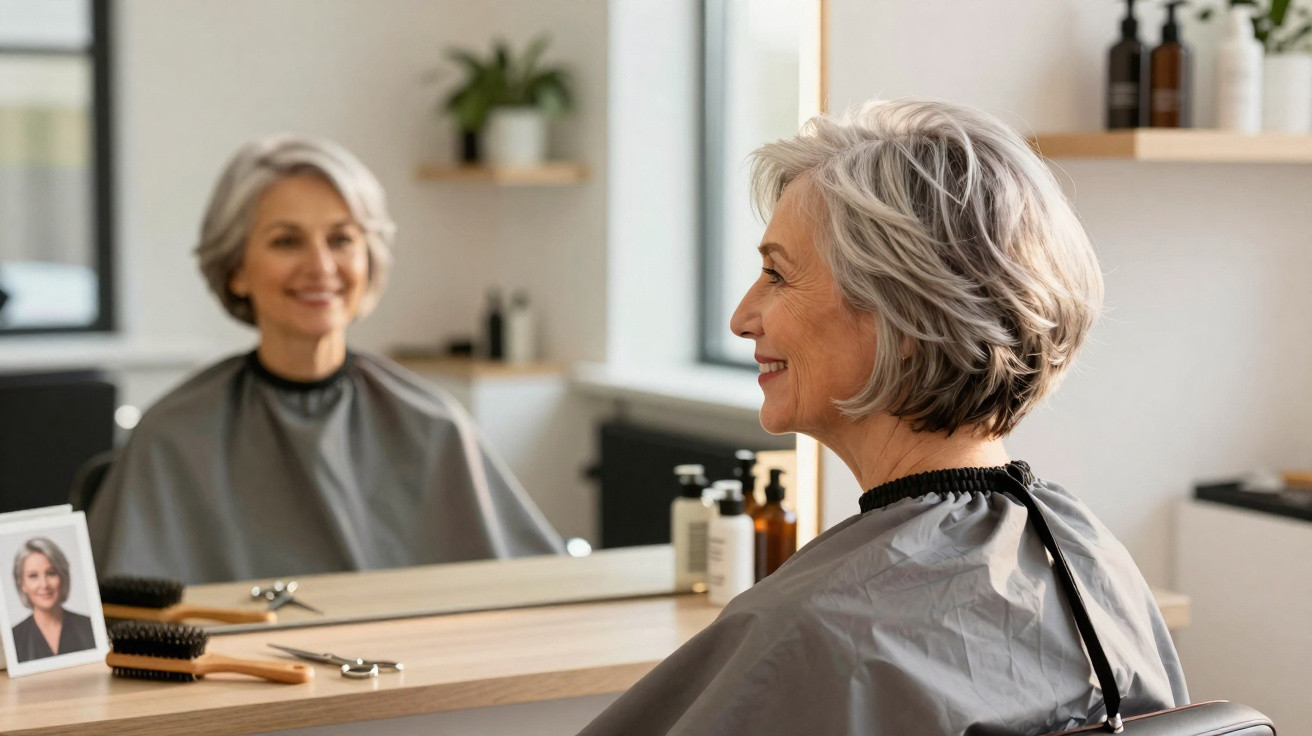
She kept running her fingers over the ends: thin, worn and weary after years of growing her hair “because my husband likes it long.” Her hairstylist, an unflustered brunette in trainers, moved around her with a sculptor’s focus. “What if,” she asked gently, “we let your face breathe?” Half an hour later, the woman looked at her reflection with wide eyes and a smile beginning to tremble across her lips. Her jaw appeared more defined and her eyes more luminous. In an instant, she looked like the sort of grandmother who books a city break on a Tuesday.
She had not had a facelift. She had simply chosen a short haircut suited to grey hair and a life well lived.
The hairstylist insisted that this was the one cut capable of taking ten years off almost any woman over 70.
The short cut that really rejuvenates after 70
Ask three hairstylists to name the “best” haircut and you may well hear ten different opinions. But when I spoke to London stylist Emma Clarke, whose clients are mainly women aged over 65, she answered straight away. Her choice: a textured, layered pixie-bob on natural grey hair. This is not the sharp, spiky pixie you may associate with the early 2000s. Picture softer contours, lift through the crown and delicate sections around the face.
The cut generally falls between the upper ear and the jawline. It is short enough to create lift, while retaining a feminine feel. Its real strength comes from the layers, which restore volume in the areas where age often reduces it, particularly across the crown and at the sides. On grey hair, these layers pick up the light like frost on foliage, making the entire face seem more alert.
One Tuesday morning, I watched Emma cut Margaret’s hair. At 79, Margaret arrived with a long grey bob fastened back with an elastic band. “My hair just hangs,” she sighed. “I look tired.” Her roots were fine and flat, while the ends felt weighed down: a familiar post-70s texture, with reduced density and increased fragility. Emma shortened the back, softened the crown with feathered layers and shaped small side sections that grazed Margaret’s cheekbones.
Once Margaret put on her glasses and looked in the mirror, the change was immediate. Her cheeks seemed higher, and her neck drew less attention. She touched the new outline, then laughed. “I look mischievous,” she said. At the till, she asked the receptionist to take a photograph “for my grandchildren, they’ll think I’ve joined a rock band.” The short grey style altered more than her mirror image: it shifted the story she had been telling herself about being “old.”
There is a straightforward reason this short hairstyle works so well beyond 70: bone structure and gravity begin to compete. Hair that once framed the face and gave it lift can start to pull it down instead. Long, weighty lengths draw facial features southwards, whereas a layered pixie-bob reverses that effect. Height at the crown and openness around the temples visually lift the face.
Grey hair contributes more than many people realise. Natural silver contains depth, from white strands and darker lowlights to the occasional warmer thread. A short layered cut allows those variations to show. Strong, single-tone colour on long hair can make the face appear flatter; by contrast, soft natural grey in a sculpted cut bounces light towards the skin. Lines suddenly seem softer - not removed, but less severe. The face doesn’t change; the frame does.
How to get the right short cut on grey hair after 70
Emma’s first instruction for women over 70 considering a shorter style is to arrive with their hair as they normally wear it. No rollers and no wedding-worthy blow-dry. “I need to see its real behavior,” she says. Before the scissors are used, she discusses everyday life with the client. Do you garden, swim or travel? Do you dislike styling tools? Even the most rejuvenating cut will fall flat if it does not suit your routine.
From that point, the process resembles tailoring. The back is trimmed a little shorter to expose the neck and create a discreet sense of lift. Texturising at the crown restores height and prevents a helmet-like shape. Emma keeps the face-framing sections soft: fine, wispy pieces by the temples, a swept fringe that brushes the eyebrows, or a light veil over forehead lines. The goal isn’t to hide age, but to draw the eye to your eyes. That is where people look when speaking with you.
Most women over 70 come in with two identical worries: “It will age me” and “I won’t know how to style it.” Hair carries a great deal of history. Perhaps someone cut it badly in the 1980s and you have never forgotten. Perhaps growing it long was an expression of freedom after years of restrictions. Hairstylists experienced in working with older clients understand this, and the best of them follow your pace rather than imposing their own.
A frequent mistake is requesting a cut designed for much thicker, younger hair. Heavy, blunt bobs without layers can hang over fine grey hair like a curtain. Holding on to a fringe that is too dense and too short is another, as it may make the expression look harsher. Let’s be honest: nobody really recreates those perfect Instagram blow-dries every day. A rejuvenating haircut needs to look presentable when air-dried. A quick blow-dry may be welcome for special occasions, but daily styling should not become a struggle involving three brushes and a round-brush circus.
Emma puts it plainly:
“At 70, 80, 90, your haircut should work harder than you do. It should lift, soften, and move with almost no effort from you. If it only looks good after 30 minutes in front of the mirror, it’s the wrong cut.”
Her practical checklist often surprises clients because it is so simple:
- Can you style it with just your hands and maybe a small brush?
- Does it still look like “you” from three angles: front, side, and slightly turned?
- Does the cut respect your cowlicks and natural parting?
- Can you go three months between cuts without it losing all shape?
- Does the colour of your grey look brighter, not duller, with this length?
Once those points are met, short grey hair no longer feels like a compromise. Instead, it becomes a quiet act of defiance against the notion that ageing means making yourself smaller.
Living with short, rejuvenating hair after 70
What almost nobody mentions is that choosing short hair after 70 is not only a beauty choice. It changes the small routines of daily life. Washing becomes simpler, travel-size shampoo bottles become smaller and the wind is no longer the enemy. After a few weeks, many of Emma’s clients make the same observation: “I didn’t realize how much space my hair was taking in my mind.” A straightforward, expertly shaped grey cut can feel like clearing out a cupboard you had not realised was overflowing.
Grey hair can be drier, wirier and occasionally stubborn at the crown. A good short haircut works with those qualities rather than against them. Usually, a small amount of lightweight cream or mousse scrunched into damp hair with your fingers will do the job. Let it dry naturally to keep its texture, or use a hairdryer for two minutes while lifting the roots with your hands. That is all. The point is not to erase every wave or kink, but to make them look intentional. The cut carries the main burden.
Last autumn, on a bus in Paris, I sat opposite a woman in her early 70s wearing a silver pixie-bob and vivid red lipstick. She was laughing with a friend, with sunglasses resting on her head and her hair falling perfectly over one eyebrow. Despite the busy bus, several passengers kept looking back at her. It was not because she appeared “young”, but because she looked completely alive at her age.
We all recognise that moment when we unexpectedly catch our reflection and wonder, “Who is that older woman?” A flattering short cut on grey hair cannot entirely erase the feeling, but it can lessen the shock. It can make the person in the mirror feel familiar again. From behind, there is movement rather than one long, flat sheet of hair. From the front, light surrounds the eyes instead of shadows created by heavy sides. Hair becomes an ally again, not a reminder of what used to be.
Some women will never want short hair, and that is perfectly fine. Yet for those who are tempted, a layered grey pixie-bob is like a half-open door: enough of a change to feel exciting, without leaving you unrecognisable. The most memorable thing Emma said had nothing to do with scissors or products: “My happiest clients over 70 are the ones who stopped trying to look like their past selves and started cutting for the face they have today.”
That outlook may be the true secret behind every “you look amazing” response after a fresh short haircut at 72, 83 or 91. Hair is merely the signal. What people are really noticing is someone whose reflection has been brought up to date with the person they have quietly become.
| Key point | Detail | Benefit for the reader |
|---|---|---|
| Ideal haircut after 70 | Textured pixie-bob, short at the nape, with flexible length around the face | Know what to ask the hairstylist for an immediate rejuvenating effect |
| Suited to grey hair | Layers reveal the natural tones in grey hair and add brightness | Make better use of natural colour without heavy colouring |
| Easy to live with | Quick styling, maintenance every 2 to 3 months, few products | Save time every day while feeling more polished |












Comments
No comments yet. Be the first to comment!
Leave a Comment