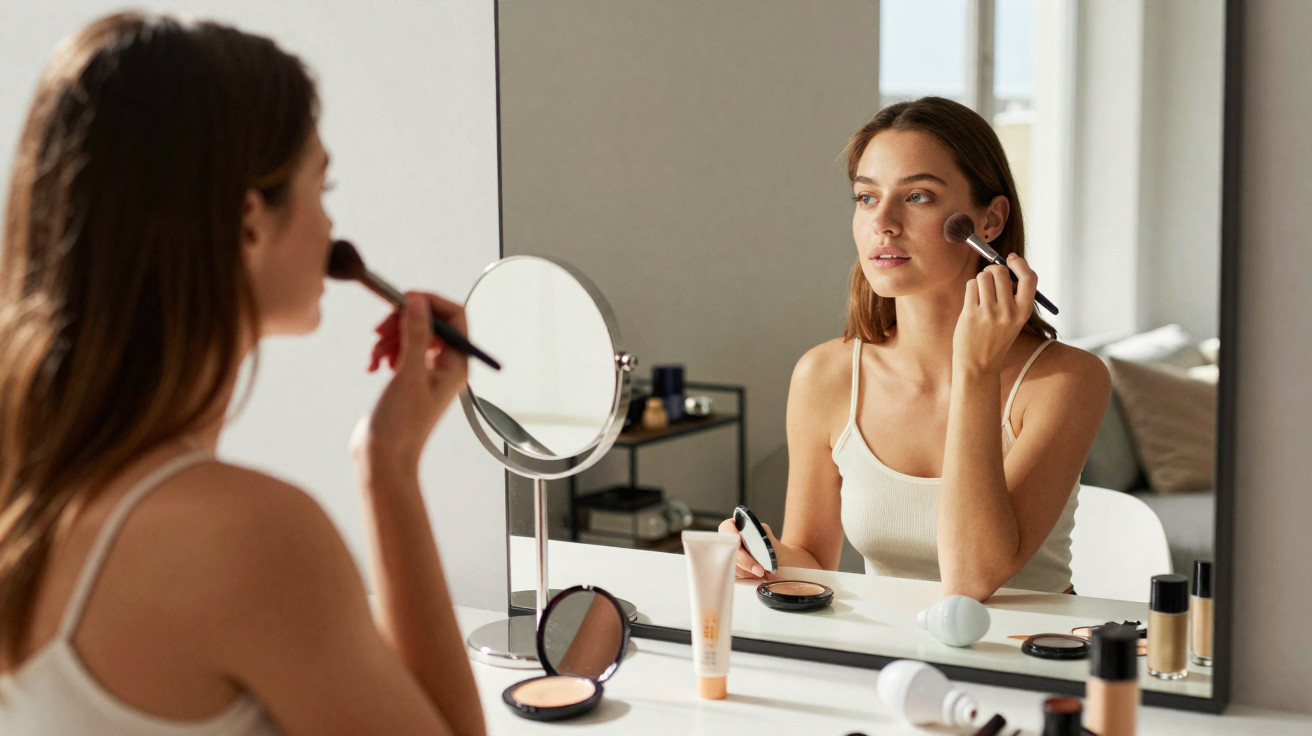
The woman staring into the café bathroom mirror looked immaculate.
Her skin appeared flawless, her cheekbones perfectly defined and her eyeliner sharp enough to cut glass. But when she walked into the midday sun, her face revealed another version of the story: a foundation edge along her jaw, concealer brighter than her future and bronzer sitting in an orange band.
She looked at her reflection in her phone screen and felt baffled. She had used the same products and followed the same routine, but suddenly everything appeared thick and conspicuous. Beside her, another woman discreetly patted her nose, apparently carrying out the same private inspection.
That small moment plays out daily in car mirrors, lift doors and office windows. We blame the foundation. We blame our technique. Almost never do we blame the lighting.
Perhaps the real “miracle product” has been above us all along.
Why natural light changes your entire face
Most of us apply makeup in truly dreadful lighting: yellow bathroom bulbs, under-eye shadows and a single struggling ceiling light. Then we head outside and cannot understand why our contour resembles war paint.
Natural light is honest. It exposes every streak, line and dry patch. In daylight, your skin tone looks cooler, more complex and more textured. That is why foundation that seemed perfectly blended at 7:30 a.m. in your bedroom can look mask-like in the street at 8:00.
Makeup is not only about formulas; it is also about working with the light around you.
A viral TikTok shows a girl applying makeup to one half of her face in a bathroom mirror, while doing the other half facing a large window. The products, brushes and hands are identical. Yet the contrast on camera is almost startling. The bathroom side looks heavier and more matte, with concealer that is too pale and blush that is too strong. The window side simply resembles skin.
Makeup artists make this point constantly backstage. They may ask for a model to be moved nearer a door or pull a chair beneath a skylight. They understand that makeup which looks incredible under hot lights can appear theatrical at brunch. One London-based artist told me that her biggest client disputes happen in hotel rooms with awful lamps.
Light does not merely alter the finish. It completely changes it.
Daylight is full-spectrum, reaching every angle and reflecting from every pore and tiny facial hair. Warm bathroom bulbs cast a flattering yellow tone, making you add coverage to correct what the lighting has already softened. When natural light catches that additional layer, it becomes immediately visible.
Studio ring lights can flatten the face and erase dimension, encouraging you to contour more heavily so you do not look pancake-flat on screen. Bring that same sculpted face outdoors and those shadows intensify, defining your features far more severely than intended.
The identical foundation, blush and bronzer can shift from “your skin but better” to “stage makeup” simply because the sun has come out.
How to work with natural light (even if your flat is a cave)
The most effective improvement to your routine is remarkably simple: position yourself closer to a window. Sit at an angle rather than directly in front of it, allowing the light to fall across one side of your face and create gentle dimension. You will immediately see your actual skin tone and the way your natural shadows sit.
Where possible, apply your base while facing that window: foundation, concealer, blush and bronzer. You can then turn back to your usual mirror for eye makeup and lips. The complexion work does the real heavy lifting, and poor lighting creates the greatest regrets there.
It can seem far too easy to make a real difference. Then you catch your reflection outside and realise that it has quietly transformed the result.
If the day is grey or your flat has very small windows, you can recreate the effect. Pick a movable mirror and place it as near to natural light as you can, even if that means applying your makeup at the kitchen table. Choose a daylight-mimicking bulb, around 5000–6500K and often labelled “cool white” or “daylight”, instead of a warm yellow bulb.
On your phone, turn the selfie camera towards the window and treat it as a live preview of how your makeup appears to other people. There is no need to record anything. Look, adjust and breathe.
We have all spotted someone whose foundation ends in a distinct line at their neck, or whose under-eyes look neon in photographs. Usually, that is not a product failure. It is a lighting failure.
“Ninety percent of the time clients ask me to ‘fix’ their makeup, the issue isn’t the products,” says pro makeup artist Lena K. “It’s the lighting they used to apply it. I can do a better face with drugstore products in good daylight than with luxury products in bad yellow light.”
The same pitfalls appear repeatedly: matching foundation to a hand or wrist, which is often darker or redder than the face; applying powder in low light until skin looks flat outdoors; and adding too much highlighter because bathroom lighting fails to pick up the shimmer.
- Match your colour in front of a window rather than beneath harsh shop spotlights.
- Apply foundation to the side of your jaw, blend it lightly, then move towards daylight before choosing a shade.
- Start with less product than you expect to need, adding more only where daylight still reveals redness or shadow.
Small lighting tweaks, huge makeup payoff
Once you see how dramatically your face changes under different kinds of light, it is impossible to ignore. You may catch yourself angling your head towards the train window or checking your reflection as you leave an Uber. It is not vanity; it is calibration.
One understated habit distinguishes the people whose skin always seems to look good: they perform a quick lighting check. Before leaving, they walk to a window or open the front door slightly and look at their face. Not to pick themselves apart, but to alter a stripe of blush, soften a lip edge or press away a cakey area around the nose.
Let us be honest: nobody really does this every single day. But on the days you do, the difference stays with you.
The more you use natural light, the more differently you begin to shop for products. You discover that half the foundations you adored under shop lighting are too yellow outdoors. You notice that the blush shade you thought was subtle actually makes you appear as though you have run a marathon in daylight.
You also start applying less. Natural light is unforgiving enough to show precisely where coverage is needed and where your skin can breathe. That is when makeup starts to feel less like a mask and more like a conversation with your own face.
And on certain mornings, honest daylight may even persuade you to skip foundation altogether.
| Key point | Detail | Benefit for the reader |
|---|---|---|
| Natural light does not lie | It reveals the real colour, texture and intensity of makeup | Understand why makeup that looks “perfect” in the mirror disappoints outside |
| Move your makeup station | Sit near a window or use a daylight bulb | Improve the finish instantly without changing products |
| Recalibrate products and technique | Test shades, control coverage and apply powder in daylight | Avoid common mistakes and achieve a more natural result |














Comments
No comments yet. Be the first to comment!
Leave a Comment