The first detail that catches your attention is how she rises. There is no slow push from the armrests or weary sigh as she gets to her feet: she does it in one smooth motion, feet beneath her hips and back straight, like a dancer who never fully gave it up. She is 78, with white hair tied back, a shopping bag in one hand and keys in the other. While men less than half her age are still hauling themselves from their seats, she is already stepping off the bus.
On the pavement, she does not simply amble along. She darts sideways to avoid a toddler, spins to say hello to a neighbour, then reaches up to pull down a fig from a branch for her grandson.
She is not “exercising”.
She is moving as though life could catch her unawares at any moment.
The hidden issue with “being good” after 70
Take a walk through any park on a weekday morning and the picture is familiar. Older people move dutifully in straight lines, counting their steps and checking their watches. They are following the standard advice: walk every day, do a few stretches and perhaps some gentle gym work when motivation strikes.
It appears healthy, and up to a point, it is.
But many still need both hands to rise from a chair, feel unsteady on uneven surfaces and fear stairs more than troubling news from their doctor.
A geriatrician in Lyon described two patients to me. Both were 74 and both were diligent followers of public-health guidance. They had the same BMI and blood pressure, and each was pleased to achieve 8,000 steps daily. Yet one had fallen twice in six months, including once after turning too sharply in the kitchen. The other continued to walk with friends on narrow, stony trails.
Their assessments exposed the difference. The trail walker could stand on one leg with eyes shut, rise from a chair ten times in under 20 seconds and step quickly sideways without losing control. The other patient could not complete any of those three tests.
Their records made them look alike. Their everyday abilities did not.
The gap was not explained by determination or genetics. It came down to the pattern of movement.
Everyday walks and occasional gym visits generally practise one narrow type of activity: forward motion, a consistent pace, predictable ground and an unchanged speed. Life after 70 is seldom so orderly. You may skid on wet tiles, stretch suddenly to stop a jar falling or twist around when the phone rings. Your nervous system needs rehearsal for unpredictability, not only stamina for routine.
This is where one overlooked movement pattern can quietly determine how long you remain independent.
Multi-directional, stop-and-go movement for healthspan
The pattern has a straightforward name, although it is surprisingly uncommon: multi-directional, stop-and-go movement. Think of it as “real-life agility”. It does not mean sprinting or lifting heavy weights. Instead, it involves changing direction, starting and stopping, transferring weight between your legs and turning your head while your feet are occupied with something different.
Your body relies on this pattern when you step around a loose rug, clear a dog toy or reach towards a high shelf as somebody calls your name. In small amounts, it combines balance, speed, coordination and strength.
Sports scientists use the rather dry phrase reactive agility. After 70, it could quietly be among the best insurance policies for your health.
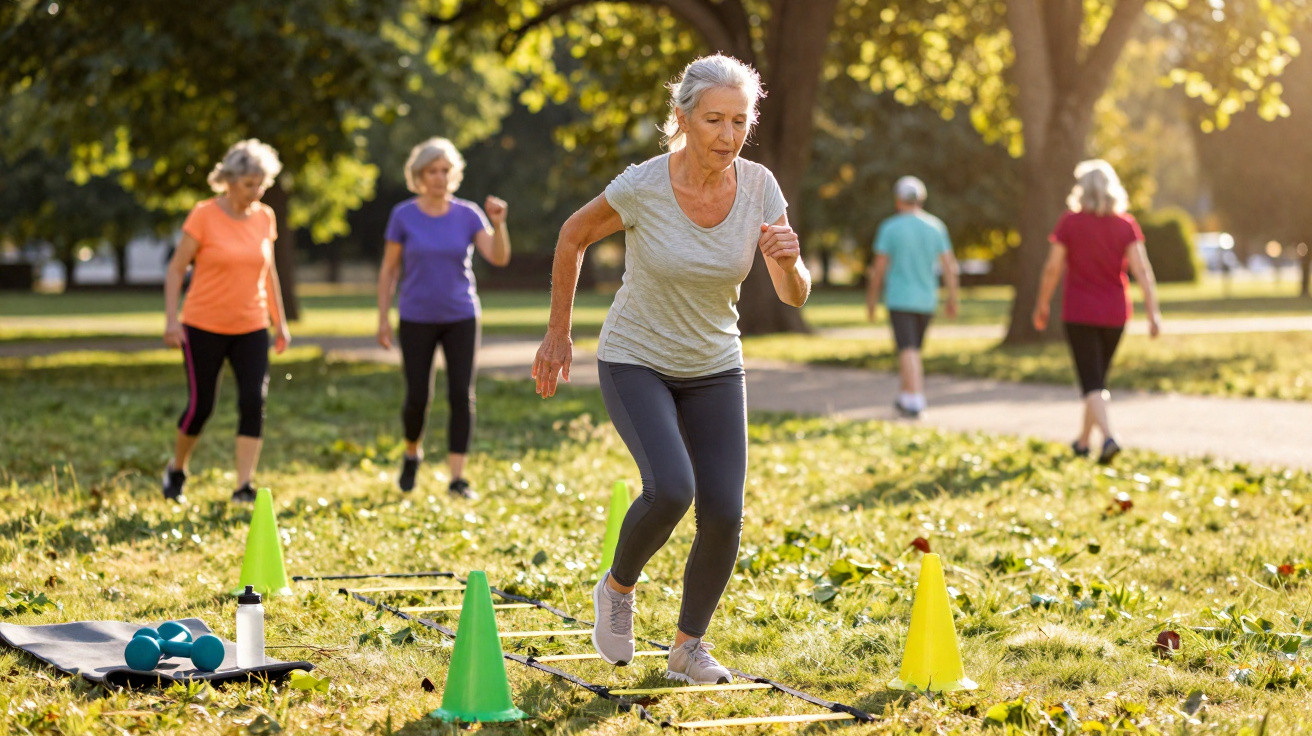
At a community centre in Madrid, I met Jorge, a 72-year-old former postman. He does not “train legs” or “work core”. Twice a week, he attends a group class that resembles carefully managed chaos. There are coloured cones across the floor, soft balls in the air and music playing. The coach calls, “Red cone, left! Green cone, right! Catch, turn, tap the wall!”
Jorge laughs between rounds, slightly breathless and rosy-cheeked.
After six months, his resting heart rate had fallen and his blood sugar had stabilised. Another change followed: he no longer clutched the handrail for the three steps outside his front door. “My feet just react now,” he told me. “I don’t think about it, they just do it.”
That is the understated benefit. Moving in several directions with unexpected changes retrains the way your brain communicates with your muscles. The small stabilising muscles around your ankles, hips and spine become active again. Your inner ear and eyes also work more effectively with your posture.
Forward walking largely works your engine. Multi-directional, stop-and-go movement develops your steering and brakes. Beyond 70, people rarely come unstuck because their engine lacks power. More often, the steering gives way for a moment or the brakes respond too late.
Agility, rather than mileage, is often what distinguishes a long life from a long, independent life.
Adding agility training to a normal week
You do not require a sports hall or personal trainer. A few simple movements can turn your sitting room into a small agility space. Begin with a “micro course”: put three cushions or books on the floor in a triangle, then stand in its centre. Step briskly to one object and return to the middle, before moving to another, changing direction each time. Start slowly and use a wall for support if necessary.
Over the following days, add new elements. Look to one side while your feet are moving. Step over the cushions rather than around them. Stop abruptly halfway through a step, then move in reverse. Two or three 30–60-second sets a few times each week can begin to reactivate these pathways.
One friendly caution: the main error is progressing too quickly simply to feel “sporty”. This is not about demonstrating that you are 25. It is about giving your nervous system clear, repeated messages without alarming your joints.
The other mistake is approaching it as a dull medical instruction. If you dislike it, you will give it up. Make it a game with grandchildren or a brief routine before your evening programme. We all know the occasion when the sofa wins the debate and the promise to “move later” quietly disappears.
In truth, hardly anyone manages this every day. Regular practice over weeks matters more than flawless practice day by day.
A physiotherapist I spoke with in Dublin captured the point in a line that stayed with me:
“After 70, you’re not training to be strong in a gym. You’re training to be unshakeable in your own hallway.”
To make that hallway work in your favour, create a small selection of movements to alternate:
- Side steps: Move left and right along a line, lightly resting your fingertips on a wall, then gradually try without support.
- Backward steps: On a clear, safe area of floor, take five or six steps backwards and then walk forwards again.
- Turn and reach: Stand upright, rotate your upper body to look behind you and reach out with one arm as though taking hold of a seatbelt, then return to the start.
- Sit-to-stand fast: Rise from a chair at a brisk but controlled pace, then lower yourself slowly again, repeating five to eight times.
- Mini “traffic lights”: Walk on the spot; when somebody says “red”, freeze; at “green”, move; and at “yellow”, move in slow motion.
Each exercise teaches a slightly different form of the same message: move, react and stay upright.
Rethinking ageing and everyday movement
Once you recognise this, it becomes difficult to overlook. There is the older man shuffling forwards with an expensive fitness watch, or the woman proudly spending 40 minutes on a treadmill but struggling to step off it without holding the rail. Their commitment is real, but so is the blind spot.
Healthspan is not just a matter of organs and measurements. It is being able to carry soup across a wet kitchen without anxiety, turn swiftly to welcome a friend without losing balance, or step down from a kerb when a car surprises you and land firmly rather than uncertainly.
The human body remains remarkably adaptable at 70, 80 and beyond. It responds most strongly to what you practise repeatedly, not what you achieved at your peak. If your routine consists of predictable, straight-line movement, your body adapts to exactly that. Gradually bring back small amounts of turning, twisting, pausing and sidestepping, and it will quietly reshape itself for those demands instead.
You do not need an immaculate programme. You need curiosity, room to experiment and the readiness to appear slightly foolish in your sitting room so that you can walk with confidence through an icy winter or a busy family kitchen.
When you next set off on your “good” daily walk, try asking a different question. Rather than “How far will I go?”, ask: “How many directions will I dare to move in today?”
| Key point | Detail | Value for the reader |
|---|---|---|
| Agility beats mileage | Multi-directional, stop-and-go movement supports balance and reaction time more effectively than straight-line walking alone. | Helps preserve independence and lower the risk of falls after 70. |
| Train steering and brakes | Straightforward home exercises, including side steps, backward steps and quick turns, reactivate stabilising muscles and coordination. | Provides a practical way to “age-proof” everyday movement. |
| Small, playful practice | Brief, game-like sessions completed regularly reshape the nervous system without requiring a gym. | Makes lasting consistency much more realistic and enjoyable. |















Comments
No comments yet. Be the first to comment!
Leave a Comment