You know the feeling: the lengths of your hair still look freshly washed, yet by lunchtime your roots have flattened into a shiny helmet. You catch your reflection in the office loo, lift your fringe and spot that unmistakable oily sheen around your face, like a greasy crown. Dry shampoo works for a few hours, and a tight ponytail conceals the worst of it, but the same cycle always returns sooner than you want.
Eventually, you begin to question whether it is your shampoo, your hormones or simply bad luck.
But what if the real culprit is your haircut?
The haircut that discreetly helps greasy roots
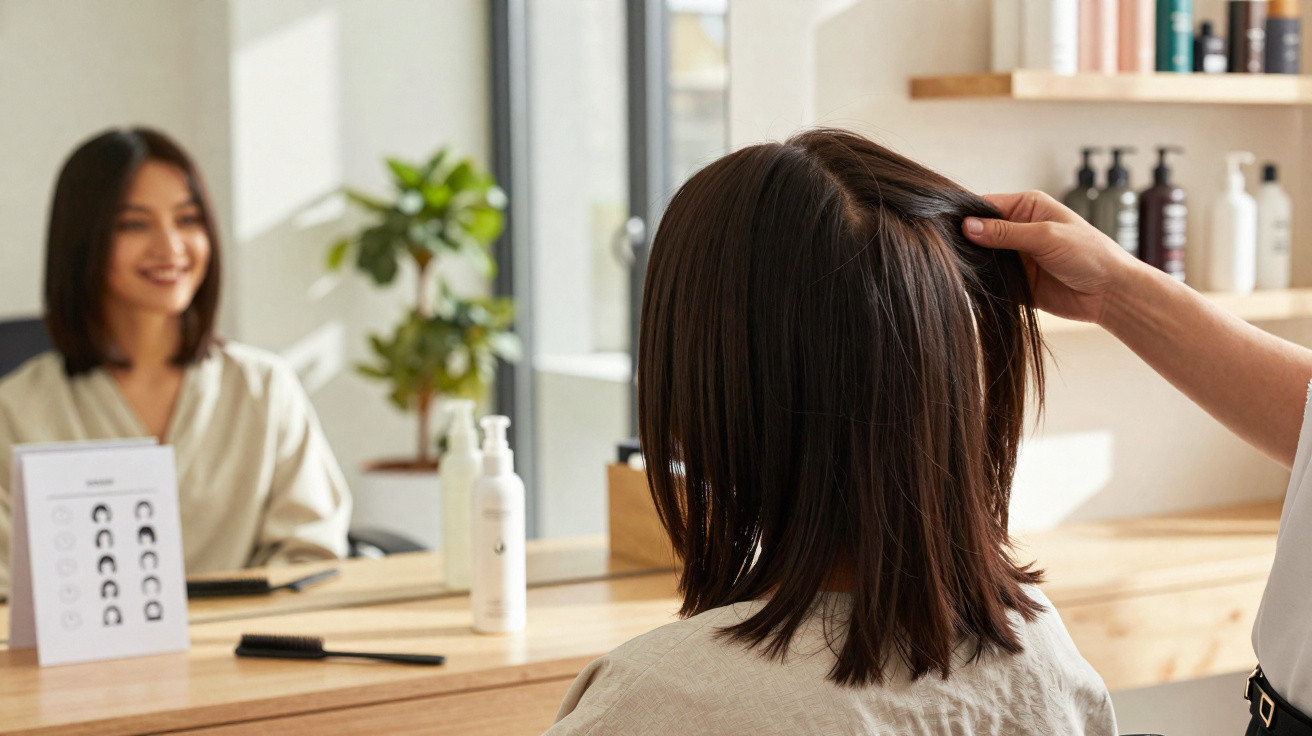
Visit any salon on a Friday evening and you are likely to see her: someone with long, weighty hair holding up a celebrity photo and saying, “My roots get greasy so fast, I want something easier.” The stylist knowingly recommends the same option being suggested in good salons right now: a layered, mid-length cut, often sitting around the collarbone, with gentle movement around the face.
It is not a dramatic pixie cut, nor is it waist-length Rapunzel hair.
Instead, it is a light, airy lob with carefully placed layers that create root lift rather than dragging the hair down.
Consider Léa, 29, who once washed her waist-length hair every morning before going to work. By 4 p.m., her roots had already given up, clinging to her scalp while her ends remained completely clean. Her hairdresser eventually gave her a frank explanation: “Your hair is simply too long for how fast your scalp produces sebum.” Her hair was cut to just below the shoulders and finished with soft layers; suddenly, she could leave two days between washes.
The shampoo was unchanged. So was her lifestyle. Yet the new cut created an entirely different routine.
The reasoning is remarkably straightforward. Long, heavy hair tugs at the roots and holds them flat to the scalp, making sebum spread more quickly and appear more obvious. A layered mid-length cut carries less weight, allowing hair to lift naturally away from the skin. That small space between the roots and scalp makes hair appear cleaner, as oil is not pressing every strand flat.
Shorter, layered hair also spreads volume rather than weight, meaning greasy roots do not immediately spoil the entire style.
How to request a haircut for greasy roots
When you next sit in the salon chair, avoid the vague request for “just a trim” and describe the actual issue instead: “My roots get greasy after one day, and everything looks flat.” Then ask for hair cut to collarbone length, or a little shorter, with invisible layers or soft graduation around the crown. This creates lift at the roots without producing the choppy, stepped effect associated with the 2000s.
For fine, limp hair, choose a long bob with soft pieces framing the face.
For thick hair, ask your stylist to remove excess bulk from the mid-lengths while retaining movement through the top.
The biggest mistake is requesting too much thinning close to the scalp. It may feel lighter during the first week, but your roots can then separate into thin, greasy-looking strands that no product will hide. It is better to retain some density at the base and opt for airy, seamlessly blended layers that shift as you move your head.
Most of us know the disappointment of leaving the salon with a cut that looked brilliant after a blow-dry, only for it to fall into a sad, oily curtain once you are at home. That does not mean you have failed at styling.
It simply means the cut has the wrong structure for your scalp.
In reality, no one keeps up an elaborate routine every day.
No one gets up early to style a complicated cut perfectly, then washes their hair at the first sign of shine. Life is untidy: you sleep through your alarm, work finishes late or you fit in a gym session.
That is why a haircut that works with greasy roots needs to be practical as well as attractive.
“Good hair isn’t about washing more, it’s about working with what your scalp naturally does,” says Camille, a Paris-based stylist who sees a lot of over-washed, over-styled hair. “When the cut is right, greasy roots become less of an emergency and more of a texture you can play with.”
- Ask for length around the collarbone – It is long enough for ponytails, yet short enough to prevent heavy, oil-slick roots.
- Request soft, blended layers at the crown – These add lift and movement without visible steps.
- Keep some density at the roots – This stops the hair from splitting into oily strands after a day.
- Use dry shampoo as a styling product rather than an emergency fix – Apply it to clean hair for added grip and volume.
- Book trims every 8–10 weeks – When the cut becomes too long, the greasy appearance quickly returns.
Living with hair that becomes greasy quickly - without hating it
When your roots turn oily fast, every social arrangement can end up hinging on one frustrating thought: “Will my hair still look okay by then?” A haircut that works with your scalp rather than against it changes more than what you see in the mirror. It also reduces the mental burden. You start to recognise that your hair follows its own rhythm, and that every day does not have to resemble a shampoo advert.
On some days, your mid-length layers will feel light, soft and full of bounce.
On others, a slight shine at the roots can create an effortlessly lived-in texture that many people try to recreate with styling products.
| Key point | Detail | Value for the reader |
|---|---|---|
| Mid-length layered cut | Lob or collarbone cut with soft layers around the crown | Makes the roots feel lighter and minimises the greasy, flat appearance |
| Weight vs. volume | Reduces heaviness while preserving movement and density | Roots look fresher for longer, allowing more time between washes |
| Real-life friendly styling | Works with easy air-drying, dry shampoo and fast touch-ups | Saves time and energy while easing “bad hair day” stress |
















Comments
No comments yet. Be the first to comment!
Leave a Comment