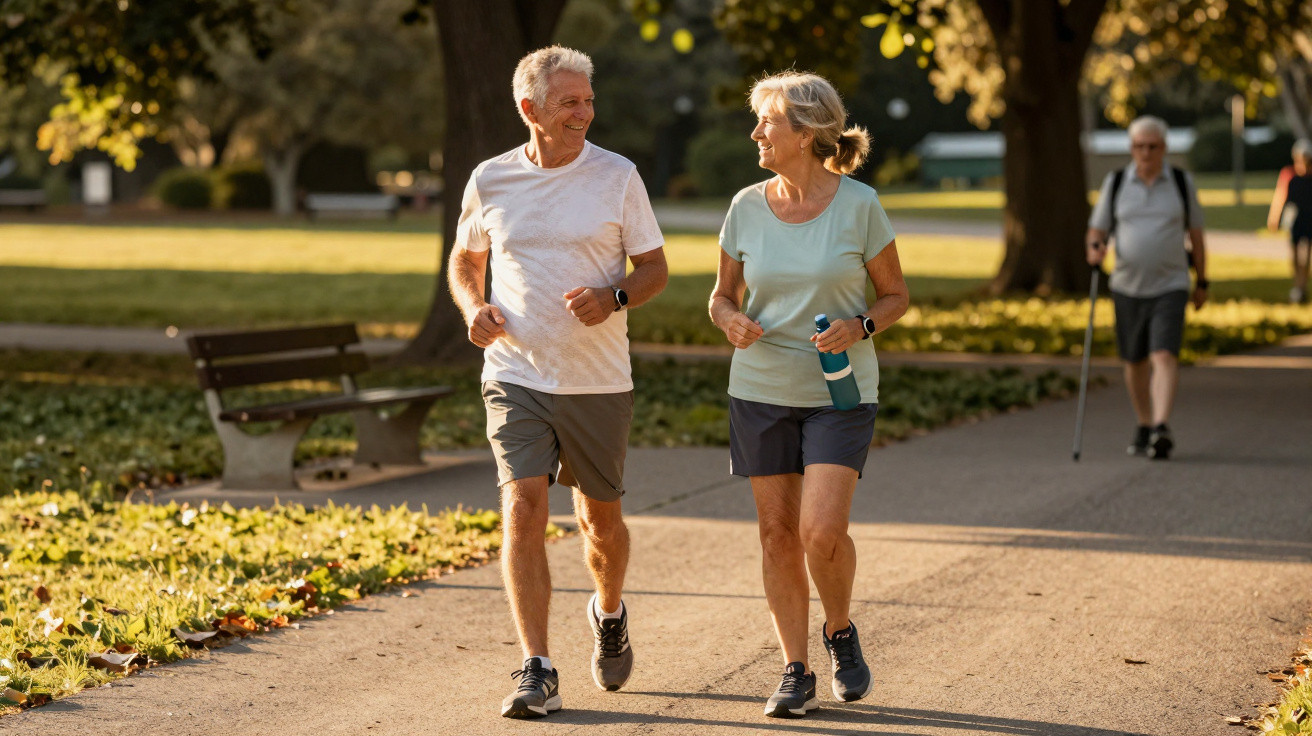
He leans lightly on his walking stick, takes one deep breath, then takes the first step. His wife is beside him, with a grey ponytail and trainers laced with neon-coloured laces. Neither of them looks like an athlete. They look like the neighbours next door. Yet within minutes, it is clear that this is training: for the heart, circulation and mind; for a life that has no intention of quietly retiring to the sofa. Many people over 70 are discovering precisely this for themselves. No high-tech equipment is needed, only comfortable shoes and a decision that can carry us further than we might imagine.
Why walking at 70 becomes a superpower
Anyone passing through a city park early in the morning can see it straight away: the rows of benches are not occupied solely by pigeons, but by older people making their rounds. Some move slowly and deliberately, while others walk at a remarkable pace. What appears from the outside to be a gentle stroll is often a small cardiovascular workout within. The pulse rises, muscles get to work and lungs fill with cool air. We all know that moment when our cheeks feel slightly warmer and our thoughts become clearer. That is where the real exercise begins: no club membership, no subscription, simply the nearest park.
A US study followed people aged over 70 who walked regularly. There were no marathons or mountain hikes, just 20 to 30 minutes of walking four to five times a week. Researchers observed fewer heart attacks, fewer hospital admissions and fewer sudden episodes of weakness. They also heard this statement far more often: “I feel steady on my feet again.” You do not need to love statistics to understand what that means. At 70, being able to move confidently through daily life, shop independently, visit friends and catch the bus brings back a little more independence every day. One step, one lap at a time.
From a biological perspective, walking sets a great deal in motion. Every step gets the blood flowing, gently stretches the blood vessels and trains the heart as a gym workout would train a muscle, only more gently. The inner vessel walls remain more elastic, deposits find it harder to build up and blood pressure may become more stable. At the same time, the leg muscles are activated, starting the so-called “muscle pump”: venous blood is transported back to the heart more effectively. This can mean fewer heavy legs and less dizziness when standing up. The body thrives on rhythm, and a steady step is one of the oldest rhythms we know.
Turning a stroll into proper heart training
If you begin exercising at 70 or 80, you do not need a training plan full of technical terms. A sound starting point is much simpler: comfortable footwear, a familiar route and a clear structure. For instance, walk gently for five minutes, pick up the pace for ten minutes, then slow down again for another five. The key is that middle section, when the speed increases slightly. You should still be able to talk, but no longer chat continuously without pausing. This is the range in which the heart and circulation are genuinely challenged without being overworked.
People often underestimate the impact of modest habits. Walking around the block every other day may sound ordinary. Yet after four weeks, the stairs to the second floor often no longer feel like a mountain. After eight weeks, carrying the shopping bag can feel easier. After three months, some people start planning longer routes: around the lake, through the woods or to the next village. Let us be honest: hardly anyone truly does it every day. There need to be breaks, low moods and rainy spells. However, those who walk three or four times a week on average usually experience the same benefits as someone following a strict programme, but with far less mental pressure.
For the heart to benefit, a certain degree of consistency is essential. The body adapts when it recognises: “Ah, this is happening more often now.” Resting heart rate may fall slightly, spikes in blood pressure become less frequent and fatigue after exertion passes more quickly. Begin slowly and increase gradually, step by step. Build up duration first, then pace. Always keep one clear safety rule in mind: stop if you experience chest pain, severe dizziness, breathlessness or sudden weakness. There is no need for heroics. Walking should make you stronger, not prove anything.
Fitting walks into everyday life without overdoing it
The easiest way to turn movement into a routine is to link it to something that already happens. Take a short walk around the block after breakfast. Before the evening news, walk to the next junction and back. After coffee with a neighbour, take a shared “walk around the neighbourhood”. One weekly walk can quickly become two or three. Anyone who likes to track their activity can use a pedometer: 3,000 to 5,000 steps a day is already a useful target for many people over 70. What matters is that walking feels more like a ritual than an obligation.
One common mistake is trying to do everything at once. A sofa dweller today, then tomorrow: “I’m going to walk for an hour every day.” Almost nobody sustains that for long. When a rainy day arrives or a medical appointment gets in the way, it can feel like failure. A better approach is to start with very small goals, such as: “I will walk for 15 minutes three times a week.” Once that works for four weeks, increase it to 20 minutes, then 25. The body responds well to this gradual progression. So does the mind, because successes occur more often than frustrating moments.
If getting going alone is difficult, deliberately find allies: a neighbour, a grandchild or a local group for older people. Conversation distracts from the inner reluctance and makes time outside feel easier. A participant in a cardiac exercise group once told me:
“I don’t walk for the steps; I walk for the stories we tell each other along the way. The steps are the bonus.”
- Start more slowly than your ambition would prefer.
- Schedule regular walking times as you would medical appointments.
- Choose familiar, safe routes with places to sit down.
- Listen to your body’s warning signals, not the stopwatch.
- Reward yourself after your walk with tea, a phone call or a good book.
Walking: a quiet ally for an independent old age
Watch older people who have walked regularly for years and a pattern emerges. They do not look younger than they are. Wrinkles remain wrinkles, and grey hair stays grey. But the way they move tells another story. Their gaze is more alert, their stride more assured and their upper body more upright. This has much to do with the heart and circulation, as well as the quiet training behind it. A heart that is challenged regularly can respond better to exertion. It remains adaptable instead of sounding the alarm at every flight of stairs.
Walking also provides structure on days that might otherwise drift away. A brief outing in the morning and another small circuit in the evening give the day anchor points. People who live alone stay in touch with the world: a quick chat with the baker, a nod to the gardener, a smile for a child on a scooter. Together, these interactions form a fine but supportive network. Many people only realise how much they miss walking when illness forces them to stop. They miss it not only physically, but in their minds, their hearts and their sense of “I still belong”.
Perhaps that is the greatest value of walking at 70 and beyond: it requires no special outfit, no entry fee and no brave public display. It adapts to difficult days, good weather and new medication. It also leaves room for small adventures: a new route, a different park or a path alongside the water. Saying “I’m going to get out more often again” at this stage of life is one of the quietest yet most effective health decisions a person can make. No spectacle and no fitness craze: simply the soft, regular sound of footsteps saying, I am still going.
| Key point | Detail | Benefit for the reader |
|---|---|---|
| Regular walking strengthens the heart and circulation | 20–30 minutes of brisk walking several times a week reduces the risk of heart problems | Understand how little is needed to achieve measurable health benefits |
| A gradual start rather than overexertion | Begin with short routes, increase duration gradually and keep the pace moderate | A realistic strategy that fits into everyday life and avoids frustration |
| Make use of social and mental benefits | Walk with company, establish fixed routines and create small rituals after a walk | Greater motivation, improved mood and a stronger sense of independence |










Comments
No comments yet. Be the first to comment!
Leave a Comment