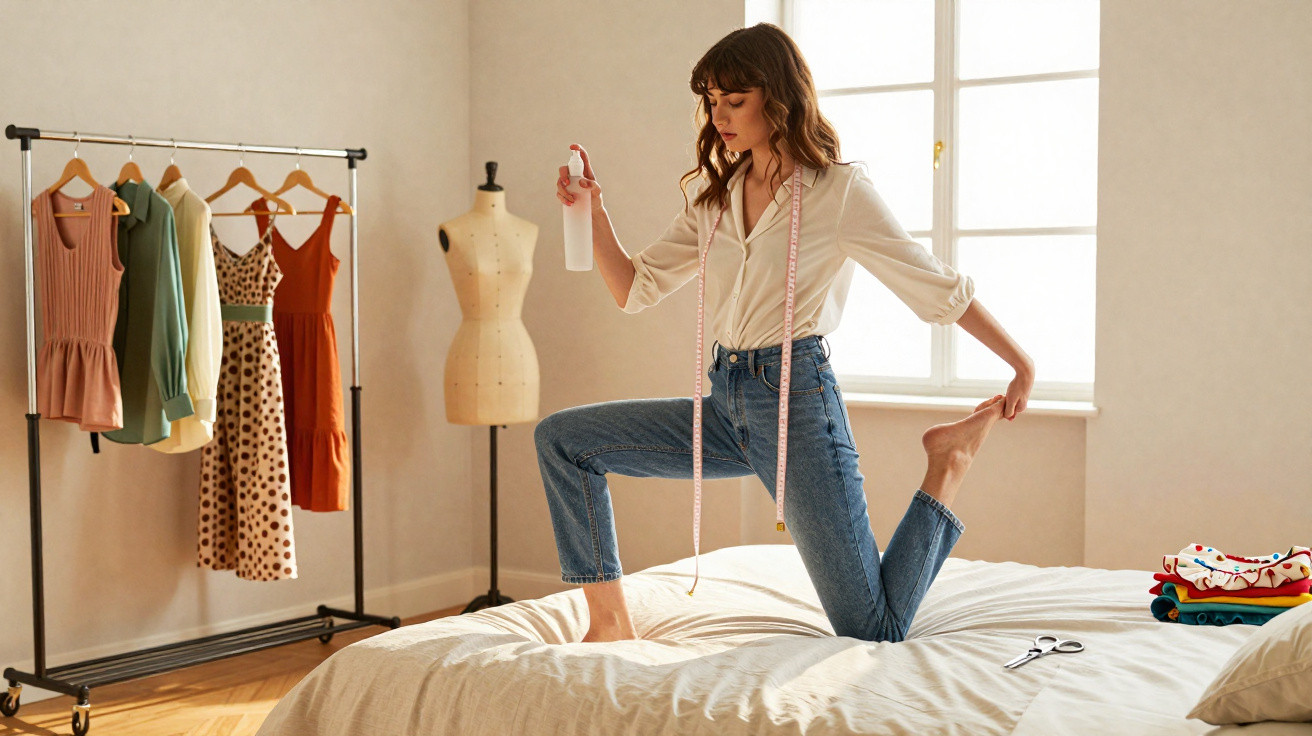
A beloved skirt from the 1960s, the perfect old pair of jeans – and then the zip will not close.
A simple trick can save the garment instead of making you give it away.
Many second-hand fashion enthusiasts know the feeling: everything looks ideal at the flea market or in an online vintage shop, but the mirror at home delivers a shock – it is far too tight. Before a treasured find disappears into the furthest corner of the wardrobe or needs costly alterations, it is worth trying several surprisingly straightforward ways to make old clothes up to a full size larger.
Why vintage clothing often seems too small today
If you are wondering whether you have put on weight, vintage cuts are often not the real reason. Clothing sizes used to be defined very differently. A ready-to-wear size labelled 40 in the 1970s would now be closer to a small size 36. The number on the label is therefore misleading: your body has not necessarily changed, but the sizing system has.
Older garments were also often cut much closer to the body. Skirts, dresses and fitted blazers sit more snugly, placing the fabric under strain at the hips, waist or bust. That pressure is focused on only a few seams, so fibres may distort or even tear if you simply fasten the item “somehow”.
“When people struggle with vintage, it is rarely because of their own measurements – old size charts and very narrow cuts are usually the problem.”
The encouraging part is that natural materials such as cotton and linen can often yield a few extra centimetres without major sewing work. There are also ways to adapt delicate treasures from previous decades while respecting their original shape.
What “one size larger” means in technical terms
Fashion fans often talk about going “one size larger” without knowing what that involves. In pattern cutting, it normally means roughly 4 cm of extra circumference at a key point, such as the waist, hips or bust.
- about 4 cm additional circumference = approximately one size
- the 4 cm is shared between both sides of the body
- in practice, that means around 2 cm at each side seam or across the front and back sections
Knowing this makes it easier to judge whether a trick remains realistic or whether only a tailor can help. Stretching fibres slightly is more likely to provide one or two centimetres. For a larger difference, the construction of the garment needs altering, for example by adding fabric inserts.
The five-minute method for tight vintage jeans
The quickest way to gain a little room in old jeans makes use of a property of denim: rigid cotton reacts noticeably to water and tension. This can be put to good use.
How the water-and-movement trick works
- Check the label: this method works best with jeans made from 100 per cent cotton, with no elastane or only a very small amount.
- Dampen the tight area: generously spray the waistband and upper hip area with lukewarm water until the fabric is thoroughly damp.
- Put the jeans on: although it may feel strange at first, wear the damp jeans and fasten the button and zip if you still can.
- Move around: do squats, lunges and gentle torso twists for three to five minutes. This spreads the tension evenly across the waistband and hip area.
- Let them dry: allow the jeans to dry slightly while you are wearing them, then take them off. Leave them to air-dry afterwards – never use a tumble dryer.
If wearing wet clothes is not for you, stretch the waistband over a very wide wooden hanger or the back of a sturdy chair instead. The damp fabric is gently pulled wider and dries in its new shape. The result is usually a little less pronounced than with movement exercises, but the process is more comfortable.
“The water method can often create up to three centimetres of extra waistband width in rigid vintage jeans – with no needle or thread required.”
Important: avoid hot water and tumble dryers, as heat is more likely to shrink cotton. Once the jeans are dry, measure them again with a tape measure. This will show whether you have nearly reached your goal or whether another alteration is needed.
When a skirt or dress feels tight: the “secret tip” from the furrier’s workshop
With narrow pencil skirts or fitted dresses, stretching alone is seldom enough. A traditional tailoring solution works better here: a wedge-shaped insert in the side seam, also simply called a triangle or insert.
How to add a discreet fabric wedge to a side seam
The principle is straightforward: open a section of the seam where the fabric is under the greatest strain and add a little volume – subtly and with very little visual impact.
A typical process is as follows:
- Mark the points on the left and right where the skirt or dress is tightest, usually at the hips or waist.
- Carefully unpick the side seam at these points for around 5 to 7 cm downwards.
- Cut a diamond-shaped piece, for example measuring 6 by 8 cm, from a similar fabric. A deliberately contrasting fabric can also create a fashionable effect.
- Fold the diamond in half to create a triangle. Its point will face downwards.
- Insert the triangle into the open seam with its point facing down and stitch it in securely on both sides using close stitches.
These triangles redistribute the tension and generally provide precisely the missing centimetres. Two neatly placed inserts will often give the familiar extra 4 cm of circumference without ruining the line or style of the original silhouette.
Elastic inserts for delicate treasures
Owners are often reluctant to use firm fabric inserts in particularly valuable garments, such as an old designer skirt or a dress with intricate detailing. Short wedges made from dense elastic at the waistband offer an alternative.
To do this, open the waistband slightly at the sides, insert a small triangle of strong elastic and sew it in so that it is barely visible when relaxed. The waistband then gives under tension while retaining its shape in the wardrobe. It is ideal for garments you want to wear for years without having to reconstruct them completely.
When it is worth visiting a tailor
These methods work well when only a small amount of extra room is needed. However, if the zip stops 10 cm before it can close, even the best trick will not solve the problem. Professional help is then required.
Typical jobs for an alterations tailor include:
- complex lining constructions in coats and jackets
- delicate fabrics such as silk, lace or very old wool
- substantial extra width, meaning clearly more than one size
- repairs to historic button plackets or unusual zips
Many tailors can tell at a glance whether a garment can be enlarged harmoniously or whether its proportions will suffer. Sending a photograph or making a brief visit can prevent frustrating attempts at home.
How to choose vintage treasures more successfully from the start
Buying vintage more deliberately means less rescuing later. Take a tape measure when browsing and measure the hips, waist and bust of the garment on the spot. Compare those figures with the measurements in which you feel comfortable, rather than relying only on your “official” ready-to-wear size.
Also consider the fabric type: pure wool, cotton and linen can be shaped slightly, whereas synthetic fibres give far less. A structured polyester skirt offers little forgiveness, while cotton jeans are more likely to adapt to your body.
Risks and limits when stretching clothing
Useful though these tricks are, they have their limits. Pulling too hard can stretch out seams or cause irreversible damage to fabric fibres. Older materials that have already become brittle are especially sensitive. Take care if the fabric turns whitish or crackles when you merely pull it apart.
It makes sense to test how the fabric responds in an inconspicuous area first. If it stretches gently and springs back only slightly, the prospects are good. If it feels rigid and unyielding, sewing in an insert is preferable to simply pulling it wider.
Why vintage clothing is worth the effort
Anyone who has found a perfectly fitting vintage piece knows how difficult it is to replace. The materials are often of higher quality, the cuts more distinctive and the environmental footprint lower than that of fast fashion. A few minutes with water, a tape measure and a needle can therefore save a garment you will wear for many years.
At the same time, your eye for quality becomes sharper: you learn to distinguish fabrics, read seams and spot where a cut has potential for alteration. In time, you will shop more confidently at flea markets and second-hand shops, choose more purposefully and make fewer disappointing purchases.
It is the combination that matters: a little technical knowledge about measurements, a quick denim trick in the bathroom and a neatly sewn insert in the right place. That is how your favourite vintage piece can genuinely grow by one size while remaining the treasure you fell for in the first place.













Comments
No comments yet. Be the first to comment!
Leave a Comment