Colourful swimming caps, foam noodles and a whistle reverberating off the tiles. On a bench by the entrance, 72-year-old Marie watches the activity as she rubs her right knee through her leggings. Her doctor has advised her to swim more. Her neighbour is convinced Pilates is the answer. Her joints, however, are unimpressed by both suggestions.
She began with swimming. Being in the water was pleasant, but navigating slippery pool steps and then facing cold air on wet skin left her drained. Pilates looked graceful on YouTube, yet once she was on the mat, her wrists and shoulders protested more loudly than her osteoarthritis had.
Like many people over 65, Marie quietly gave up. That changed when her physiotherapist proposed an activity she had never viewed seriously – one that is steadily proving transformative for painful joints.
Why walking – but not just any walking – beats the “fancy” activities
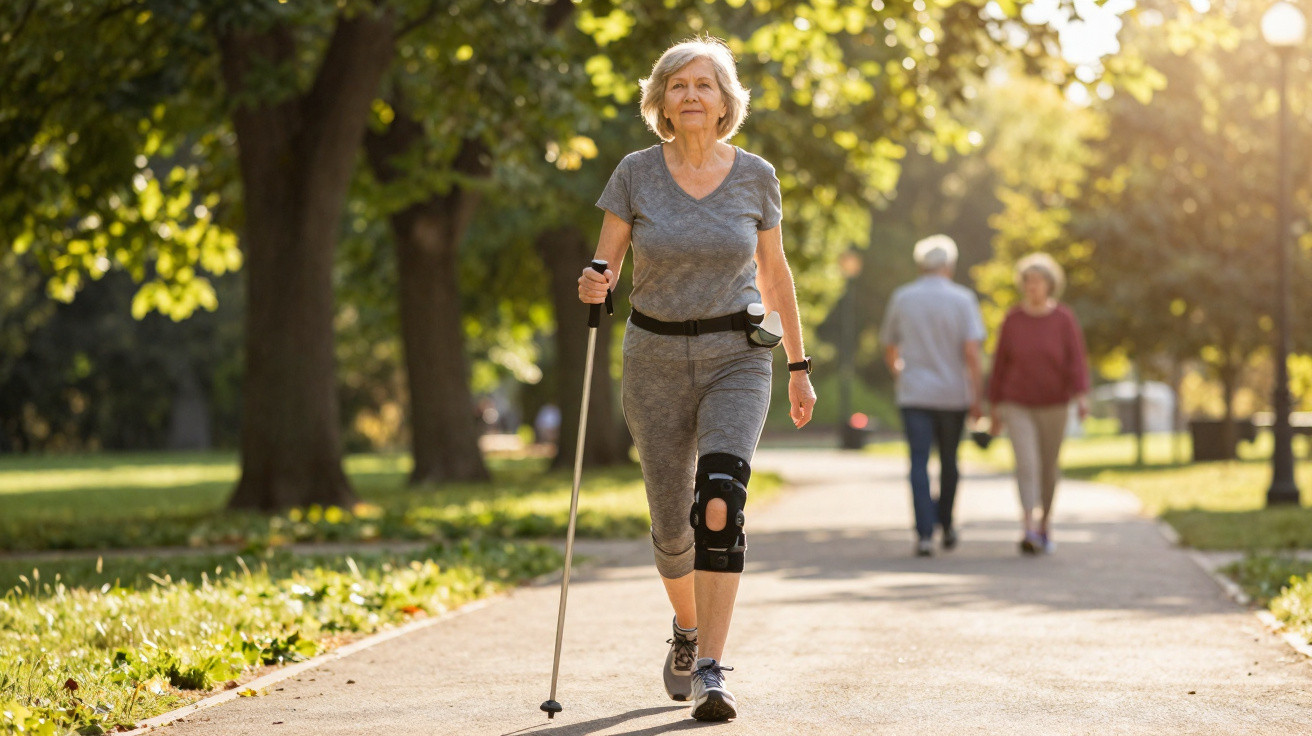
The activity repeatedly highlighted by serious research for over 65s with joint problems is hardly glamorous. It requires no equipment, membership card or specialist footwear. It is walking – provided it is planned, purposeful and a little more considered than simply walking while doing the shopping.
At an appropriate pace, on a suitable surface and in repeated short sessions, walking can outperform many supposedly gentler sports for joint health, particularly in the knees, hips and lower back. The body responds well to this regular, low-impact motion. Movement, rather than rest, helps nourish cartilage. Circulation improves, while the muscles that support the joints begin working again.
Unlike swimming or Pilates, there are no pool timetables, changing rooms or difficult positions to contend with. You open the front door, step out and begin. It is straightforward, certainly, but it should not be haphazard.
Consider Louis, 68, a former delivery driver whose knees were badly worn. For years, every appointment with a doctor ended with the same advice: “You should swim.” He gave it a go twice. The first time he forgot his towel; the second, the pool was shut for maintenance. His swimming career ended there.
Later, his granddaughter gave him a watch that counted steps. Louis began recording his walks on a small calendar attached to the fridge. During the first week, he managed 1,500 steps a day. His knees hurt, and he limped home. His physiotherapist did not tell him to stop; instead, she advised shorter, more frequent walks on level pavements.
After three months, he was taking three 12-minute walks each day. His average pain score, on a scale from 0 to 10, had fallen from 7 to 3. Without “being on a diet”, he had lost 3 kilos. Most unexpectedly, he slept better on the days when he walked.
Joint pain is not solely about “too much wear”; it can also result from “not enough movement”. Once we stop moving, the muscles that shield our joints lose strength. The joint becomes less stable, making every step feel more acute and more burdensome. Fear then takes hold. We move less still, and the downward cycle continues.
Walking can gently break that cycle. Its impact is far lower than many people assume, especially when you walk on even, predictable ground in supportive shoes. There are no abrupt turns as in tennis, no enforced postures like certain Pilates movements, and no extreme range of motion such as breaststroke kicks in the pool.
There is a benefit for the brain, too. Walking outdoors challenges balance, coordination and attention in ways a mat-based class rarely can. The setting changes, the eyes assess the environment and the inner ear continually adjusts. Joints are mechanical, but pain is also a story the brain tells. A regular, safe walk can make that story less intense.
How to walk when your joints already hurt
For over 65s with joint problems, one of the most useful approaches is what many physiotherapists call “interval walking for real life”. This is not the athletic form of interval training, but a gentler version. Choose a duration rather than a distance – 10 minutes, for instance.
Begin with 3 very slow minutes, almost at a strolling pace. Follow this with 4 minutes at a “conversation” pace: you can speak, but you can feel your body working a little. Finish with another 3 minutes very slowly. That is one complete session. If you want to do another, rest for at least two hours first.
The aim is not performance; it is consistency. Take short walks on most days, using ground you feel confident on. This might be a park path, a broad level pavement or, on rainy days, the covered walkway of a shopping centre. Benches can become “micro-goals”: walk from one bench to the next lamppost, then return.
There is one common trap: overdoing it on a “good” day. When a knee feels lighter or a hip feels less stiff, it is tempting – sometimes proudly – to walk twice as far. The following morning, the joint can feel as though it is on fire. You blame walking and conclude, “Clearly this activity isn’t for me.”
That is not failure; it is human nature. We often forget that joints over 65 can react 24–48 hours later. What felt enjoyable on Tuesday may lead to swelling on Wednesday. The answer is not to fear walking, but to manage it like medicine: the right dose, at the right time, on a regular basis.
Another typical error is trying to “walk properly” immediately: taking long strides, swinging the arms widely and moving quickly. It may look athletic, but to an arthritic knee it can feel like a small earthquake. Shorter steps are kinder. A useful guide is this: if pain rises by more than two points on your normal scale during or after a walk, that session was too ambitious.
As one geriatrician told me recently, “The problem is not that older people don’t move enough. It’s that we gave them the idea that movement has to be complicated, or done in special places, to count.” His patients who do best are not the ones enrolled in the trendiest classes. They’re the ones who organize their weeks around simple, predictable walks.
- Start tiny – for the first week, walk for 5 to 8 minutes once daily, even if you “feel you could do more”.
- Choose a route you know by heart – this lets you concentrate on your body rather than deciding where to go.
- Use pain as a guide, not a verdict – mild discomfort is normal; sharp or increasing pain means slow down rather than abandoning walking altogether.
- Identify chairs for resting or walls to lean against – spotting them along the route can reduce anxiety before you even set off.
- Keep one “no negotiation” walking date a week – a brief, non-negotiable appointment with yourself that helps establish the habit.
Walking as a quiet way of reclaiming your body after 65
Beneath this discussion of joints and steps is something broader: the right to live in your own body without feeling frail or “finished”. Walking asks very little, which is exactly why it can restore confidence. There is no need to change clothes, wear a swimsuit in public or understand an instructor’s terminology.
Often, the first change is not visible on a knee X-ray. It is a shift in the relationship with time. A 12-minute walk gives the day a small structure, a moving pause. The phone remains in a pocket, while the world narrows to what your feet, breathing and eyes are doing. For many people over 65, this is the first “appointment with their body” they’ve had in years, outside of medical offices.
Realistically, nobody manages this every single day. Life intervenes: grandchildren visit, rain lasts all week, pain flares, motivation disappears. Perfection is not the objective. What matters is not abandoning the habit entirely after one missed walk or one difficult morning. The body is more forgiving than we imagine when it is treated consistently and gently.
There is a social aspect as well. Two neighbours who walk together once a week may talk about grandchildren, worries or the new bakery. Joints warm up, and conversation often flows more freely when the body is in motion. Some communities now run “slow walking groups” for older people with pain, with no targets for speed. Many who initially attend for their knees remain for the companionship.
Swimming and Pilates are not the villains here. Both remain excellent choices for people who enjoy them and can attend regularly. The quieter change is happening elsewhere: on pavements and park paths, among people who put on their shoes not to “get back into shape”, but to halt the decline and feel a little less stiff, a little less old.
When doctors call walking “the best activity for over 65s with joint problems”, it may sound almost underwhelming. Many people expect a new technique, a specialist programme or something more sophisticated. Yet this seeming simplicity is its greatest advantage: no subscription, no expensive kit and no age limit.
Perhaps the more useful question is not “What is the best activity?” but “What activity can I honestly see myself doing most weeks, in my real life, with my real joints?” For a great many people over 65, the truthful answer is neither swimming nor Pilates nor a gym class. It is the route from the front door to the corner and back – then a little further, then again the following week.
| Key point | Detail | Value for the reader |
|---|---|---|
| Structured short walks | 10–15 minutes with slow–moderate–slow intervals, repeated several times a week | Protects joints without overloading them and fits easily into daily life |
| Use pain as a guide | Accept mild discomfort, stop or reduce if pain rises sharply or lasts more than 48 hours | Reduces fear of movement while avoiding real flare-ups |
| Familiar, flat routes | Pavements, parks, shopping centres with benches and safe surfaces | Improves confidence, balance, and regularity of the new habit |












Comments
No comments yet. Be the first to comment!
Leave a Comment