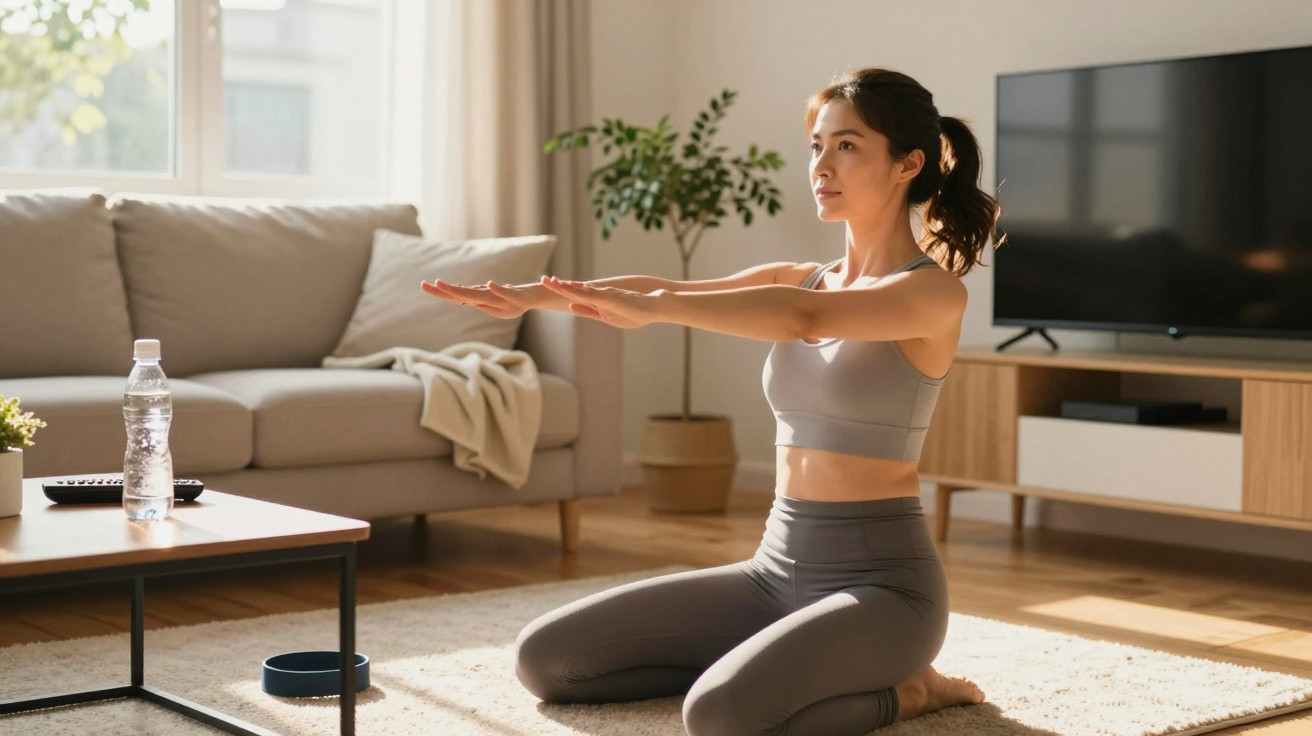
A few well-chosen movements in front of the television can make a difference.
After a long day at work, most people who finally settle on the sofa are not thinking about exercise. Their midsection, however, is an unforgiving reminder that hours of sitting can take their toll. The good news is that you do not need to turn your living room into a gym to achieve a firmer stomach. Just a handful of smart exercises will do – right in front of the screen, without working up much of a sweat or using equipment.
Why belly fat becomes particularly stubborn after 40
The body changes noticeably over time. From around the age of 40, metabolism slows, muscle mass declines slightly and many people move less in everyday life. As a result, the body is more likely to store fat around the abdomen than burn it.
- Basal metabolic rate falls, meaning we use fewer calories while at rest.
- Sedentary work and extended screen time make the issue worse.
- Stress and insufficient sleep can encourage cravings and abdominal fat.
- Hormonal changes, such as those during the menopause, can promote fat around the lower stomach.
Yet a strained abdominal area is not simply about appearance. The deep core muscles stabilise the spine, protect the spinal discs and reduce pressure on the pelvic floor. Training this area specifically therefore brings several everyday benefits.
Targeted strengthening of the abdominal and pelvic-floor muscles supports better posture, a flatter stomach and greater everyday control – all without a hardcore workout.
Why television time is ideal for mini-workouts
Many people do not lack motivation; they feel that: “I have no time.” This is exactly where television time has an advantage. You are already in the living room, reasonably relaxed, and only need to overcome a small amount of resistance to move briefly.
Experts favour slow, controlled movements that engage the deep abdominal muscles, rather than hundreds of crunches, which can often strain the neck more than the stomach. Spending a few minutes exercising while watching a series creates a form of incidental movement: it is not as demanding as an intense workout, but it is considerably more effective than simply sitting still.
Four simple abdominal exercises to do in front of the television
1. Side plank for the obliques and waist
The side plank primarily works the muscles along the side of the core and helps create a more stable midsection.
How to do it:
- Lie on your side and position your forearm beneath your shoulder.
- Straighten your legs, placing your feet either one on top of the other or staggered.
- Raise your hips until your body forms a straight line from head to feet.
- Tighten your stomach and keep your shoulders away from your ears.
- Hold for 15–30 seconds, then change sides.
If this feels too difficult, rest your knees on the floor. This reduces the load while still working the side abdominal muscles.
2. Seated abdominal exercises on the sofa
This movement is ideal for advert breaks or quieter moments in a series. It trains the rectus abdominis and can improve posture.
How to do it:
- Sit upright on the edge of the sofa, with both feet on the floor and your back straight.
- Draw your shoulders back and lift your chest slightly.
- As you exhale, consciously draw in your stomach.
- Lift one knee without tipping your upper body forwards.
- Place the foot down again, then raise the other knee.
If you have a resistance band, place it around your feet to increase the resistance. The key point remains the same: do not round your back; work from abdominal tension instead.
3. Scissor movement for the lower stomach
The scissor movement is aimed particularly at the lower abdominal area, often considered a “problem area”.
How to do it:
- Lie on your back in front of the television, with your hands beside your body or underneath your buttocks.
- Keep your legs straight and lift both feet a few centimetres from the floor.
- Raise one leg to roughly 45 degrees while the other stays close to the floor.
- Alternate the legs so they cross like a pair of scissors.
- Continue breathing calmly, keep your stomach tight and do not allow your lower back to arch excessively.
Anyone with lower-back problems can reduce the range of movement or lift their upper body slightly to gain more stability.
4. Small leg movements for sustained core tension
After the scissor movements, small, quick up-and-down leg movements provide additional activation for the lower abdominal muscles.
How to do it:
- Stay on your back, holding your straight legs a few centimetres above the floor.
- Make small, rapid alternating upward and downward movements with your feet.
- Keep your stomach firm and your lower back as close to the floor as possible.
- Work for 10–20 seconds, take a short break, then begin again.
This exercise may look unremarkable, but when performed neatly and with control, it quickly creates a surprisingly strong burn in the abdominal area.
How often, how long and what to watch out for
Nobody needs to remain in a plank position for an entire episode. A short but focused block during each episode is more effective. Experts recommend a small number of clean repetitions rather than endless sets performed with poor technique.
| Exercise | Duration / repetitions | Tip |
|---|---|---|
| Side plank | 2–3 rounds per side of 15–30 seconds | Do not let the hips drop |
| Seated abdominal exercise | 2–3 sets of 12–15 knee lifts per side | Keep your back straight |
| Scissor movement | 2–3 sets of 10–15 alternations | Move slowly and with control |
| Small leg movements | 2–3 sets of 10–20 seconds | Do not lose abdominal tension |
If you have discomfort in your back, hips or pelvic floor, speak with a doctor or physiotherapist beforehand. Pain is a warning sign: stop the exercise immediately and adjust the variation or intensity.
How much do these exercises really help against belly fat?
The honest answer is this: these four exercises can tone the stomach, make the core more stable and improve posture. This alone often makes the abdomen look flatter. Actual fat loss, however, depends mainly on diet and overall everyday activity.
Targeted exercises shape the muscles – whether the stomach becomes visibly flatter is determined by the calorie balance across the whole day.
Combining the television workout with a few straightforward habits can significantly improve your chances:
- Take more steps each day, for example with short walks.
- Cut down on sugary drinks and choose water or unsweetened tea instead.
- Eat protein-rich meals to support muscle growth and stay full for longer.
- Sleep regularly to help prevent hunger cravings.
Pelvic floor, posture and back pain: the hidden benefits
One aspect is often overlooked when people discuss the stomach: the pelvic floor. It supports the bladder, uterus and bowel. This area can be affected particularly quickly after pregnancy, during the menopause or after prolonged sitting. Many television exercises also engage the pelvic floor because it works together with the deep abdominal muscles.
Consciously drawing the lower stomach slightly inwards during training and tightening the area around the pubic bone and sitting bones strengthens this important muscle group. Over time, this may help reduce mild urine leakage when coughing, laughing or sneezing, while improving body awareness.
The back benefits too: strong core muscles relieve the lumbar spine, which is often heavily strained by sitting and incorrect lifting in daily life. After several weeks, many people notice a more upright posture and less tightness in the lower back.
Practical tips to make your sofa workout a real habit
A clear plan helps prevent good intentions from fading quickly. A few simple approaches make it easier to get started:
- Choose a fixed point in a series, such as the first five minutes of every episode.
- Keep a mat or blanket next to the sofa permanently – then there is no excuse.
- Begin with just one exercise and add more only after a few days.
- Record your progress, such as the seconds you can hold a side plank.
If motivation is difficult at first, begin by engaging the pelvic floor and stomach while seated. It can even be done invisibly – nobody will notice that you are exercising. Confidence builds over time, making it much easier to get down on the floor.
That way, an evening in front of the television becomes not a source of guilt but a quiet ally against a protruding stomach: only a few minutes, very little effort, a noticeable effect – and your favourite series continues uninterrupted.








Comments
No comments yet. Be the first to comment!
Leave a Comment