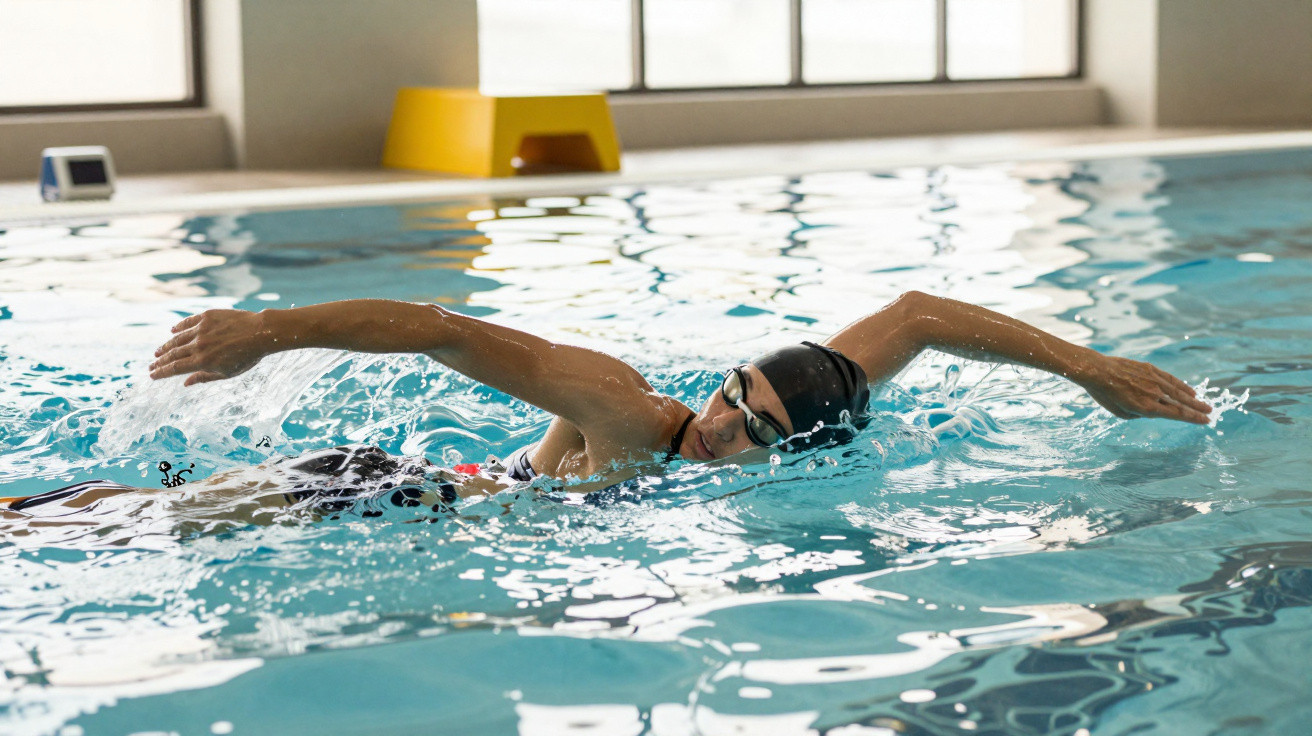
At the swimming pool, the scene is usually familiar: people race through lengths, stop at the pool edge out of breath and hope speed will produce a six-pack. An experienced fitness coach turns that idea on its head. In her experience, slow swimming with clean technique often does more for the abdominal muscles and core than any frantic high-intensity workout.
Why slow swimming challenges the core so effectively
In the water, your body needs to remain horizontal. Buoyancy supports you, but the water resists every movement. To move forwards at all, your arms and legs must work while your torso stays steady. That is where the deep muscles come in: the transverse abdominals, obliques, spinal erectors and glutes.
These muscles function like a natural corset, keeping the ribcage, abdomen and pelvis aligned. Simply increasing your speed often causes that stability to disappear. The head rises too far from the water, the hips drop and the legs start kicking wildly. At that point, the shoulders and thighs do most of the work while the core disengages.
“Slow, controlled strokes force the core to stay under tension throughout – it is pure core training in the water.”
Swimming at an easy pace gives you more time to focus on every part of the movement: the hand entering the water, the pull phase, the arm path and the kick. If you consciously maintain the line between your head, back and pelvis, your abdominal and back muscles work much like they would in an isometric plank hold – but more gently and with less stress on the joints.
The method: more calm, targeted sprints
The fitness coach, who has worked with recreational exercisers for more than 15 years, recommends a clear structure for swimming training. Her approach is to spend most of the session swimming calmly with sound technique, adding brief faster sections – not to chase records, but to take the body out of its comfort zone.
What a 30–40-minute session could look like
- 5–10 minutes of gentle swimming to start: Settle into the water, find your breathing rhythm and feel your body position.
- Main interval block: 5 to 10 sets of 100 metres, with 75 metres slow and 25 metres at a brisker pace.
- Easy cool-down swim: 5 minutes at a very relaxed pace, focusing on lengthening out and taking long strokes.
The slow sections are clearly the priority. These phases are where you develop technique, balance and core tension. The brief faster efforts stimulate the cardiovascular system and add variety to the session without breaking down your form.
Swimming this way two to three times a week works the core intensively without having to struggle through crunches or jumps. This blend of strengthening and relief is particularly beneficial for people with sensitive knees or backs.
Technique before speed: the ideal swimming position
For calm swimming to genuinely target the centre of the body, every detail of your posture matters. Once the body starts to “bend”, some of the training stimulus for the core is lost.
Many recreational swimmers do not pay enough attention to the following points:
- Head position: Look diagonally downwards rather than ahead. This keeps the neck relaxed and the upper body aligned.
- Back: Lengthen through it instead of dropping into an exaggerated arch. Imagine someone is gently pulling you forwards from the back of your head.
- Pelvis: Keep it in line with your shoulders and ribcage. Do not allow it to sink or lift too high.
- Kick: Kick lightly from the hips, using small movements. Avoid frantic kicking driven from the knees.
- Arms: Keep your strokes controlled rather than yanking through the water. Power should be even, never jerky.
“As soon as the head looks too far out of the water or the legs kick wildly, the tension in the abdomen collapses – and with it the most important training effect.”
Simple water exercises for greater core tension
A few very straightforward variations can help you develop a better feel for your core in the water. They can be incorporated into any session.
Using a kickboard: control for the pelvis and abdomen
Hold a kickboard in front of you with your arms extended. Swim using very slow kicks. Draw your abdomen in slightly and aim to keep the pelvis completely still. If your hips sway or your lower back begins to arch, reduce the pace further.
On your back: a stable core and active legs
Float on your back, with your arms by your sides or slightly out to the sides. Then kick using only your legs, again keeping the movement small and calm. The aim is for the ribcage and abdomen to move as little as possible, with the torso remaining plank-like. This exercise quickly reveals whether your abdominal muscles are truly contributing.
Gentle wave movements for the whole body
Extend your arms forwards, place your face in the water and create small wave-like movements from your torso. The movement begins in the centre of the body before continuing through the legs and feet. The aim is not to shoot through the water like a dolphin, but to feel the connection between the upper and lower body.
Which swimming stroke is particularly suitable for the core?
In principle, every swimming stroke uses the core muscles when the technique is correct. At an easy pace, however, some strokes work especially well as core training.
| Swimming stroke | Core benefit | Who is it suitable for? |
|---|---|---|
| Front crawl | Places high demands on hip rotation and stability | Anyone who already feels reasonably confident in the water |
| Backstroke | Very gentle on the joints; the back and abdominal muscles work continuously | People with neck problems or discomfort in the lower back |
| Breaststroke | Easy to control, but risky with poor head position | Beginners who swim deliberately slowly and with good form |
Many coaches advise using front crawl and backstroke at a relaxed pace in particular. Those who constantly lift their head out of the water while swimming breaststroke overload the neck, while core tension suffers.
How often should you swim to see results?
With one or two relaxed water-based sessions each week, most people notice a more stable core after just a few weeks. Clearly noticeable changes in posture and abdominal tension tend to appear after around two to three months if you remain consistent.
This is worthwhile in many everyday situations: climbing stairs, carrying shopping bags or sitting at a desk for long periods. A trained core means the back complains less and movements feel easier.
Common mistakes that reduce the effect on the core
Anyone who simply churns out lengths can easily undermine their own training progress. The most frequent mistakes include:
- Being too ambitious about speed: Constantly swimming against the clock makes it easy to forget posture and breathing.
- Keeping the head above water all the time: The neck tenses, the back arches and the abdomen switches off.
- Taking overly long breaks: If you spend several minutes chatting at the pool edge after every length, the training stimulus disappears.
- Having no structure: Swimming “whatever comes to mind” usually achieves less than a clearly planned alternation between slow and slightly faster work.
Why slow swimming is so gentle on the joints
Compared with many land-based sports, swimming places very little strain on the joints. Buoyancy reduces the effective body weight and there is no impact. For people with osteoarthritis, excess weight or knee problems, the pool is often a safe place for intensive exercise without leaving them in pain for days afterwards.
The combination of slow technical work and short faster sections provides cardiovascular stimulus while sparing the bones and joints. Throughout it all, the core works continuously in the background to maintain that balance.
How to combine swimming intelligently with other training
For many people, a water-based workout fits perfectly into a varied weekly plan. For example:
- Day 1: Strength training using machines or bodyweight
- Day 2: Swimming session focused on calm technique and the core
- Day 3: Walking, easy jogging or cycling
- Day 4: Another swim or a short core workout at home
This keeps the body moving without repeatedly placing it under the same type of stress. Anyone prone to tension or tired of high-impact classes can do a great deal for their abdomen and back with a few calm lengths.
What matters in the end is not how quickly you complete a length, but how consciously you move in the water. Calm swimming with technically clean form can become a quiet secret weapon for a strong core – away from workout hype and the bustle of the gym.













Comments
No comments yet. Be the first to comment!
Leave a Comment