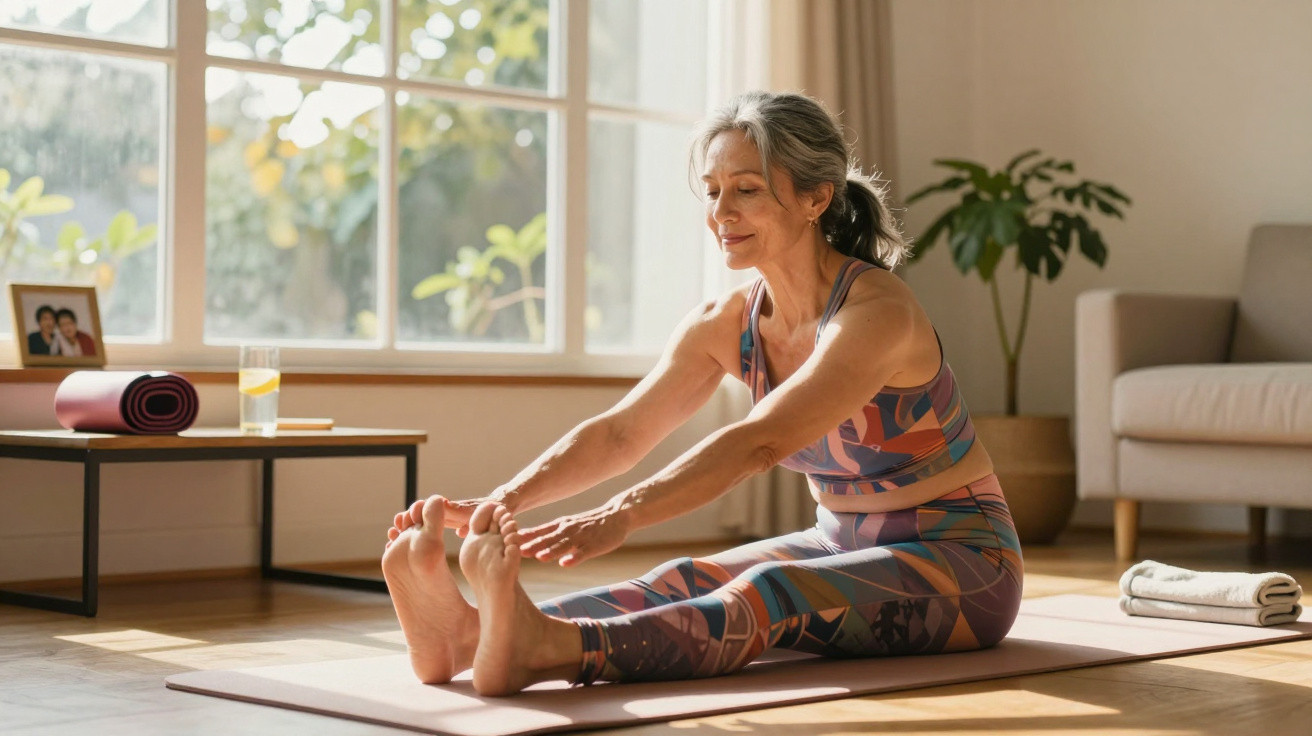
A woman in the exercise room braces one hand against the wall, her gaze fixed and her breathing steady. “I used to just bend down,” she says, laughing briefly as she slowly draws up her leg. Now, at 62, it no longer works “just like that”. Every movement is more deliberate and slower, as though she first has to make friends with her own body again. Around her are people aged over 50: some in sportswear, others still in office clothes, all sharing the same quiet hope – not to seize up.
At the front, the physiotherapist counts softly. It is not a drill, more an invitation. 10 seconds. 20. 30. Suddenly, stretching feels less like a school obligation and more like a conversation with your own joints. This is precisely where it becomes clear: something changes when we slow down.
Why slow stretching after 50 can make such a difference
Anyone over 50 knows the feeling: you rise from a chair, want to get going quickly – and your body takes two or three seconds to catch up. Your joints make themselves known, and your muscles are no longer “ready to go” immediately. Many people shrug and say: “Well, that’s part of getting older.” Physiotherapists, however, often see it as a training issue rather than a verdict on age.
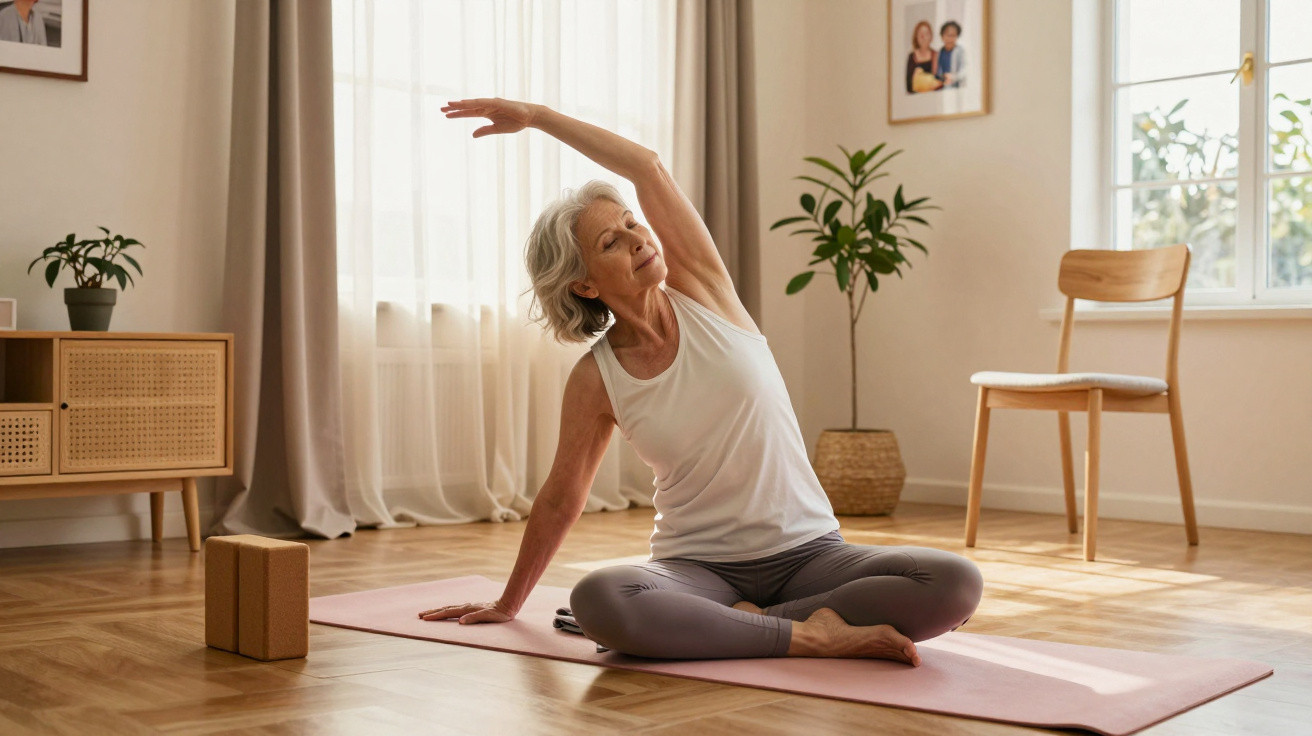
Slow stretching exercises work rather like a reset button for the muscles and fascia. They allow the body time to release tension instead of forcing it into a position. Stretching stops being an acrobatic feat and becomes a calm dialogue. This is where genuine mobility starts – not with whether you can still do the splits.
At a clinic in Cologne, a physiotherapist observed patients aged over 50 for a year. Many arrived with the same complaints: stiff hips, a tense back and restricted shoulder movement. Most had already tried everything: physiotherapy, spinal disc surgery, the gym and yoga videos on YouTube. What often remained in the end were very simple, slow stretching routines – held for 20 to 60 seconds, without grimacing in pain or any pressure to perform.
One 58-year-old teacher said that, after three months of gentle stretching, she could get out of bed in the morning without having to psych herself up. There was no miracle cure and no “I’m 25 again” story. Simply less cracking, smoother movement and greater trust in her own body. It is these small changes that can genuinely transform everyday life.
Physiotherapists explain it in fairly matter-of-fact terms: as we age, muscles and connective tissue lose elasticity, while joints take longer to warm up. Fast, jerky movements can easily overload these structures, particularly after a day spent sitting. Slow stretching, by contrast, acts rather like a reset for the nervous system. Stretch receptors within the muscles have time to understand: “This is not a threat; you can let go.”
At that point, muscle tone drops, the fascia can glide a little more freely again, and joint surfaces gain a few degrees of movement. It may sound technical, but it simply feels as if you have outgrown a jacket that was too tight. Put plainly: the body is capable of a great deal when it is finally given time.
What slow, joint-friendly stretching after 50 looks like in practice
A slow hip-flexor stretch is one example many physiotherapists favour. Kneel with one leg on the floor and place the other in front, with both knees at roughly 90 degrees. Then gently move the pelvis forwards until you feel a mild pull in the groin of the rear leg. Now comes the crucial part: do not force your way into it or try to “get a little more out of it”. Instead, breathe calmly for 30 seconds, fixing your eyes on a point on the floor.
With every exhalation, let go a little; there is no need for a spectacle. Anyone doing this exercise two or three times on each side may notice after a few days that climbing stairs feels easier and long periods of sitting no longer cause such a pinch. This is the point at which slow stretching suddenly becomes more than “a bit of stretching”.
Of course, this is where many people fall into the familiar trap: after feeling better for a few days, they assume they must intensify their stretches, go deeper and force faster progress. That is exactly when strains or those typical “I’ve trapped something in my back” moments happen. Let’s be honest: nobody actually does it every single day. And anyone trying to make up for ten years of inactivity in one week will usually come unstuck.
Physiotherapists are more likely to advise mini rituals: three to five slow stretching exercises, each held for 30 to 45 seconds, on four days a week. No perfectionism and no guilt if you miss a session. Instead, adopt the attitude: “Today, I’m giving my joints a little breathing space.” It may sound ordinary, but it is a small mental revolution.
An experienced therapist from Hamburg sums it up this way:
“We train speed in sport; we train relaxation through stretching. Anyone over 50 needs both – but most people only have one of them on their radar.”
To make this more practical, here is a short list that his patients like to photograph:
- Start every stretch in a position where you could still breathe and speak comfortably.
- Increase the intensity only to a “pleasant pull”, never to pain.
- Hold the position for at least 20, ideally 30–45 seconds, without bouncing.
- Focus on exhaling – it is your built-in “let-go signal”.
- Stop if you notice that you are holding your breath or lifting your shoulders.
It almost sounds too simple. Yet that very simplicity is what makes slow stretching so suitable for daily life – especially when discipline is in short supply.
Mobility as a quiet luxury: how slow stretching shapes quality of life
At some point in life, the benchmark shifts. It is no longer about looking spectacular on the beach in summer, but about being able to put your socks on in the morning without swearing. Anyone over 50 realises that mobility is a quiet luxury. It does not show up in photographs, but in invisible moments: bending down, turning over in bed or getting into the car.
Slow stretching exercises create space for precisely these moments. They take the body out of its constant state of “functioning” and return something many people have lost over the years: the feeling of not being trapped within their own range of movement. You do not need to roll out a mat or light candles. Five minutes beside the bed will do, as will a quiet evening in the living room or a brief pause after a walk. Anyone sharing this is sharing more than a tip; they are sharing a little relief.
| Key point | Detail | Benefit for the reader |
|---|---|---|
| Slow stretching relaxes rather than overwhelms | Longer, calm holds (20–60 seconds) reduce muscle tone and stress in the tissue | Less stiffness, lower injury risk and more comfortable movement in daily life |
| Consistency beats intensity | 3–5 exercises, several times a week, are enough to create noticeable changes | A realistic starting point without performance pressure, easy to fit into busy days |
| Breathing is the hidden amplifier | Conscious exhalation tells the nervous system: “No alarm, you can let go” | Tension eases faster and the body feels calmer after stretching |








Comments
No comments yet. Be the first to comment!
Leave a Comment