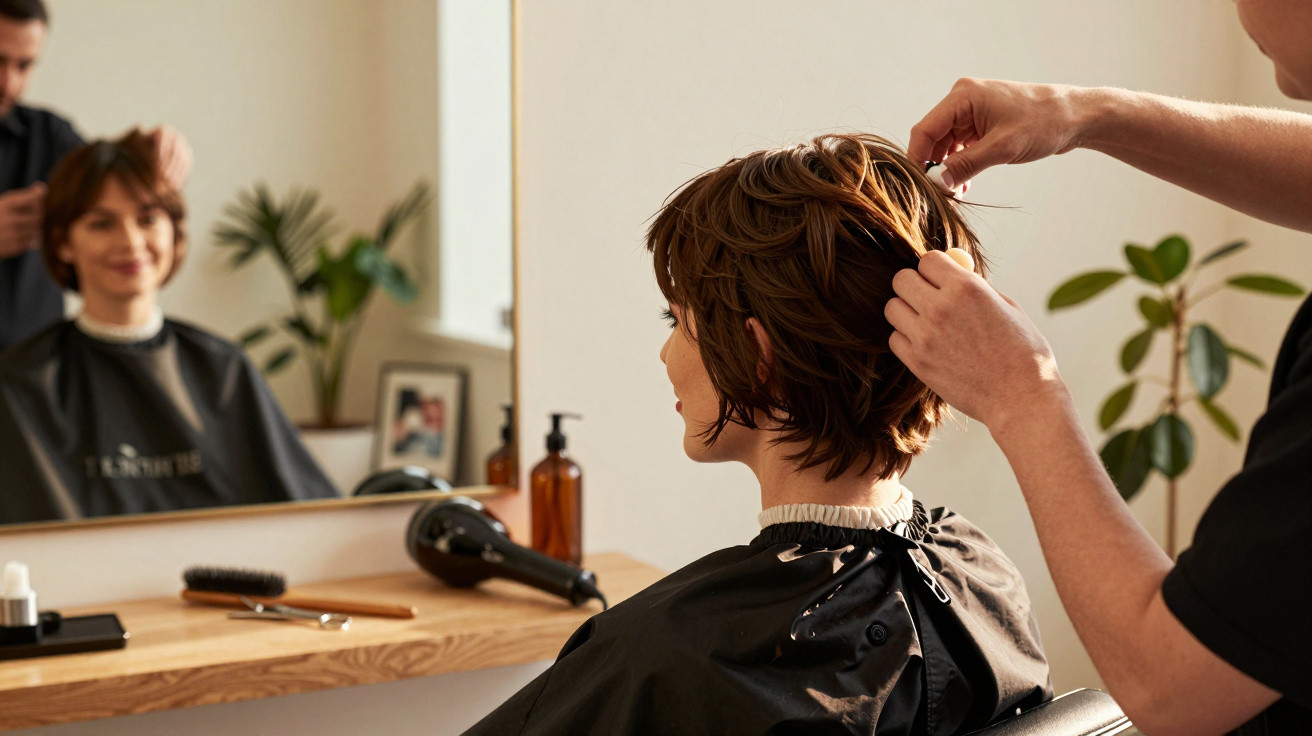
The woman sitting in my chair that morning studied her reflection as though it were an ex she had never quite forgiven. She wound a limp lock around her finger, sighed, and said the phrase I hear at least five times a week: “My hair used to have so much volume… and then I turned 40.”
The road outside buzzed with people hurrying to work, but the salon felt still. There was only her, me, and the fine, flat hair she believed had let her down.
She had no interest in extensions, spending an hour every morning with a round brush, or “fighting” her hair any longer. What she wanted was a haircut that would genuinely work for her.
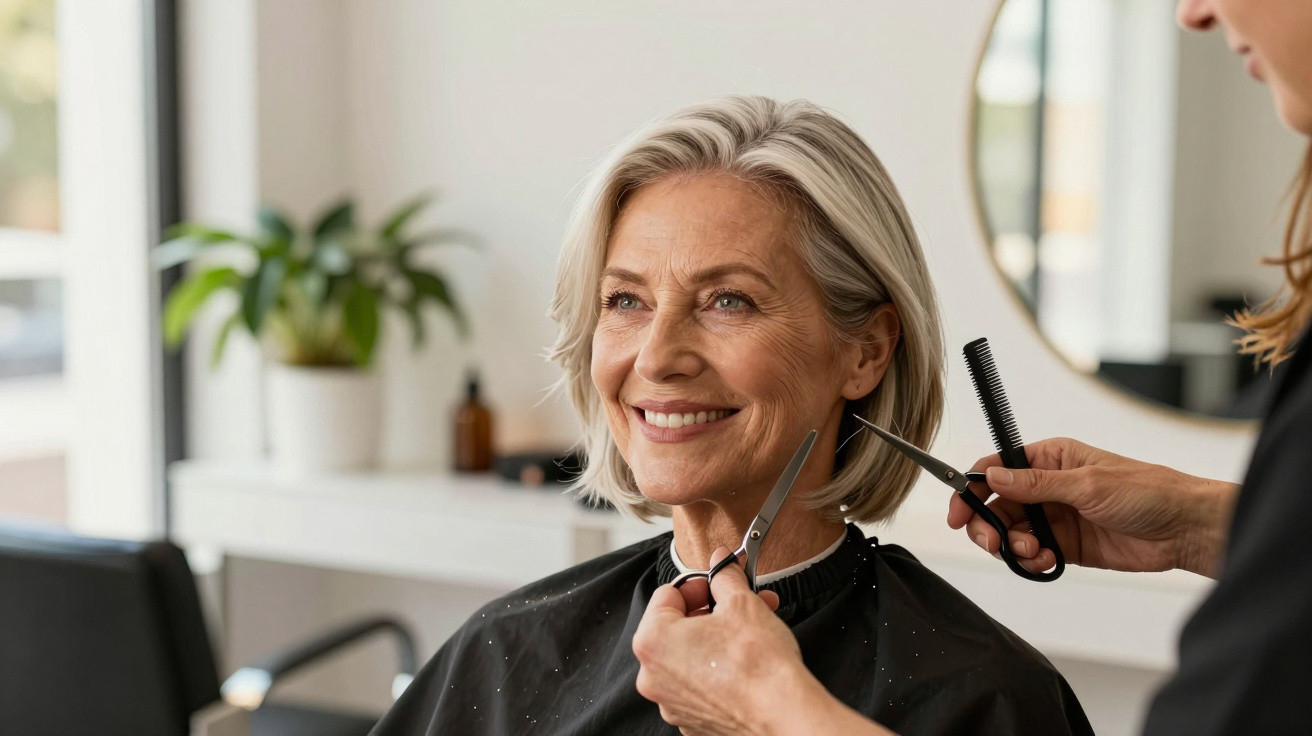
Forty-five minutes later, her jaw appeared more defined, her eyes looked brighter, and her hand shot up to her hair. “Wait… is that all my hair?”
The answer was one very particular pixie cut.
A pixie that gives nature a slight helping hand.
The pixie cut that gives fine hair a second life after 40
When I mention a “pixie”, many women over 40 imagine something severe and boyish: a short fringe, a flat crown, and ears on full display. That is not the style I am describing.
The pixie cut that creates the most volume for fine hair after 40 is softer, layered and almost feather-light. It is cropped at the nape, left longer through the top, and carefully over-layered at the crown to create lift without making it rigid.
It is not a military crop. It is closer to a cloud with an underlying structure.
From the front, it softly frames the face. In profile, there is a gentle “bump” at the back of the head where the hair rises. That is where the transformation happens.
Last spring, a client of mine called Sophie, 47, arrived with one firm condition: “Nothing shorter than my chin.”
Her hair was fine, oily at the roots and dry through the ends. The familiar mid-length style that had suited her in her thirties now hung in tired-looking ribbons. She wanted volume, yet every blow-dry had fallen by lunchtime.
We spoke properly. About hormones, time, and how women see themselves at 40+. I then showed her photographs of a layered pixie with added weight at the crown and a longer, sweeping fringe.
When she returned two months later, she was smiling. Her colleagues had asked whether she had “done something” to her face. She had not; the cut had simply lifted everything around it.
There is a clear reason this shape is so effective for fine hair after 40. As oestrogen levels decline, hair may become thinner around the temples and crown, losing density and “grip”. Long, weighty lengths pull the whole shape down.
A layered pixie turns that effect around. Taking weight from the nape and sides gives the top layers space to rise. Less hair equals more volume when the cut is built correctly.
The real secret is in the internal layering: tiny, unseen cuts that form support beneath the top layer. Instead of collapsing like a wet sheet, fine strands are encouraged to stand up like a tent.
It is more than a hairstyle. It is a small adjustment to gravity, right on your head.
How I cut and style this volume-boosting pixie in real life
This is how I construct the cut in the salon. First, I divide the hair into four main areas: nape, sides, crown and fringe. The nape is cut shortest, following the natural curve of the head so that it sits neatly against the neck rather than sticking out.
Next comes the crown, which is the centre of the volume. I elevate small sections to 90 degrees and slide-cut internally to create micro-layers that lift from the roots. Think of it as scaffolding rather than choppy texture.
I retain enough length on top for the hair to be lightly tucked behind the ear or swept over the forehead. As well as softening facial features, this keeps the style feminine and easy to arrange with your hands alone.
At home, the routine has to be ruthlessly simple, otherwise it will not be done. On damp hair, I suggest a lightweight volumising mousse or spray at the roots only, never piled onto the ends. Then comes a quick rough-dry with the head tipped forwards, using your fingers to raise the roots.
Let’s be honest: nobody really does this every day with a round brush and ten products.
I therefore cut with real mornings in mind: towel, product, three minutes of rough-drying, finished. Fine hair responds well to movement. Too much product makes it flat, so I always advise clients to stop when they think, “Maybe I need a bit more.” That is usually exactly enough.
Some women return saying they have “done something wrong” because the first week feels unfamiliar. Their neck is suddenly visible, their glasses are more noticeable, and their make-up appears different. That is completely normal.
Emotionally, short hair can feel like a statement. After 40, many women tell me they are afraid it will make them “look older”. My honest view is this: age is not in the length; it is in the shape and styling.
One woman said to me, “I thought short hair was for when you’d given up.” Later, she spotted herself in a shop window wearing her new pixie and sunglasses, then sent me this message:
“I don’t know how to say this without sounding dramatic, but I look… sharp. Like I got myself back.”
Because people enjoy leaving the salon with a useful little checklist, these are the points I regularly repeat:
- Keep the crown layered rather than heavy: this is where your volume sits.
- Request softness around the face instead of blunt edges.
- Choose light products, mainly at the roots and only rarely on the ends.
- Book small trims every 6–8 weeks to maintain the shape.
- Allow yourself two weeks to emotionally “grow into” the style.
What this cut changes beyond just your hair
There is a moment I witness repeatedly. A client turns her head to the left and then the right, and her posture changes. Her shoulders move back, her chin lifts, and there is a slight smirk. Practically speaking, the right pixie removes weight from around the face, reveals the neck and directs attention to the eyes.
At a deeper level, it can signal a dividing line in someone’s life: children are older, a career is more established, and there is less energy left for pretending. This cut works well for that stage when you want less “maintenance” and more intention.
On a hectic Tuesday, among hairdryers and coffee cups, these small revolutions can seem minor. They are not. On a difficult day, a great haircut is a small source of control.
We have all looked at old photographs and thought, “I wish I still had that hair.” But your hair at 25 was not “better”; it was simply different. Your face, hormones, lifestyle and everything else have changed.
The pixie I mean is not trying to turn back time. It works with the texture you have today rather than the texture you once had. It accepts that your hair may drop more quickly, your scalp may be slightly more visible, and your mornings may be shorter.
That honesty can be remarkably liberating. Instead of pursuing the volume you once had, you begin creating the volume that genuinely suits who you are now.
Some of my favourite responses arrive weeks after an appointment. One woman messaged from holiday: “I swam, let it air-dry, and it still looked good.” Another wrote: “My partner says he can see my eyes again.”
They are small details, but they change the way you move through a day. You may begin wearing larger earrings or try a red lipstick you had never felt brave enough to wear. With the nape uncovered and the crown elevated, clothes sit differently, scarves fall differently, and even your silhouette can feel lighter.
Hair is not merely hair. It is a gentle kind of armour. When that armour works with you at 40, 50 or 60, you stop battling it and start enjoying it again.
So yes, I am a hairdresser, and I can say without hesitation that this layered, volume-focused pixie is the cut that delivers the most noticeable lift for fine hair after 40. Not because it is fashionable, but because physics and everyday life both support it.
Short at the nape, shaped through the crown, soft around the face, and long enough on top to feel feminine and like “you”. Minimal effort, maximum impact.
The real question is not “Will it suit me?” but “Which version of it is mine?” Rounded or edgy, textured or sleek, with a playful fringe or a clear forehead. There is not one pixie; there are dozens of subtle variations built around the same principle: add volume where it matters and remove weight where it pulls you down.
Perhaps that is why so many women keep the style once they have tried it. Not because it makes them look different, but because they finally recognise themselves in the mirror again.
| Key point | Detail | Benefit for the reader |
|---|---|---|
| Pixie architecture | Short nape, heavily worked crown, with a longer and softer top | Understand the shape that gives fine hair the most volume |
| Volume technique | Internal micro-layers at the crown, with weight removed from the nape and sides | Know what to ask your hairdresser for to avoid a flat result |
| Realistic daily routine | Lightweight product at the roots, quick upside-down drying, and maintenance every 6–8 weeks | Create a voluminous look without spending 30 minutes a day in the bathroom |






Comments
No comments yet. Be the first to comment!
Leave a Comment