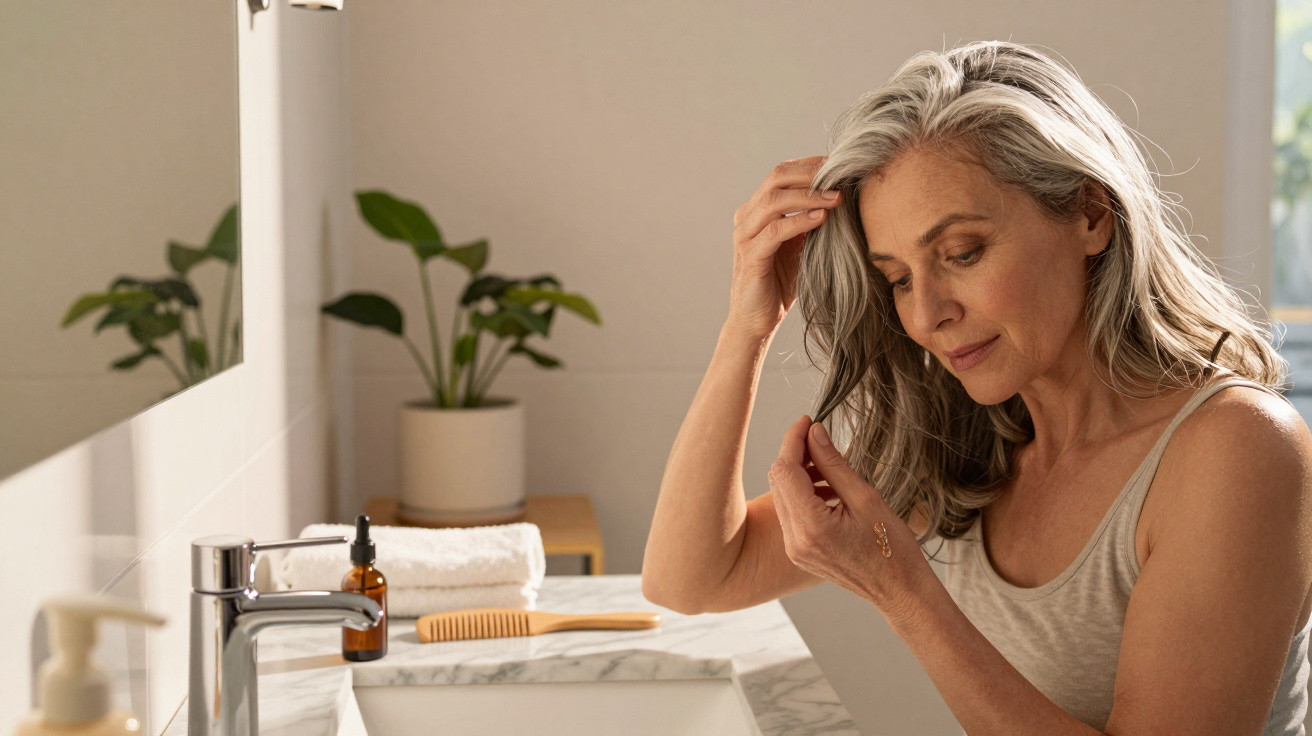
The scene is set in an utterly ordinary bathroom. No luxury, no spa atmosphere – just a towel on the radiator and a small mirror that shows every wrinkle with ruthless honesty. A few months ago, a friend of mine, 67, told me that she had tried “the internet ritual” that women over 60 were suddenly praising in forums everywhere. Supposedly, it was a simple trick: a little oil, a little massage, less shampoo – and voilà: soft, glossy hair like it used to be. No expensive ampoules and no £120 hair appointment.
She stood there, ran her fingers through her hair and grinned: “It feels like I’m 40.”
But a few weeks later, she got in touch again. This time, she had an itchy scalp, red patches and plenty of questions.
So what is really behind this craze?
The “less is more” ritual: why everyone is suddenly talking about it
Anyone scrolling through Facebook groups, Instagram Reels or YouTube channels aimed at women aged 60 and over will inevitably come across this trend. Some call it “Oil-Only”, others refer to “Low Poo”, while some use the term “Scalp Ritual”. The basic principle is similar in every case: less harsh cleansing, more gentle care, preferably with household ingredients rather than high-end laboratory products.
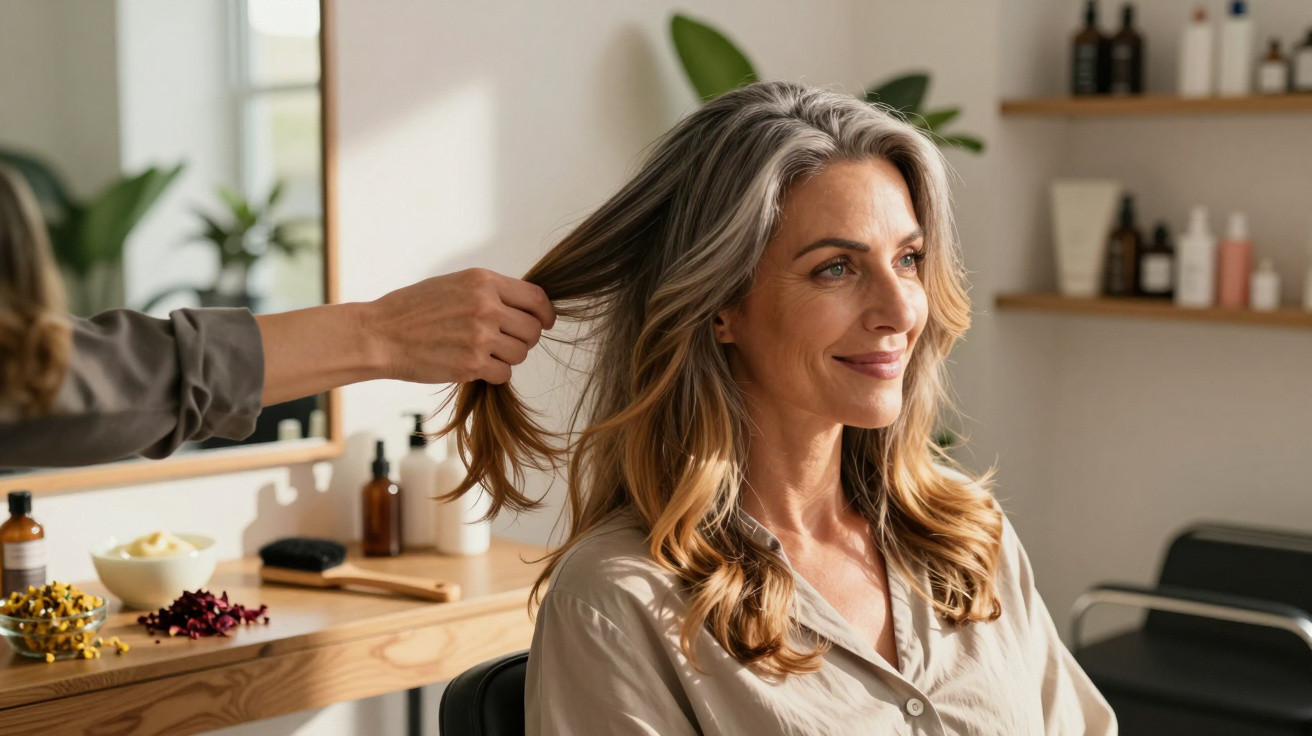
It sounds tempting: an inexpensive vegetable oil from the kitchen, lukewarm water and a mild cleanser every few days. Add a longer scalp massage, supposedly ideal for circulation and hair roots. Then there are the before-and-after pictures, showing dull, brittle grey hair transformed into soft, light-reflecting strands. Many women describe it as a small way of turning back time.
That promise is precisely what makes the trend so irresistible.
In a survey in a large German-language Facebook group for women aged 60 and over, with more than 40,000 members, over half said they had already experimented with washing less often or using oil rituals. One user wrote: “I stopped using my expensive anti-ageing products and now only use almond oil and baby shampoo – my hair has never been so soft.” Another proudly said that she had changed hairdresser after 20 years because they “didn’t take” her ritual seriously.
Then come the other comments: the quiet, slightly embarrassed ones. Women who, after three weeks, suddenly developed itchy, tight-feeling scalps. Redness along the hairline. Small flakes that settled on their shoulders like a fine grey film. Many say they “almost felt ashamed” to return to conventional shampoo because they thought they had simply “not done it properly”.
We know that moment: you want to try something new, feel wonderful for a while, then barely dare to admit that it was not as magical as it seemed.
Dermatologists are observing exactly this with increasing scepticism. The scalp changes with age. Sebum production decreases, circulation slows and the protective barrier becomes thinner. What the skin could easily tolerate at 30 may suddenly cause irritation at 65. Oil rituals without a clear approach can block pores; bacteria and yeasts thrive on the oily film; and mild products are not automatically suitable for every hair type.
The sober reality is this: what works for an influencer with thick hair and hardly any grey strands may not only be ineffective for a woman with fine, dry or medically treated scalp skin, but actively counterproductive. Yet the trend continues to go viral because it touches something deeply human: the desire to regain control over one’s body, without clinics, bills or technical jargon.
On closer inspection, the ritual usually has three components: less shampoo, more oil and more massage. It sounds straightforward, perhaps even too straightforward to be risky. The reasoning is that if the scalp is cleansed less frequently and more gently, its natural sebum remains for longer. A thin oily layer sits around the hair and skin like a protective coating, making brittle lengths appear smoother. Applying oil before washing is also intended to “seal” the hair so it loses less moisture during cleansing.
For many women, it works surprisingly well at first, particularly if they had previously used harsh shampoos every day. The immediate comparison can be dramatic: less frizz, more shine and fewer flyaway hairs. Anyone who has consistently washed away anything “greasy” may experience this change in thinking as a small revelation. Suddenly, the aim is no longer to fight the hair, but to support it.
However, the body does not always cooperate as neatly as we would like.
The crucial issue is the scalp. It is not a smooth surface that can simply be oiled and rinsed as desired. It is a living organ. When thick layers of oil are regularly left on the skin while cleansing is reduced, a small ecosystem can develop underneath: sebum, dead skin cells and styling-product residue. This creates an ideal breeding ground for microorganisms that are usually harmless but can multiply excessively in these conditions.
Dermatologists report a noticeable rise in patients aged 60 and over arriving at their practices with complaints they describe as “Scalp Detox gone wrong”. There may be red, burning patches, diffuse hair thinning and, in some cases, persistent seborrhoeic dermatitis. What began as an inexpensive wellness idea then ends with medicated shampoos and corticosteroid solutions. And yes, this can feel like a personal failure, especially if the ritual had previously taken on an almost spiritual quality.
Let us puncture the illusion for a moment: not every scalp can cope with experimentation, and certainly not every mature scalp.
Anyone wanting to try the ritual does not need a holy grail, but a very practical plan. Step one is to assess the condition of the skin honestly. Are there existing issues such as dandruff, psoriasis, eczema, very sensitive skin or medicines that affect the skin? If so, it is better to speak to a dermatologist before pouring litres of oil over your head. Step two is to proceed gradually. Do not move from daily shampooing to washing only once a week; instead, increase the gaps between washes carefully.
For most mature women, it is enough to find a mild shampoo free from strong fragrances and unnecessary irritants, then use a light, well-tolerated oil only on the lengths rather than the scalp. A brief, gentle fingertip massage before washing may be sufficient to stimulate circulation. More is rarely better; it is often simply greasier.
Above all, no trend in the world is worth making your scalp sore for weeks.
The most common mistake is a very human one: if a little is good, surely a lot must be brilliant. So oil is left on overnight twice a week. Shampoo is practically “demonised”, as if it were the enemy of all youthfulness. Then comes the pressure to “stick with it”, because others in the group have written that the first few weeks are merely “an adjustment period”.
Many women say they ignored the first signs – mild itching, tightness or slight redness – because they were afraid of giving up too early. Or they told themselves: “I’ve done everything wrong all my life, so I just have to get through this.” This is exactly the point at which a sensible wish for gentle care turns into self-imposed pressure.
Let us be honest: nobody meticulously rinses every comb, consistently washes towels at 60°C and checks their scalp in the mirror every day. This is everyday life, not a laboratory experiment.
“I want women to love their hair, but not at the expense of their skin health,” says the fictional dermatologist Dr Jana Richter. “A gentle ritual can be wonderful – as long as it suits the individual scalp and does not blindly follow a trend.”
- Start small: use only a few drops of oil, apply it to the lengths only and leave it on for no more than 30 minutes before washing.
- Watch for changes: itching, burning, flakes or hair loss are warning signs, not an “adjustment”.
- Choose products without strong fragrances or unnecessarily complicated “natural blends”.
- Clean regularly: wash combs, brushes and towels at high temperatures, otherwise you are simply spreading residue around.
- Seek help: if symptoms persist, see a dermatologist early rather than continuing to self-treat.
In the end, the question remains: what do we actually want from our hair? Only shine in the mirror, or a sense of authenticity that can coexist with wrinkles and grey strands? Rituals can ground us, restore a feeling of control and even preserve a degree of dignity as we age. But they can also become a silent obligation, a secret form of self-optimisation behind a closed bathroom door.
Perhaps real freedom does not lie in the perfect oil or the “correct” interval between shampoos, but in allowing yourself to change course. To say: “That wasn’t for me.” And still stand proudly in front of the mirror – with hair that may not follow the trend, but is honestly healthy.
| Key point | Detail | Added value for the reader |
|---|---|---|
| Start gently rather than making radical changes | Extend the intervals between washes slowly, use oil sparingly and do not assume it belongs on the scalp | Reduces the risk of irritation and makes the ritual manageable in everyday life |
| Treat the scalp as an organ | Mature skin responds more sensitively to oily films, fragrances and vigorous friction | Helps readers identify warning signs early and avoid damage |
| Choose an individual solution rather than copying a trend | Take account of hair and scalp condition, medication and pre-existing conditions; ask a dermatologist if unsure | Encourages independent decisions instead of blindly following others |








Comments
No comments yet. Be the first to comment!
Leave a Comment