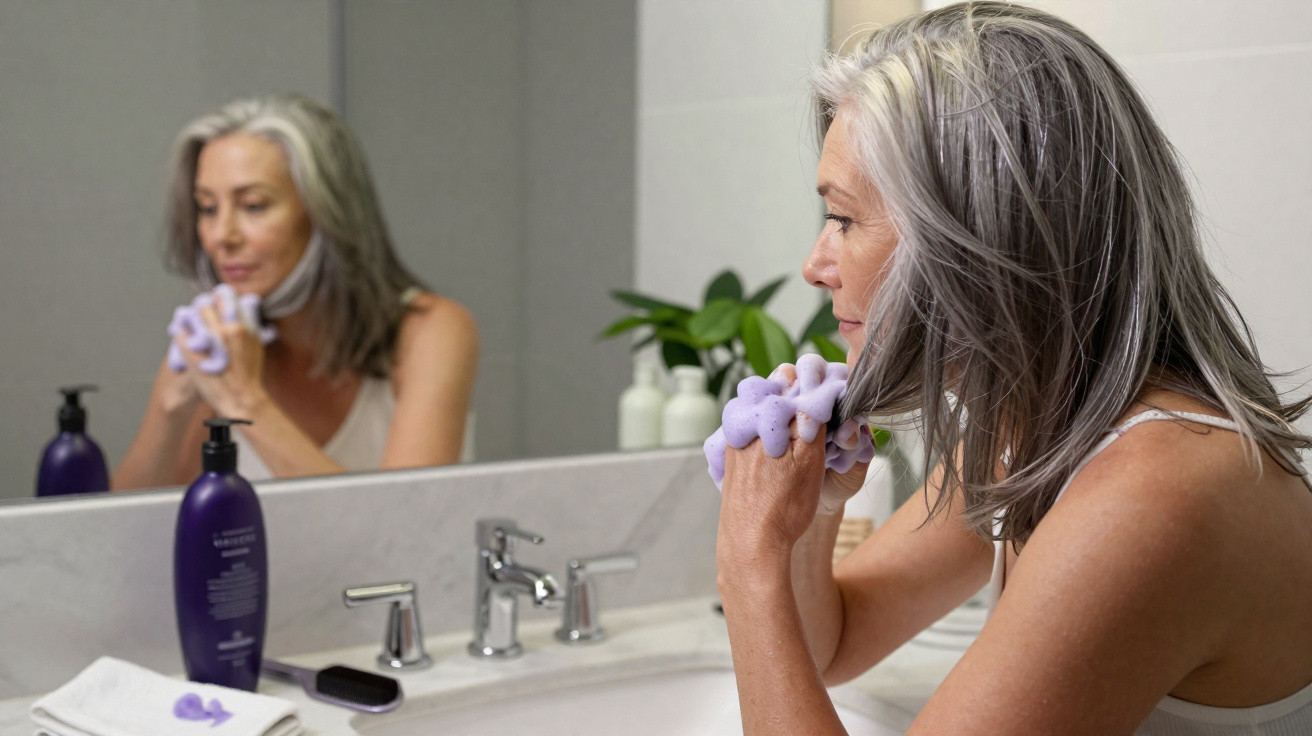
From afar, her grey hair looked fashionable and striking. Closer up, though, there was clearly something wrong. The luminous silver she had wanted had become a dull, smoky lavender-beige that no longer reflected the light.
“I use purple shampoo every time I wash it,” she said with pride. Her stylist paused briefly, then gave the understanding smile of someone who has heard this many times before. The product promising “instant icy silver” had gradually taken the lustre from her hair.
The same situation plays out in salons and bathrooms everywhere. People pursue the ideal metallic grey, then eventually find their hair looks oddly lacklustre, almost grubby, even when it has just been washed. The unexpected reason can be a little painful.
When ‘icy silver’ becomes muddy: what is actually happening
A glance at Instagram could convince you that purple shampoo is a magical filter to pour over your hair. One wash is meant to turn grey strands into liquid chrome, isn’t it? The packaging is full of shine, light and dramatic before-and-after images worthy of a reality television transformation.
In reality, it is more complicated. As their hair turns grey, many people feel exposed, scrutinised or strangely conspicuous. A small bottle of purple shampoo can seem like protection against yellow tones and ageist remarks. They therefore rely on it, wash after wash and week after week, until the mirror eventually reflects a colour that bears little resemblance to the dream.
After going fully grey, 63-year-old Marina began recording her hair’s progress in selfies. Initially, using purple shampoo once a week changed her warm, slightly yellow strands into a cooler silver she loved. She then stepped things up. Rather than using it only on Sundays, she applied it at every wash, working in the violet foam “just like the influencers.”
Two months later, the difference was clear in her photographs. The radiance had disappeared. Her hair appeared almost smoky under the kitchen lights. In daylight, the mid-lengths looked faintly bruised with a violet tinge, while the ends carried an unusual grey-brown film. Her daughter gently asked, “Did you darken your hair?” She had not. The pigment had simply built up.
Hairdressers encounter this every week. Clients arrive believing their hair is naturally “ashy and lifeless.” They grimace at their reflection and attribute it to age, stress or hormones. Yet, when asked about their shampoo, they casually reveal that they use purple formulas three, four or five times weekly. They are often shocked to hear that the product they trusted most may be causing the issue.
The science is straightforward, if not especially exciting. Purple shampoo is a toning product. Its violet pigment is intended to counter yellow and golden hues, rather than remain on the hair permanently. Used from time to time, it softly neutralises warmth and leaves grey or blonde hair looking cleaner and brighter. When used excessively, however, the pigments do not simply wash away.
They adhere to the cuticle, particularly on porous grey hair, which often has a rougher texture. As the layers accumulate, they form a translucent coating that alters the way light reflects from each strand. Rather than getting shine and sparkle, you see a darkened, subdued result. It is like placing grey-tinted sunglasses over a bright photograph: contrast weakens and vibrancy disappears. Violet build-up can do precisely that to hair.
How to use purple shampoo without losing your grey hair’s glow
Most stylists specialising in natural grey hair give similar advice: view purple shampoo as a treatment rather than an everyday essential. Once a week is a sensible starting point, or even once every ten days if your water is not particularly hard and your hair does not develop much yellowing. On other wash days, a mild sulphate-free shampoo will cleanse the scalp without adding more pigment.
Many colourists recommend a straightforward approach called “micro-toning.” In practice, this means less product, less frequently and for less time. Rather than saturating the hair and leaving the shampoo on for ten minutes while you scroll on your phone, use a small amount, distribute it quickly through the mid-lengths and ends, and rinse after two or three minutes. Brief contact gives a controlled finish.
In practical terms, alternating products is your best strategy. At one wash, use ordinary shampoo. At the next, use ordinary shampoo with a moisturising conditioner. For the third wash, apply purple shampoo for a short time, followed by a nourishing mask. Then return to your basic routine for a couple of washes. This sequence gives hair time to recover between toning sessions while still protecting against the yellowish cast that concerns so many people.
Fear is where things often go wrong. Worried about “looking yellow”, people use every possible solution at once: purple shampoo, purple conditioner and purple mask. When the “muddy veil” begins to appear, their response is to add more violet, believing they have simply not toned enough. The outcome is the complete opposite of what they were trying to achieve.
On a good day, grey hair shines because it has clarity and contrast. Individual strands stand out, with white, steel and softer grey tones playing against one another. Too much purple shampoo removes that subtle variation. The colour may look more even, but it also becomes more static and lifeless. This is when people say, “Short hair might be better, mine just looks tired,” although the real problem is neither their age nor the length of their hair; it is pigment build-up.
There is also an emotional element: control. When hair turns grey, it can feel as though your body has made a decision without consulting you. Purple shampoo can seem like a way to regain control, so you grasp it more firmly, use it more often and repeat the process in the hope of mastering it. Let us be honest: nobody really does this every day while following the instructions exactly. We become careless, improvise and leave it on longer “just this once.” Then we are surprised when the mirror gives back a harsh result.
“People think their hair is ‘too ashy’ or ‘dirty gray,’ but what I’m really seeing is two years of toner layered over each other,” says London-based colourist Leigh Morrison. “When we gently remove that buildup, their natural silver is stunning. They just never got to see it.”
The most effective routine is not elaborate; it is gentle and consistent. Alternate your products, add moisture and pay attention to what your hair actually does rather than what the label claims. For many people, this means halving their purple shampoo use and adding hydrating masks, lightweight oils or leave-in creams to bring back softness and shine.
- Begin by using purple shampoo no more than 1x per week, then adjust as needed.
- Alternate it with a gentle, non-toning shampoo and a rich conditioner.
- If your hair appears dull, reduce use for 2–3 weeks before assessing your grey hair.
Rethinking “perfect silver” and allowing grey hair to be itself
A subtle change occurs when people stop pursuing the filtered icy grey seen online. Once the violet haze has faded, their true hair pattern becomes visible: a section of pure white at the temples, steel streaks at the nape and soft salt-and-pepper tones on top. It is not uniform or computer-generated. It is simply their own hair.
Some people adore the result immediately, while others need an adjustment period. A few feel almost misled because their actual colour does not match the cool chrome image they had imagined. Even so, many begin to see something different in the mirror: texture, movement and shine that had disappeared when every strand was forced into the same tone. Often, that change begins with one uncomplicated experiment - putting the purple bottle aside for a month.
At a deeper level, the fixation on over-toned silver hair reveals something about how we have been taught to interpret age in a face. Purple shampoo becomes a defence against remarks, judgement or a casual “You’re brave to go gray” at a dinner party. Allowing hair to breathe is not merely a technical decision; it is a quiet refusal to treat your head as a permanent filter.
Next time your grey hair seems “muddy”, review your routine before blaming biology. Has violet shampoo become a crutch? Has saturation gradually replaced shine? The solution is not always the next stronger toner promoted on your feed. Sometimes the answer is the reverse: scale back, rinse more thoroughly and simplify.
Speak to your stylist rather than relying solely on your algorithm. Take photographs of your hair in natural light and ask how often they would use purple shampoo if your hair were their canvas. You may leave with fewer products but greater understanding - and hair that catches the light again.
If you are in the shower tonight with the bottle in your hand, unsure whether to choose purple or plain shampoo, ask yourself one small but important question: am I trying to brighten my grey, or hide it?
| Key point | Detail | Benefit for the reader |
|---|---|---|
| Moderate use of purple shampoo | Limit use to 1 time per week, with a short processing time | Prevents a dull, muddy effect on grey hair |
| Alternating products | Alternate ordinary shampoo, moisturising care and purple shampoo | Maintains shine, softness and balanced colour |
| Managing pigment build-up | Take breaks, prioritise hydration and use gentle washes | Allows grey hair to regain radiance, variation and light |









Comments
No comments yet. Be the first to comment!
Leave a Comment