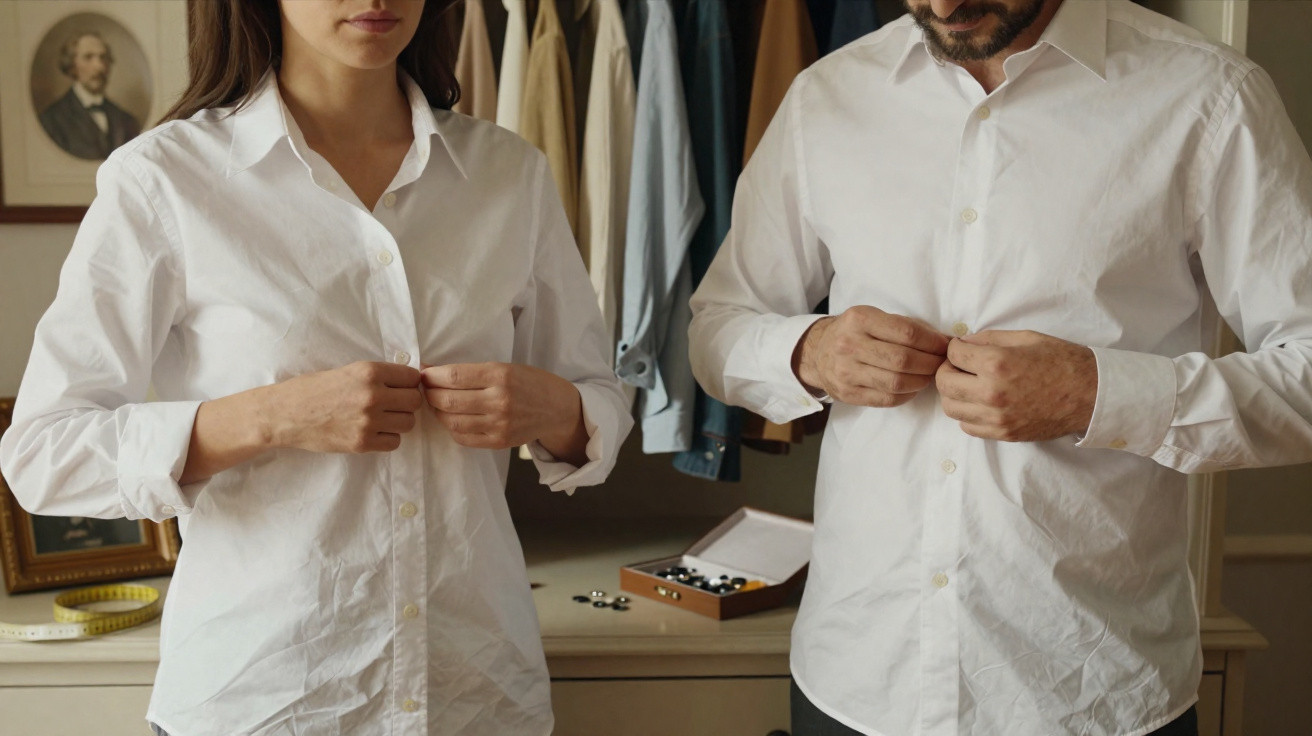
In a tiny changing room, a man slips into a shirt and does up the buttons within seconds. In the cubicle beside him, a woman wrestles with her reflection, fingers searching for the fastening on the “wrong” side, muttering that designers must have a warped sense of humour. The shirts share the same fabric and label. Their buttons, however, sit on opposite sides of history.
It is easy to dismiss this as an arbitrary style choice, like shoulder pads or skinny jeans. But this minor feature of everyday clothing preserves a link to a time when affluent women were rarely expected to dress themselves, and when buttons staged a quiet display of gender, class and power.
Why do men’s shirts fasten right over left while women’s fasten left over right, decades after corsets and domestic servants disappeared from daily life?
The peculiar asymmetry in your wardrobe
Once you have noticed the button placement, it is difficult to ignore. Pick up a men’s shirt and the buttons will generally be sewn onto the right-hand side, with the placket crossing leftwards. On a women’s blouse, the buttons are normally on the left, fastening towards the right. It is the same kind of garment, but the construction is entirely reversed.
Try helping a friend into your own shirt and the difference becomes immediately apparent. The movement feels inverted and strangely awkward, as though your hands had abruptly become left-handed. This modest asymmetry has outlasted wars, revolutions, industrial manufacturing and fast fashion, yet shop assistants are unlikely ever to point it out.
Most of us accept it as a given, much like cutlery or traffic lights. It is not, however, rooted in nature or ergonomics. Its origins lie in an age when the person fastening the buttons was often not the person wearing the clothes.
Costume historians commonly date the convention to the 18th and 19th centuries, when dress was designed as much to demonstrate rank as to provide comfort. Buttons were costly and complicated to make, so they belonged largely to people able to afford elaborate details: aristocrats, military officers and the exceptionally wealthy. A garment laden with buttons was, in itself, a conspicuous show of status.
At that time, many upper-class women were not dressed without assistance. Ladies’ maids laced, hooked and buttoned their mistresses into intricate layers. Clothing was therefore made with the dresser in mind, rather than its wearer. For a right-handed maid facing her mistress, fastening a garment whose buttons sat on the woman’s left was the most practical arrangement.
Imagine it: pale early-morning light in a chilly bedroom; a wealthy woman standing motionless in a corset; a maid working swiftly and almost silently through lines of buttons from her own right-handed viewpoint. The shirt followed the rhythm of the maid’s work, not the movement of its wearer’s fingers.
Men, meanwhile, were more likely to dress themselves. This was particularly true in military settings, where uniforms needed to be functional, quick to put on and reliable amid the disorder of everyday life. A right-handed man could more easily steady the fabric with his left hand and guide buttons through buttonholes with his right. Consequently, men’s garments were cut with buttons on the right.
That is the source of this unusual code: men’s buttons were intended for the person dressing himself, while women’s buttons were arranged for the servant. The convention remained in place even as middle-class and working women increasingly dressed without help. Fashion is attached to tradition, especially when few people think to challenge it.
Other explanations have emerged over the years. One suggests that wealthy women riding horses held the reins in their right hand and needed clothing that would not blow open in the wind. Another claims that left-side fastenings enabled breastfeeding mothers to open bodices more discreetly. Both ideas are appealing, and they may have applied to some garments.
Still, the most consistently supported account is remarkably blunt: clothing functioned as a working tool for servants. Buttons were positioned where workers’ hands naturally went. The wealthy person inside the garment was effectively a mannequin. As a result, the right hand of a maid continues to influence how billions of women fasten their shirts.
Shirt buttons as a social X-ray
The next time you pick up a shirt, carry out a quick test. Hold it in front of you and see where the buttons are placed. Buttons on the right traditionally indicate a “male” cut; buttons on the left traditionally indicate a “female” one. It is a nearly invisible gender marker, encoded in plastic and thread.
Pay attention to your hands as you fasten it. For right-handed people, a men’s shirt will often feel a little more natural and more closely aligned with the movement of their fingers. A women’s shirt calls for a tiny adjustment, an unconscious recalibration. That brief hesitation is an echo of the period when somebody else was supposed to carry out the task.
In gender-neutral and unisex collections, designers often discreetly opt for the “men’s side” of the garment. This is not necessarily an attempt to remove women’s fashion; rather, it reflects the assumption that the wearer is dressing themselves. It is a subtle challenge to a past in which getting dressed was a service performed for someone else.
On a busy morning Tube journey, look at shirts, jackets, jeans and even certain pyjamas. The same code appears throughout. A man in a sharply pressed work shirt has buttons running down the right; a woman in a silky blouse has a row of dots along the left. Nothing explains the distinction. It simply persists as a silent division, as though it had been determined by nature.
Designer Stella, who has worked for both luxury houses and fast-fashion chains, put it plainly when speaking to me: “We keep it because everyone else keeps it.” Manufacturing teams are structured around established patterns. Factories cut thousands of garments each day. Reversing the buttons would disrupt sizing conventions, confuse shoppers and interfere with stock coding.
Fast fashion prioritises consistency and speed over historical detail. With a glance at the buttons, you can immediately tell which department supplied a shirt. In the confusion of a crowded shop on a Saturday afternoon, that convenience matters more than reconsidering a rule inherited from aristocrats and servants.
The convention extends well beyond shirts. Jackets, blazers and trench coats still follow the same gendered principle in their overlaps and the way fabric crosses the torso. Yet shoppers now move more freely between sections and styles. Plenty of women choose “men’s” shirts for their straight lines, while many men try “women’s” cuts for their colour or volume.
There is a quiet tension in that experience. You may find a shirt that suits your body and reflects your identity, only for its buttons to seem back to front. Years of muscle memory reveal themselves in your hands. It is a small, personal reminder that clothes were not always created with you in mind. On an off day, it can seem as if your wardrobe is disputing you.
As growing numbers of people question gender binaries, the button convention suddenly appears especially dated and arbitrary. It is a relic that has endured largely because nobody has bothered to pick up a seam ripper and begin again.
What shirt buttons reveal about power, habit and quiet rebellion
To experience this history through your hands, try a straightforward exercise at home. Take one of your shirts and imagine its buttons were placed on the opposite side. Then fasten it deliberately and slowly, as though you were teaching your hands a new language.
That clumsiness - the split second of “wait, how do I do this?” - marks the gap between a world in which clothes served servants’ needs and one in which we expect to shape our own appearance. It is a small confrontation between autonomy and tradition, acted out in thread and cotton.
Some stylists even advise mixing different cuts on purpose. A woman might choose a “men’s” shirt for its altered line and posture. A man may select a so-called “women’s” shirt for its print or drape, paying no attention to the button rule. The act may appear insignificant, but wearing it can feel like a quiet act of reclamation.
Of course, everyday life is less neat. When you are rushing in the morning, you wear whatever is clean rather than conducting a philosophical inspection of the wardrobe. Let’s be honest: nobody genuinely does that every day.
Even so, simply understanding the history carries an odd kind of power. You learn that a shirt fastening once indicated whether its wearer was likely to dress independently or be dressed by another person. You learn that right-over-left and left-over-right once acted as visual signals in ballrooms and drawing rooms. Your outfit remains unchanged, but the story visible in the mirror becomes different.
Everyone has experienced a minor detail suddenly clarifying a far larger feeling. For some people, discovering this history produces a flicker of anger: why are we still wearing the remains of an old hierarchy without noticing? For others, it prompts a raised eyebrow, combining curiosity with amusement at the endurance of old conventions.
Some designers are trying to leave the distinction behind. Unisex labels may put buttons on either side they choose, or avoid the old code altogether with zips and poppers. They may not highlight that decision in advertising campaigns, but it remains sewn into the pattern.
“Fashion changes every season, but the deepest rules often survive precisely because they feel invisible,” says a London-based costume historian I spoke with. “Buttons are tiny. Their symbolism is not.”
A few straightforward points help put the story into perspective:
- Buttons on the right generally indicate a “male” self-dressing tradition.
- Buttons on the left recall a period when affluent women were expected to be dressed by others.
- Gender-neutral designs often quietly challenge this divide, whether or not brands promote that fact.
A minor detail with a major question behind it
Once you know the background, every shirt in your wardrobe becomes a kind of artefact. It is neither sacred nor precious, merely quietly charged with meaning. Your morning routine is no longer only “get dressed and go”; it is also a handshake with a lengthy chain of hierarchies and habits that has reached you through fashion lookbooks and industrial machinery.
Men’s buttons on the right and women’s on the left are more than tailoring oddities. They are fossils from a past that expected some bodies to act and others to remain passive, some hands to work and others to wait. The servants are gone, and most mansions have become museums or flats, but the gesture has remained intact on the front of our shirts.
So, when you next struggle with a button or feel that small annoyance in a changing room, you will know it is not simply poor design. It is history pushing back, stitch by stitch. You may even start to ask which other apparently “obvious” rules around you belong to a world that has vanished. At that point, a simple button is no longer merely a detail: it becomes the start of a conversation.
| Key point | Detail | Why it matters to the reader |
|---|---|---|
| Origins of different button placements | Wealthy women were dressed by right-handed servants, hence buttons on the left | Understand that clothing can tell a story about class and power |
| Why the rule persists | The fashion industry keeps the standard because of habit and logistics | See how a small convention still shapes modern shopping |
| Modern reinterpretations | Unisex brands and some designers quietly disrupt the tradition | Encourage readers to observe, choose and sometimes subvert the rule |
















Comments
No comments yet. Be the first to comment!
Leave a Comment