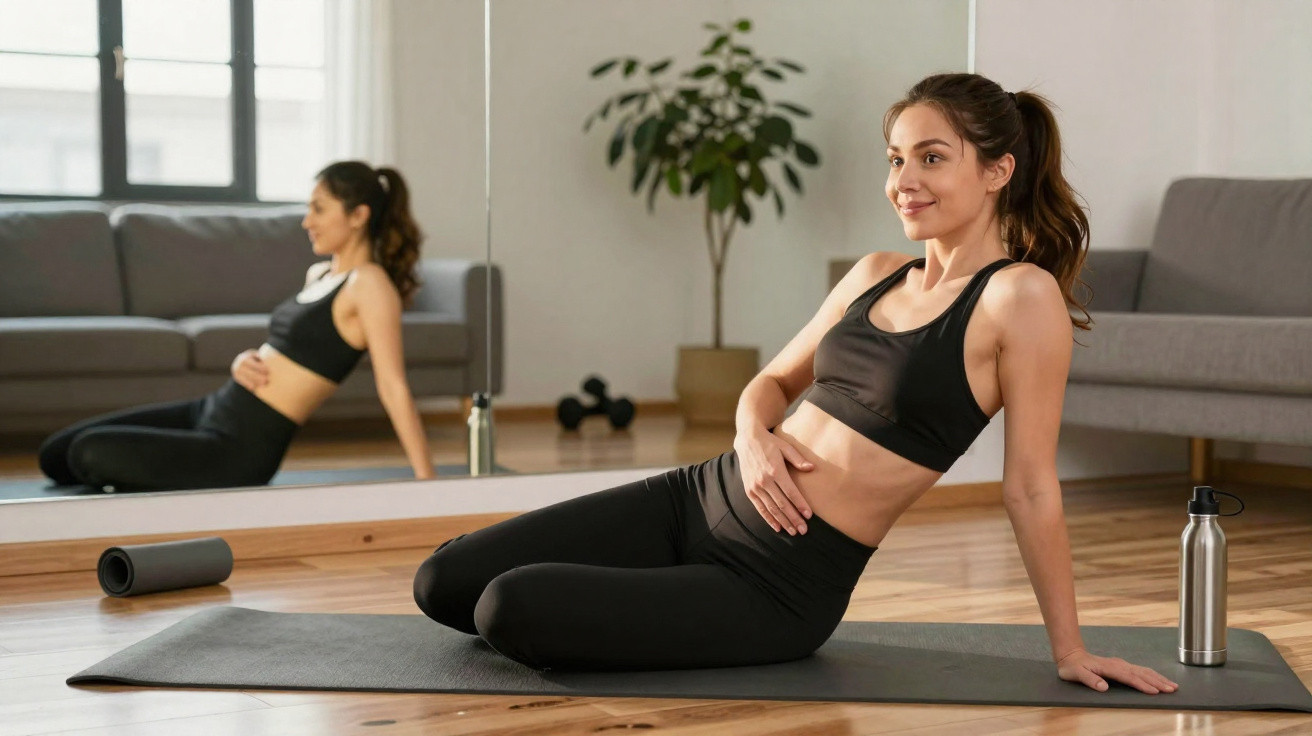
You are standing slightly sideways in front of the fridge, T-shirt rolled up, and your eyes land on that subtly protruding stomach again. Not fat, not really “big” – more like a half-inflated balloon hanging over the waistband of your jeans and spoiling your mood. It presses when you sit down, irritates you in mirror selfies and simply feels like it is in the way during exercise. Inside, you are thinking: “I don’t even eat that badly, so why does my stomach still look like this?” The thought sticks with you: at the office, on the Underground and while getting changed at the gym. We rarely discuss it, but for many people this small bulge becomes a constant, silent companion. And it has more to do with your core muscles than you may suspect.
Why your stomach really protrudes – and what your core has to do with it
There is that moment in the mirror when you consciously pull your stomach in and, suddenly, everything looks fairly athletic. Relax, though, and it pops forwards again. That is where the truth about your core begins. Your stomach is not just fat or water; it is part of a muscular corset that holds your whole midsection together. When that corset lacks tension, your pelvis tips slightly forwards, your lower back arches and your stomach automatically pushes outwards. It is a little like a balloon inside a net that is too loose. Many people immediately think of crunches and sit-ups. Your body is looking for something else: stability.
Speak to physiotherapists or good trainers and you will hear similar stories from all of them. There is the 32-year-old graphic designer who complains about a “constantly bloated stomach” – and ends up training her deep abdominal muscles rather than keeping a food diary. Or the 45-year-old office worker convinced that his beer belly is entirely down to hops, until someone checks his posture: nine hours of sitting, weak glutes, an underactive core and permanently tight hip flexors. The figures are clear: in many industrialised countries, people spend more than seven hours a day sitting on average. The core simply was not designed for that. It wastes away in the office chair. That visible, protruding stomach almost becomes a symptom of our sitting society.
The straightforward truth is that a bloated-looking, protruding stomach often has less to do with “not having enough discipline in the kitchen” and more to do with a core that no longer performs its role. The deep abdominal muscles, the transverse abdominis and the obliques should all work like an internal fitted sheet, keeping the organs close to the centre of the body. When they are weak, gravity gets to do what it does best. A well-trained core acts almost like an invisible hand, gently guiding your stomach inwards and lengthening your spine. Rather than trying to hide more, it suddenly makes sense to build yourself up from within.
The 3 core exercises that genuinely change how your stomach looks
The first exercise is unremarkable – and that is precisely why it is so effective: the Dead Bug. Lie on your back with your arms extended upwards and your knees bent at 90 degrees above your hips. Now breathe out as if you were steaming up a mirror, while gently drawing your navel towards your spine. Slowly lower your right arm backwards and your left leg forwards, without allowing your lower back to lift from the floor. Return to the centre, then switch sides. Do 8–10 repetitions per side at a controlled pace. You will feel your deep core muscles having to work to keep you stable. No pulling in the neck, no frantic rocking – just controlled tension.
Many people rush this exercise. They fully straighten their legs, lose contact between their lower back and the floor, then later wonder why they feel an unpleasant pulling sensation. Core training is not a race or a competition of strength; it is more like precision work. The aim is not to make the most dramatic movements possible, but to gain as much control as possible over small movements. We all know that moment when we think, “Oh, it’ll be fine,” only to drop into an excessive lower-back arch. Let us be honest: nobody does it perfectly every day. That is exactly why it is so liberating to allow yourself a deliberately slow, clean pace with this exercise.
The second and third exercises sound almost too simple: Plank variations and the so-called “Hollow Body Hold”. For a forearm plank, take up the classic Plank position: elbows beneath your shoulders, legs straight and body forming one line. Here is the crucial difference: actively push the floor away, tense your glutes and thighs, and draw your ribs slightly downwards. At first, 20–30 seconds are enough. For the Hollow Body Hold, lie on your back again, pull your navel towards your spine, lift your shoulder blades slightly and extend your arms and legs diagonally forwards until your lower back firmly “melts” into the mat. Both exercises train your internal corset so that your stomach pushes forwards less when you are at rest.
Common mistakes, small mental tricks – and how to stick with it
Perhaps the most important way to change your bloated-looking stomach has nothing to do with extremes, but with consistently small doses. Three core-training sessions a week, lasting 10–15 minutes each, are more realistic than any 90-day programme that collapses under everyday life by day 6. You could create a mini ritual, for instance: a short core session with Dead Bug, Plank and Hollow Hold after brushing your teeth on Monday, Wednesday and Friday evenings. No getting changed, no elaborate set-up – simply roll out the mat, set a timer for 12 minutes and begin. This manageable structure removes the pressure and makes it far more likely that how your stomach looks will genuinely change visibly within a few weeks.
The classic mistake is seeing core training purely as a “summer stomach measure”. Three weeks at full speed, 1,000 crunches, then frustration because the mirror does not immediately catch up. It is much more honest to view the core as your body’s health centre rather than just an appearance issue. A stable core takes pressure off your back, improves your breathing and makes every other movement easier – from climbing stairs to carrying boxes. Once you start to see the exercises not as punishment but as a tool for greater freedom in everyday life, motivation shifts. Suddenly, a 20-second Plank feels less like a test and more like an investment. That mental switch is precisely what keeps you going in the long run.
“The stomach you see in the mirror is often less a food log and much more a training log for your core.” – a sports physiotherapist who sees people with back pain and ‘ironing-board-belly ideas’ every day
- Prioritise quality over quantity – three clean Dead Bug repetitions are better than 15 half-done repetitions with an arched lower back.
- Schedule fixed core days each week – they should become as routine as showering or making coffee.
- Use everyday cues – do a Plank during an advert break, or two Hollow Holds before bed.
- Do not expect a Hollywood transformation in 7 days – a more stable core often shows up first in how your body feels, then in the mirror.
- Accept short breaks, but never give up entirely – missing one day is no reason to write off whole weeks.
The moment your stomach feels different from before
At some point – usually not after three days, but more often after three or four weeks – something strange happens. You are sitting at your desk, leaning back slightly, and notice that your stomach no longer falls forwards so uncontrollably. It feels more “held”, without you consciously holding your breath. Your upper body sways less as you walk, and when tying your shoes you no longer need to drop so deeply into a lower-back arch. These are the understated but very real signs that your core is beginning to take over its job again. The mirror image often follows with a delay, but your body awareness recognises the progress first.
You may also develop a different kind of pride. Not the “summer body with a six-pack” kind, but the quiet knowledge that: “I am looking after myself from within.” Your bloated, protruding stomach was never your enemy; it was more like a slightly loud feedback system. When you respond with smart core work, you change more than just a silhouette – you also change your attitude towards yourself. That is exactly the point at which many people stop seeing their stomach as a problem and start regarding it as an interesting indicator of how they treat their body. You could almost say that the most visible part of your middle tells the story of what is happening in the invisible inner part.
| Key point | Detail | Benefit for the reader |
|---|---|---|
| Core, not just stomach | A protruding stomach is closely linked to weak deep muscles and posture | Shifts the focus away from dieting alone and towards useful stability work |
| Three targeted exercises | Dead Bug, Plank and Hollow Body Hold as a basic routine requiring little time | Clear, practical guidance with no complicated equipment or need for a gym |
| An everyday approach | Small, fixed rituals instead of extreme short-term programmes | Makes it more likely that readers will keep going long term and see real changes |
















Comments
No comments yet. Be the first to comment!
Leave a Comment